- European business leaders optimistic about Vietnam’s economic outlook
- Austrian businesses remain keen on Vietnamese consumer goods
- HCM City businesses to enjoy 0% interest rate credit package
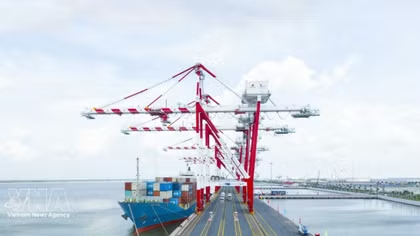
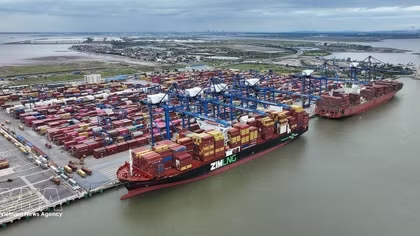
With an impressive trade surplus of over US$19 billion last year, the industry and trade sector aims to increase the total export turnover for this year by between 4% and 5%, with the country’s trade surplus anticipated to maintain its momentum.
Despite this, Vietnamese exports this year are largely dependent on the prospects of the global economy, particularly if the novel coronavirus (COVID-19) pandemic can be brought under control.
With regard to the export situation in the year ahead, Vu Duc Giang, chairman of the Vietnam Textile and Apparel Association (VITAS), said textile and garment exports this year will continue to face numerous difficulties ahead in the post-pandemic period. In line with this, Vietnam is likely to export goods worth between US$37 billion and US$38 billion providing that the pandemic is brought under control globally.
Giang pointed out that over the long-run, the Vietnamese garment and textile sector will continue to encounter challenges over the subsequent three years, noting that exports to major markets gradually return to a normal state once the pandemic is successfully curbed by the end of the third quarter of 2023.
He emphasised that new-generation FTAs, especially the EU-Vietnam Free Trade Agreement (EVFTA), the Regional Comprehensive Economic Partnership (RCEP), and the Comprehensive and Progressive Agreement for Trans-Pacific Partnership (CPTPP) can be expected to boost exports moving forward.
Experts have therefore attributed these difficulties to the current low level of market diversification among some agricultural and aquatic products, pointing out that although several products enjoy a tariff reduction of 0%, a number of domestic agricultural products have been not been allowed to gain entry into some markets.
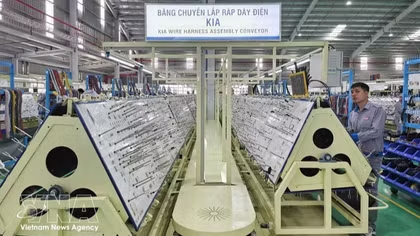
Furthermore, despite the proportion of the FDI sector’s export value decreasing in recent years, it accounts for over 64% of the country’s total export value. This is due to the sector’s production and export activities being largely dependent on regional and global supply chains.
Moreover, the impact of the rising trend of protectionism, trade conflicts, and complicated developments of the COVID-19 pandemic globally have changed the structure of global supply chains, with several countries, especially the United States and western nations, strengthening trade protectionism measures.
Phan Thi Thanh Xuan, vice president and General Secretary of the Vietnam Leather, Footwear and Handbag Association, revealed that the leather and footwear sector has made the best use of the EVFTA, adding that the industry’s exports are poised to grow by between 15% and 20% this year if the COVID-19 epidemic is successfully contained.
Xuan underlined the need to devise stronger policies aimed at accelerating the development of the local supporting industry so it can independently produce raw materials and avoid a heavy reliance on imports.
In an effort to maintain the export growth in the year ahead, the Ministry of Industry and Trade is expected to help businesses take full advantage of opportunities from FTAs by removing barriers for market expansion and keeping a close watch on the developments of the COVID-19 pandemic in order to take timely response measures.
She pointed out that new generation FTAs such as the CPTPP and the EVFTA are expected to provide fresh impetus to export growth over the coming year thanks to tariff incentives, adding that the shift in FDI investment flow from regional countries to the nation, along with the restructuring of supply chains, will also contribute to boosting exports this year.
Key solutions that can promote import and export activities moving forward will largely focus on diversifying markets, maximising the benefits from relevant FTAs, restructuring export products, developing brands, whilst grasping market information and changes in policies of importers, Xuan noted.
Deputy Minister of Foreign Affairs Le Hoai Trung also underscored the importance of opportunities brought about by FTAs while urging the local ecnonomy to improve its autonomy to prepare for any worse-case scenarios and utilising the system of commercial counselors to perform tasks in line with these changes.
Minister of Industry and Trade and deputy head of the Party Central Committee's Economic Commission Tran Tuan Anh, said there will be a positive outlook for the country in the years ahead thanks to favourable conditions from integration strategies and the enforcement of FTAs.
In addition, the Government’s schemes on economic restructuring, social security, reforms, open-door policies, and efforts to fine tune the legal system will also be beneficial.