Can Tho to become first smart city in Mekong Delta by 2025

Can Tho, the most populated city in the Mekong Delta region, has achieved outstanding results in developing a project to build a smart city after nearly two years of implementation.
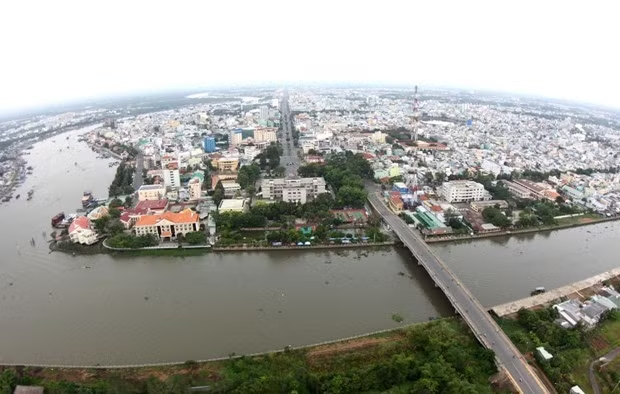
A view of Can Tho city (Photo: VNA)

Can Tho, the most populated city in the Mekong Delta region, has achieved outstanding results in developing a project to build a smart city after nearly two years of implementation. 

Vo Thi Hong Anh, Vice Chairwoman of the Can Tho City People’s Committee, said the project aims to make the city to become the first smart city in the southwestern region by 2025.

A smart city enhances civic engagement in urban management, with the aim of improving competitiveness and socio-economic development, she said.

To achieve the goal, Can Tho will use modern information technology and improve State management and the quality of life, she said.

Can Tho’s agencies have many plans to achieve the goal. 

The Department of Planning and Investment is building technical platforms to develop an e-government model, while the Department of Transport has started using IT to manage urban transport services.

Two years ago, Can Tho city signed a cooperation agreement with the Vietnam Posts and Communications Group (VNPT) to develop its smart city project by 2025.

Under the project, VNPT has set up a smart city framework system, including an Information and Communication Technology (ICT) and smart city solution framework, ensuring that the solutions of all developers can run on this platform.

Can Tho and VNPT have worked to apply a range of information technologies in city administrative activities to better serve people and businesses.

Do Hoang Trung, Director of Can Tho city’s Department of Information and Communications, said the city is building an intelligent operating centre connected with information technology systems to monitor socio-economic targets and the government’s performance. 

The centre will supervise the education and tourism sectors and monitor residents’ feedback, ensuring urban order and security.

In addition, Can Tho will use My City app, a mobile platform with a built-in camera system and an intelligent security surveillance, to receive and resolve residents’ feedback on public services.

The city will also apply information technology in management of traffic safety; information security and safety; food safety and hygiene; environmental protection, as well as land use management.

In addition, intelligent parking systems at tourist destinations and integrated traffic management system, including traffic lights, signs and traffic flow analysis, will be set up. 

Can Tho will encourage the private sector to take part in the smart city project by applying technologies and innovation in providing services to the public. 

Experts said enterprises play a major role in the socio-economic development of smart urban areas, which should be supported with infrastructure and incentive policies based on modern technology. 

To ensure the project’s schedule, the Department of Information and Communications will seek experts’ opinions in implementing the smart city plan.


VNA

Other News

Hanoi ready to implement Capital Law 2026, unlocking new development momentum

Hanoi ready to implement Capital Law 2026, unlocking new development momentum

The effectiveness of the Capital Law 2026 will be measured not by the number of legal documents issued but by tangible improvements in governance and public administration, better services for people and businesses, faster administrative procedures, stronger investment attraction and higher economic growth.

Vietnamese students earn honours at ROBOG Asia Cup 2026

Vietnamese students earn honours at ROBOG Asia Cup 2026

Three teams from Chu Van An Secondary School in Vietnam’s Thai Nguyen province have earned First Prize honours and advanced to the quarterfinals at the ROBOG Asia Cup 2026, a regional robotics and artificial intelligence (AI) competition for students held in Hong Kong, China.

Hanoi sets out new investment blueprint with century-long development vision

Hanoi sets out new investment blueprint with century-long development vision

As of early June, Hanoi had attracted 74.6 billion USD in foreign direct investment (FDI) through more than 9,250 valid projects. FDI inflows in the first six months were projected at 3.2 billion USD, surpassing the annual target by 116%, while nearly 16,000 new businesses were established in the first five months, up 34.4% year-on-year.

Vietnam promotes legal cooperation and rule of law at global forum

Vietnam promotes legal cooperation and rule of law at global forum

Vietnam’s development and international integration have gone hand in hand with the improvement of its legal system, the incorporation of international commitments into domestic legislation, and legal reforms aimed at fostering development, openness and global integration. The country regards international law as an essential instrument for building fair, mutually beneficial relations among nations.

Hanoi to hold investment promotion event on June 29

Hanoi to hold investment promotion event on June 29

At the event, Hanoi authorities plan to grant investment policy decisions and investment registration certificates to 20 exemplary projects in the fields of transportation infrastructure, industrial parks, urban development, social housing, environment, science and technology, and foreign investment attraction.

Hanoi's Red River urban area development draws widespread attention

Hanoi's Red River urban area development draws widespread attention

Located south of the Red River and extending from the historic inner city to newly developing areas in the south and the west, the central urban area along Red River’s right bank covers approximately 45,317 hectares and is projected to accommodate around 6.365 million residents by 2045 and 6.455 million by 2065.

Hanoi's Red River urban area development draws widespread attention

Hanoi's Red River urban area development draws widespread attention

Located south of the Red River and extending from the historic inner city to newly developing areas in the south and the west, the central urban area along Red River’s right bank covers approximately 45,317 hectares and is projected to accommodate around 6.365 million residents by 2045 and 6.455 million by 2065.

Regional cooperation strengthened to combat cross-border drug crime

Regional cooperation strengthened to combat cross-border drug crime

Vietnam, China, Laos and Myanmar face common challenges as drug syndicates increasingly exploit the Mekong River, cross-border transport networks, e-commerce platforms, international logistics services, cyberspace and cryptocurrencies to organise drug transactions and smuggling operations.