Can Vietnamese COVID-19 vaccine ensure safety?

It is impossible to say whether or not a drug or vaccine is absolutely safe, and in order to evaluate a vaccine both short-term and long-term safety must be considered, according to health experts.

Hoang Hoa Son of the Department of Science, Technology and Training under the Ministry of Health, the unit in charge of domestic novel coronavirus (COVID-19) vaccine research, highlighted the correct Vietnamese policy of determining early COVID-19 vaccine production.

Despite this, to have a vaccine for use by all people is not something that is done overnight.

Currently, there are two COVID-19 vaccines that are in the phase of undergoing human trials, including the Institute of Vaccines and Medical Biologicals (IVAC)'s COVIVAC vaccine and Nanogen Pharmaceutical Biotechnology JSC’s Nano Covax vaccine.

With the COVIVAC vaccine, the first phase of the trial involving 120 people has been completed, with 720 blood samples being sent to Canada to evaluate the immunogenicity. It is therefore expected that by the end of June, the initial results for the preliminary assessment of phase one will be complete and trials will be eligible to move to phase two.

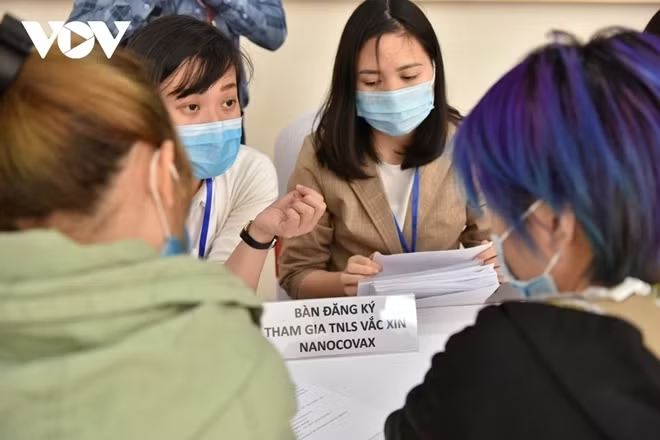
With regard to Nanogen's Nano Covax vaccine, the Military Medical Academy under the Ministry of Defence has launched phase three of trial injections, with doses being given to the initial 240 volunteers.

"It is impossible to confirm in which month there will be a vaccine for people because it depends on many factors, such as the urgent pandemic situation and the supply of vaccines.

The are two main indicators to evaluate vaccine effectiveness, namely reduced morbidity and mortality," Son said.

It is entirely possible that after receiving the vaccination, people will still get the disease, although the severity of the virus would drastically decrease. This means individuals could contract the disease, although there would be no need for major treatment.

Currently, as a means of creating herd immunity, up to 80% of the population must have COVID-19 antibodies. In order to have antibodies the only possible ways are to either be infected naturally or have the vaccination, Son stated.

However, natural infection poses many great risks as it could result in treatment facilities being overloaded, with evidence for this being seen in many countries around the world who have paid a heavy price for this option, according to Son.

Vietnam has chosen the second path through vaccinations. As soon as the nation was hit by the COVID-19 pandemic at the beginning of 2020, the Ministry of Health determined that only vaccinations could bring people's life back to normal. They therefore sent official documents requesting local manufacturers to consider the capacity and ability to develop vaccines domestically.

Currently, the pandemic has been brought under basic control. It is therefore anticipated that by the end of September the nation will have approximately six million doses of the COVID-19 vaccine. This includes three million doses of the Astra Zeneca vaccine ordered by the Ministry of Health through the Vietnam Vaccine Joint Stock Company (VNVC) and through the COVAX Facility.

Furthermore, pharmaceutical company Pfizer said that three million doses of the COVID-19 vaccine will be shipped to the country in the third quarter. The vaccines will be allocated according to priority groups in line with the Government's Resolution 21 regarding the purchase of and use of vaccines and localities with industrial zones.

According to details provided by experts, local people should not be overly concerned regarding the current supply of vaccines. Each citizen should continue to strictly follow preventive measures set out by the Ministry of Health and stay active in improving their own health.
VOV

Other News

Hanoi ready to implement Capital Law 2026, unlocking new development momentum

Hanoi ready to implement Capital Law 2026, unlocking new development momentum

The effectiveness of the Capital Law 2026 will be measured not by the number of legal documents issued but by tangible improvements in governance and public administration, better services for people and businesses, faster administrative procedures, stronger investment attraction and higher economic growth.

Vietnamese students earn honours at ROBOG Asia Cup 2026

Vietnamese students earn honours at ROBOG Asia Cup 2026

Three teams from Chu Van An Secondary School in Vietnam’s Thai Nguyen province have earned First Prize honours and advanced to the quarterfinals at the ROBOG Asia Cup 2026, a regional robotics and artificial intelligence (AI) competition for students held in Hong Kong, China.

Hanoi sets out new investment blueprint with century-long development vision

Hanoi sets out new investment blueprint with century-long development vision

As of early June, Hanoi had attracted 74.6 billion USD in foreign direct investment (FDI) through more than 9,250 valid projects. FDI inflows in the first six months were projected at 3.2 billion USD, surpassing the annual target by 116%, while nearly 16,000 new businesses were established in the first five months, up 34.4% year-on-year.

Vietnam promotes legal cooperation and rule of law at global forum

Vietnam promotes legal cooperation and rule of law at global forum

Vietnam’s development and international integration have gone hand in hand with the improvement of its legal system, the incorporation of international commitments into domestic legislation, and legal reforms aimed at fostering development, openness and global integration. The country regards international law as an essential instrument for building fair, mutually beneficial relations among nations.

Hanoi to hold investment promotion event on June 29

Hanoi to hold investment promotion event on June 29

At the event, Hanoi authorities plan to grant investment policy decisions and investment registration certificates to 20 exemplary projects in the fields of transportation infrastructure, industrial parks, urban development, social housing, environment, science and technology, and foreign investment attraction.

Hanoi's Red River urban area development draws widespread attention

Hanoi's Red River urban area development draws widespread attention

Located south of the Red River and extending from the historic inner city to newly developing areas in the south and the west, the central urban area along Red River’s right bank covers approximately 45,317 hectares and is projected to accommodate around 6.365 million residents by 2045 and 6.455 million by 2065.

Hanoi's Red River urban area development draws widespread attention

Hanoi's Red River urban area development draws widespread attention

Located south of the Red River and extending from the historic inner city to newly developing areas in the south and the west, the central urban area along Red River’s right bank covers approximately 45,317 hectares and is projected to accommodate around 6.365 million residents by 2045 and 6.455 million by 2065.

Regional cooperation strengthened to combat cross-border drug crime

Regional cooperation strengthened to combat cross-border drug crime

Vietnam, China, Laos and Myanmar face common challenges as drug syndicates increasingly exploit the Mekong River, cross-border transport networks, e-commerce platforms, international logistics services, cyberspace and cryptocurrencies to organise drug transactions and smuggling operations.