 |
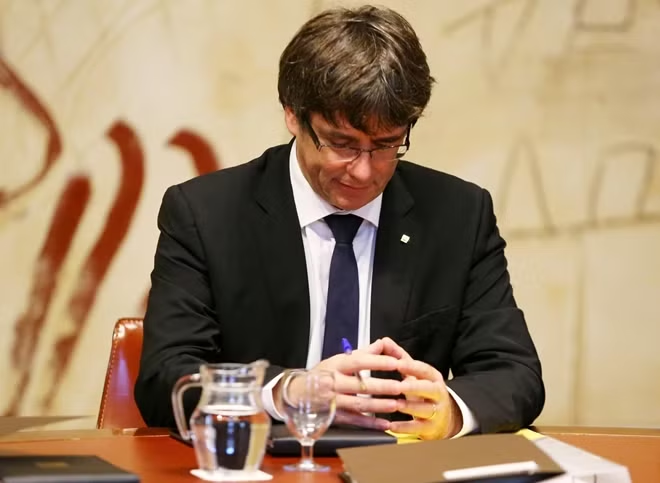
| Catalan President Carles Puigdemont presides over a cabinet meeting at the regional government headquarters, the Generalitat, in Barcelona, Spain October 10, 2017. REUTERS/Ivan Alvarado |
Regional leader Carles Puigdemont held a meeting of his cabinet to decide how to press an independence drive that has stirred powerful emotions across Spain and raised concern in European Union partner states.
Catalan police armed with automatic rifles stood guard at Barcelona’s Parc de la Ciutadella which houses the elegant 18th century building. Spanish national police, decried by separatists over their use of force to hinder an Oct. 1 referendum, were not to be seen.
A declaration of independence would deepen Spain’s biggest political crisis since an attempted military coup in 1981 and would almost certainly draw tough counter-measures from Madrid, possibly including suspension of the regional government.
Puigdemont has said he is determined to apply a law passed by the Catalan assembly which called for a declaration of independence within days if Catalans voted ‘yes’ in the Oct. 1 referendum.
The government of Spain’s wealthiest region says 90 percent of those who voted backed independence, but turnout was only 43 percent as many opponents of independence stayed at home.
The Madrid government has said it will respond immediately to any unilateral declaration.
Puigdemont could ask the parliament to vote on a motion of independence, which lawmakers say would start a period of up to six months during which Catalonia would write a new constitution and negotiate a divorce with Spain; or he could make a statement of intent on a future independence declaration.
Catalan government spokesman Jordi Turull refused to disclose what Puigdemont would say but told a news conference after the cabinet meeting he would be “clear and explicit” and Tuesday would be an historic day.
Ruling party lawmakers say Prime Minister Mariano Rajoy is considering taking the unprecedented step of dissolving the Catalan parliament and triggering new regional elections, the so-called nuclear option.
The European Commission repeated its call for dialogue in Spain to end the crisis in Catalonia. Puigdemont has also called for talks and international mediation, but Rajoy has said he will not negotiate with the Catalan leaders unless they abandon plans to declare independence.
The parliament and other buildings, such as the regional high court building, could become a focus of contention between Spanish and Catalan authorities.
Thousands of national police reinforcements sent by Madrid for the referendum remain in the area, many of them in two cruise ships docked in Barcelona harbor.
Pro-independence demonstrators were due to gather before the parliament building under the slogan “Hello Republic” to mark Puigdemont’s speech at 6 p.m. (1600 GMT).
Hundreds of thousands of people demonstrated in Barcelona against independence at the weekend, waving red-yellow Spanish flags through the city center. That rally fell a week after some 900 people were injured when police fired rubber bullets and stormed crowds with truncheons to disrupt a referendum ruled illegal in Madrid.
BUSINESS CLIMATE
Markets have been rattled by the Catalan crisis, raising Spain’s borrowing costs and pushing down shares.
Spain’s benchmark 10-year bond yields were a touch lower on Tuesday, but above lows hit the previous session as investors awaited Puigdemont’s speech. Spain’s benchmark Ibex share index was down nearly one percent.
The tension is taking its toll on the business climate. On Monday, three more Catalonia-based companies joined a business drift from the region that has gathered steam since the Oct. 1 referendum.
Property group Inmobiliaria Colonial and infrastructure firm Abertis both decided to relocate their head offices to Madrid and telecoms firm Cellnex said it would do the same for as long as political uncertainty in Catalonia continued.
Publishing house Grupo Planeta said it would move its registered office from Barcelona to Madrid if the Catalan parliament unilaterally declared independence.
Spain’s finance minister said it was the Catalan government’s fault the companies were leaving.
The issue has deeply divided the northeastern region as well as the Spanish nation. Opinion polls conducted before the vote suggested a minority of around 40 percent of residents in Catalonia backed independence.
Losing Catalonia, which has its own language and culture, would deprive Spain of a fifth of its economic output and more than a quarter of exports.
The crisis has reopened old divisions in a nation where the right-wing dictatorship of General Francisco Franco, who died in 1975, is a living memory easily revived by strong displays of nationalism.