 |
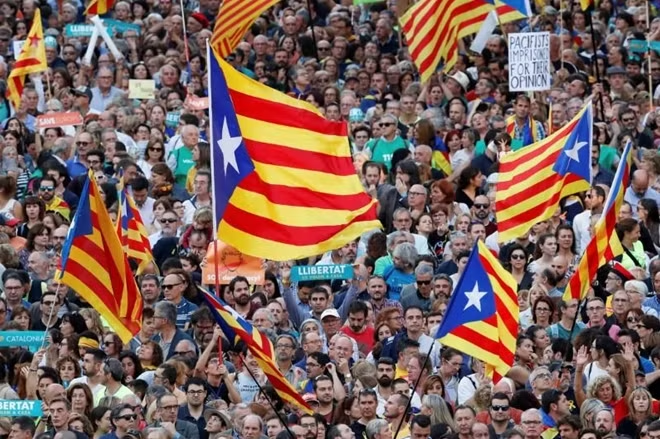
| People wave Catalan separatist flags during a demonstration. Reuters |
Spanish Prime Minister Mariano Rajoy announced earlier on Saturday he would invoke special constitutional powers to fire the regional government and force a new election to counter the region’s move towards independence.
Catalan President Carles Puigdemont, who made a symbolic declaration of independence on Oct. 10 after a referendum to secede, called Rajoy’s moves the “worst attacks against the people of Catalonia” since Spain’s military dictatorship.
It is the first time since Spain’s return to democracy that the central government has used its powers to seize control of a regional administration.
Rajoy said it was necessary to end a crisis that has fractured the country and prompted Spain to reduce growth forecasts for the euro zone’s fourth-largest economy.
After taking party in peaceful demonstration, Puigdemont expressed his rejection of Madrid’s move, but stopped short of saying he would make good his threat to push ahead with the independence bid before direct rule takes effect.
“I ask the (Catalan) parliament to meet in a plenary session during which we, the representatives of the citizens’ sovereignty, will be able to decide over this attempt to liquidate our government and our democracy, and act in consequence,” Puigdemont said in a televised address.
Rajoy, who acted with backing from the main opposition party in Madrid and King Felipe, needs the authorization of Spain’s upper house of parliament to impose direct rule.
“Our objective is to restore the law and a normal cohabitation among citizens, which has deteriorated a lot, continue with the economic recovery, which is under threat today in Catalonia, and celebrate elections in a situation of normality,” he said.
The Senate vote that would give Madrid full control of Catalonia’s finances, police and public media and curb the powers of the regional parliament for up to six months is scheduled for next Friday.
That could give the independence movement room to maneuver.
The regional parliament’s speaker, Carme Forcadell, said she would not accept Madrid’s move and accused Rajoy of a “coup.”
“Prime Minister Rajoy wants the parliament of Catalonia to stop being a democratic parliament, and we will not allow this to happen,” Forcadell said in a televised speech.
The assembly is expected to decide on Monday whether to hold a session to formally proclaim the republic of Catalonia.
Catalan media have said Puigdemont could dissolve the regional parliament and call elections by next Friday. Under Catalan law, those elections would take place within two months.
That would enable Puigdemont to go the polls earlier than envisaged by Rajoy, who spoke of a six-month timetable, and to exploit the anti-Madrid sentiment running high in the region.
Pro-independence groups have previously mustered more than 1 million people onto the streets in protest at Madrid’s refusal to negotiate a solution.