 |
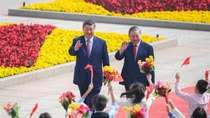
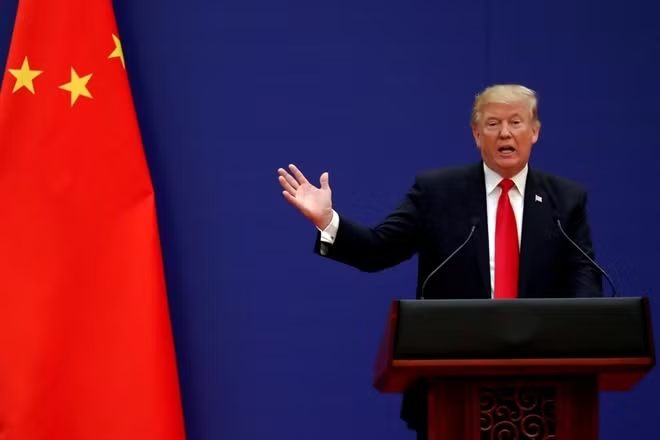
| U.S President Donald Trump delivers his speech as he and China's President Xi Jinping meet business leaders at the Great Hall of People in Beijing, China, November 9, 2017. Reuters |
The Chinese commerce ministry’s statement came hours after Trump said he was imposing 10 percent tariffs on about $200 billion worth of imports from China, and threatened duties on about $267 billion more if China retaliated against the U.S. action.
The brief statement gave no details on China’s plans, but Foreign Ministry spokesman Geng Shuang told a news briefing later that the U.S. steps have brought “new uncertainty” to talks between the two countries.
“China has always emphasized that the only correct way to resolve the China-U.S. trade issue is via talks and consultations held on an equal, sincere and mutually respectful basis. But at this time, everything the United States does not give the impression of sincerity or goodwill,” he added.
Geng said he would not comment on “hypotheticals” such as what measures Beijing might consider apart from tariffs on U.S. products, saying only that details would be released at the appropriate time.
Trump warned on Monday that if China takes retaliatory action against U.S. farmers or industries, “we will immediately pursue phase three, which is tariffs on approximately $267 billion of additional imports.”
The latest U.S. duties spared smart watches from Apple and Fitbit and other consumer products such as baby car seats. But if the administration enacts the additional tariffs it would engulf all remaining U.S. imports from China and Apple products like the iPhone and its competitors would not likely be spared.
Last month, China unveiled a proposed list of tariffs on $60 billion of U.S. goods ranging from liquefied natural gas to certain types of aircraft - should Washington activate the tariffs on its $200 billion list.
“THIS ESCALATION VERY UNFORTUNATE”
China is reviewing plans to send a delegation to Washington for fresh talks in light of the U.S. action, the South China Morning Post reported on Tuesday, citing a government source in Beijing.
Collection of tariffs on the long-anticipated U.S. list will start on Sept. 24 but the rate will increase to 25 percent by the end of 2018, allowing U.S. companies some time to adjust their supply chains to alternate countries.
So far, the United States has imposed tariffs on $50 billion worth of Chinese products to pressure Beijing to reduce its huge bilateral trade surplus and make sweeping changes to its trade, technology transfer and high-tech industrial subsidy policies.
Beijing has retaliated in kind, but some analysts and American businesses are concerned it could resort to other measures such as pressuring U.S. companies operating in China.
A senior Chinese securities market official said U.S. trade actions will not work as China has ample fiscal and monetary policy tools to cope with the impact. The government already has been ramping up spending on infrastructure.
“President Trump is a hard-hitting businessman, and he tries to put pressure on China so he can get concessions from our negotiations. I think that kind of tactic is not going to work with China,” Fang Xinghai, vice chairman of China’s securities regulator, said at a conference in the port city of Tianjin.
Trump’s latest escalation of tariffs on China comes after several rounds of talks yielded no progress. U.S. Treasury Secretary Steven Mnuchin last week invited top Chinese officials to fresh discussions, but thus far nothing has been scheduled.
“We have been very clear about the type of changes that need to be made, and we have given China every opportunity to treat us more fairly,” Trump said in a statement. “But, so far, China has been unwilling to change its practices.”
U.S. Commerce Secretary Wilbur Ross said on Tuesday the next step on holding “constructive negotiations” was up to China.
“So the question about whether or when to have a discussion is very importantly in their ballpark,” Ross told CNBC.
China's yuan currency slipped against the dollar on Tuesday after news of the U.S. measures. It has weakened by about 6.0 percent since mid-June, offsetting the 10 percent tariff rate by a considerable margin.
The U.S. Trade Representative’s office eliminated 297 product categories from the latest proposed tariff list, along with some subsets of other categories.
But the adjustments did little to appease technology and retail groups who argued U.S. consumers would feel the pain.
“President Trump’s decision ... is reckless and will create lasting harm to communities across the country,” said Dean Garfield, president of the Information Technology Industry Council, which represents major tech firms.
Kenneth Jarrett, president of the American Chamber of Commerce in Shanghai, said three quarters of its members will be hit by the tariffs, and they will not bring jobs back to the United States.