Chinese ambassador to U.S.: Sovereignty not a 'bargaining chip'

In a veiled warning to U.S. President-elect Donald Trump, China's ambassador to the United States said on Wednesday that Beijing would never bargain with Washington over issues involving its national sovereignty or territorial integrity.

Ambassador Cui Tiankai, speaking to executives of top U.S. companies, said China and the United States needed to work to strengthen their relationship.

"The political foundation of China-U.S. relations should not be undermined. It should be preserved," Cui said.
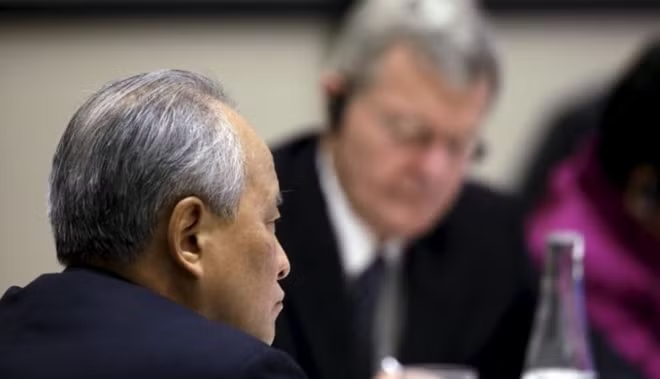
China's Ambassador to the U.S. Cui Tiankai (L), listens as U.S. Ambassador to China Max Baucus takes notes while Chinese President Xi Jinping speaks at a U.S.-China business roundtable, comprised of U.S. and Chinese CEOs in Seattle, Washington September 23, 2015. REUTERS/Elaine Thompson/Pool

"And basic norms of international relations should be observed, not ignored, certainly not be seen as something you can trade off," he said. "And indeed, national sovereignty and territorial integrity are not bargaining chips. Absolutely not. I hope everybody would understand that."

Cui's remarks were in line with recent protests from China's Foreign Ministry, which regards the "one China" principle as the "political basis" for U.S.-China ties.

Beijing regards Taiwan as a renegade province and has vowed to use military force to bring it under mainland rule if the island were to formally declare independence.

Trump, in an interview on "Fox News Sunday," suggested that the U.S. position on Taiwan could become part of his pledge to negotiate more favorable trade terms with China.

"I fully understand the 'one China' policy, but I don't know why we have to be bound by a 'one China' policy unless we make a deal with China having to do with other things, including trade," Trump said.

U.S. corporate executives are increasingly pessimistic about their business prospects in China in light of tough restrictions on foreign investment in the country's vast service sector, new cyber-security regulations that favor domestic technologies and weak enforcement of intellectual property protections.

Earlier on Wednesday, news that Chinese officials may penalize a U.S. automaker for monopolistic pricing behavior pushed down shares of General Motors Co (GM.N) and Ford Motor Co (F.N).

Reuters

Other News

Vietnam supports UNESCO's people-centred approach, multilateral cooperation: official

Vietnam supports UNESCO's people-centred approach, multilateral cooperation: official

Van affirmed Vietnam’s support for the UNESCO80 reform roadmap, focusing on the organisation’s core mandate, priority areas, interdisciplinary approach, and the special status of the Vietnam National Commission for UNESCO, and UNESCO representative offices, alongside efforts to diversify resources and strengthen global partnerships to enhance the organisation’s effectiveness.

Regional media highlight significant step in Vietnam’s leadership structure

Regional media highlight significant step in Vietnam’s leadership structure

Under General Secretary and President Lam’s leadership, Vietnam is expected to maintain a balanced foreign policy, strengthen its regional standing and accelerate economic development, thereby improving living standards and creating new opportunities for international investors, according to the India-based platform Devdiscourse.

Laos identifies 10 key tasks to build independent, self-reliant economy

Laos identifies 10 key tasks to build independent, self-reliant economy

Laos will step up agricultural production to ensure food security, meet domestic demand and expand exports; encourage the development of agro-processing industries, including those related to rubber, aquatic products, cassava and sugarcane, as well as fertiliser and animal feed production, in order to increase added value and create jobs in rural areas.

Malaysia steps up cyber security resilience

Malaysia steps up cyber security resilience

To ensure accountability, Malaysia plans to finalise the Cybercrime Bill this year which addresses both cyber-dependent and cyber-enabled offences, introducing stricter penalties and prison terms to enhance deterrence.

US public opinion positive about PM Pham Minh Chinh’s visit

US public opinion positive about PM Pham Minh Chinh’s visit

Public opinion in the US is generally positive about Vietnamese Prime Minister Pham Minh Chinh’s trip to the US from September 17-23 to attend the 78th session of the United Nations General Assembly, which took place immediately after the upgrading of the Vietnam - US relations to a comprehensive strategic partnership on the occasion of US President Joe Biden’s official visit to Vietnam.