Citizens’ relaxation poses big risk to pandemic prevention work ​

Citizens’ laxation of COVID-19 preventive measures is posing a big risk to the pandemic prevention and control in the country.
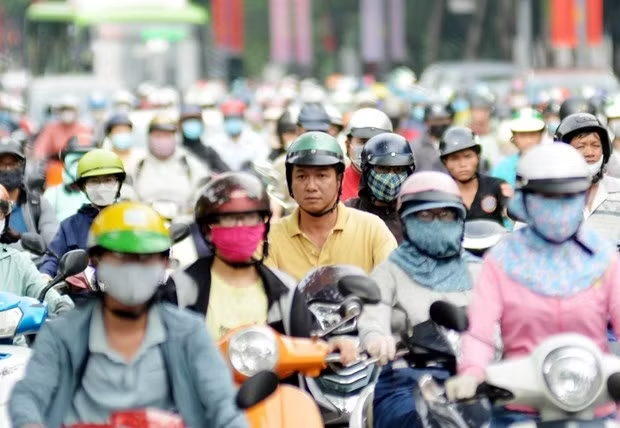
Many people in Ho Chi Minh City do not wear a face mask in public places (Photo: VNA)

Many people in Ho Chi Minh City do not wear a face mask in public places (Photo: VNA) 

Citizens’ laxation of COVID-19 preventive measures is posing a big risk to the pandemic prevention and control in the country.

Recently, the Trang An tourism complex in the northern province of Ninh Binh is rather crowded. However, few among the tourists wore a face mask, even though notices about pandemic prevention measures are posted everywhere and hand sanitizer is readily available. Many staff members in the complex, including guards, ticket sellers or waiters and waitresses at local restaurants do not wear face masks.

In fact, adherence to pandemic prevention measures in many localities has been loosened. Even in big cities with dense population, the abidance by epidemic prevention measures has become lax. In office buildings or apartment high-rises, it is easy to see people wearing no face masks in elevators.

Not only people but also relevant forces seem more relaxed in enforcing preventive measures. According to latest statistics of Ho Chi Minh City, forces gave warnings to 9,300 people and fined 4,064 others for not wearing face masks in public places during the period from August 5 to October 10. However, the real figure of violators must be much higher as it is easy to meet people wearing no face masks in public places.

Meanwhile, the situation of COVID-19 pandemic in the world shows no sign of abating. As of October 23 morning, the worldometers.info reported the total number of COVID-19 cases in the world has surpassed 41.9 million, with over 1.142 million deaths. The pandemic has spread to 217 countries and territories.

For every 100 new cases in the world, 34 are in Europe. Many European countries have begun to re-impose restriction measures to curb the return of the pandemic. The World Health Organisation is concerned that the crisis is worsening, and predicts that more deaths will occur in Europe in the time ahead.

Vietnam has entered the 51st day without any new infections in the community on October 23, with 1,148 cases of COVID-19 recorded as of 6am on October 23.

However, acting Health Minister Nguyen Thanh Long warned that the risk of pandemic entering the country remains high, especially when more flights are bringing Vietnamese citizens and foreign experts home, including international commercial flights. In addition, the weather in winter and spring is favourable for infectious diseases to spread. It is worrying that recent inspections of the Health Ministry revealed that some localities and units are not following regulations and guidance in epidemic prevention. The monitoring of people quarantined at home is not strict enough.

Vietnam has been described as a model in COVID-19 prevention and control for its spirit of “fighting the pandemic like fighting an enemy,” and the strategy of mobilising the entire political system in quickly stamping out any outbreak, which allows the country to successfully curb the epidemic despite limited resources. “Know your enemy, and you can fight a hundred battles without loss,” was one of the classic military tactics by ancient Chinese military strategist Sun Tzu, which can be applied not only in war but also in many social and economic fields. On the contrary, overconfidence and under-estimating the enemy are the cause of all defeat.

Deputy Prime Minister Vu Duc Dam has stressed that in the fight against the COVID-19 pandemic, Vietnam has only won some battles, and more fighting remains ahead. Therefore, each person must not loosen vigilance and must adapt to the “new normal” situation by observing the 5-K message: Khau trang (facemask) – Khu khuan (disinfection) – Khoang cach (Keeping distance) – Khong tu tap (no gatherings) – Khaibao y te (medical declaration).


VNA

Other News

Hanoi ready to implement Capital Law 2026, unlocking new development momentum

Hanoi ready to implement Capital Law 2026, unlocking new development momentum

The effectiveness of the Capital Law 2026 will be measured not by the number of legal documents issued but by tangible improvements in governance and public administration, better services for people and businesses, faster administrative procedures, stronger investment attraction and higher economic growth.

Vietnamese students earn honours at ROBOG Asia Cup 2026

Vietnamese students earn honours at ROBOG Asia Cup 2026

Three teams from Chu Van An Secondary School in Vietnam’s Thai Nguyen province have earned First Prize honours and advanced to the quarterfinals at the ROBOG Asia Cup 2026, a regional robotics and artificial intelligence (AI) competition for students held in Hong Kong, China.

Hanoi sets out new investment blueprint with century-long development vision

Hanoi sets out new investment blueprint with century-long development vision

As of early June, Hanoi had attracted 74.6 billion USD in foreign direct investment (FDI) through more than 9,250 valid projects. FDI inflows in the first six months were projected at 3.2 billion USD, surpassing the annual target by 116%, while nearly 16,000 new businesses were established in the first five months, up 34.4% year-on-year.

Vietnam promotes legal cooperation and rule of law at global forum

Vietnam promotes legal cooperation and rule of law at global forum

Vietnam’s development and international integration have gone hand in hand with the improvement of its legal system, the incorporation of international commitments into domestic legislation, and legal reforms aimed at fostering development, openness and global integration. The country regards international law as an essential instrument for building fair, mutually beneficial relations among nations.

Hanoi to hold investment promotion event on June 29

Hanoi to hold investment promotion event on June 29

At the event, Hanoi authorities plan to grant investment policy decisions and investment registration certificates to 20 exemplary projects in the fields of transportation infrastructure, industrial parks, urban development, social housing, environment, science and technology, and foreign investment attraction.

Hanoi's Red River urban area development draws widespread attention

Hanoi's Red River urban area development draws widespread attention

Located south of the Red River and extending from the historic inner city to newly developing areas in the south and the west, the central urban area along Red River’s right bank covers approximately 45,317 hectares and is projected to accommodate around 6.365 million residents by 2045 and 6.455 million by 2065.

Hanoi's Red River urban area development draws widespread attention

Hanoi's Red River urban area development draws widespread attention

Located south of the Red River and extending from the historic inner city to newly developing areas in the south and the west, the central urban area along Red River’s right bank covers approximately 45,317 hectares and is projected to accommodate around 6.365 million residents by 2045 and 6.455 million by 2065.

Regional cooperation strengthened to combat cross-border drug crime

Regional cooperation strengthened to combat cross-border drug crime

Vietnam, China, Laos and Myanmar face common challenges as drug syndicates increasingly exploit the Mekong River, cross-border transport networks, e-commerce platforms, international logistics services, cyberspace and cryptocurrencies to organise drug transactions and smuggling operations.