COVID vaccines create 9 new billionaires

At least nine people have become new billionaires since the beginning of the COVID pandemic, thanks to the excessive profits pharmaceutical corporations with monopolies on COVID vaccines are making, The People’s Vaccine Alliance revealed today ahead of a G20 leaders Global Health Summit.

The nine new billionaires, have a combined net wealth of $19.3 billion, enough to fully vaccinate all people in low-income countries 1.3 times. Meanwhile, these countries have received only 0.2 per cent of the global supply of vaccines, because of the massive shortfall in available doses, despite being home to 10 per cent of the world’s population. 

In addition, eight existing billionaires– who have extensive portfolios in the COVID-19 vaccine pharma corporations - have seen their combined wealth increase by $32.2 billion, enough to fully vaccinate everyone in India. 
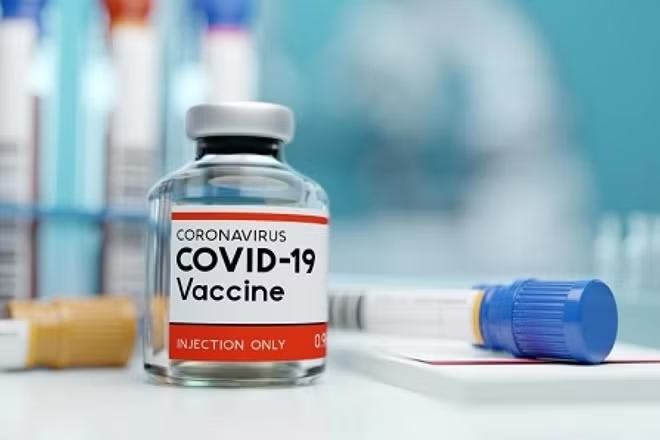
Campaigners from the People’s Vaccine Alliance – whose members include Global Justice Now, Oxfam and UNAIDS, have analysed Forbes Rich List data to highlight the massive wealth being generated for a handful of people from vaccines which were largely public funded. 

Anna Marriott, Oxfam’s Health Policy Manager, said: “What a testament to our collective failure to control this cruel disease that we quickly create new vaccine billionaires but totally fail to vaccinate the billions who desperately need to feel safe. 

“These billionaires are the human face of the huge profits many pharmaceutical corporations are making from the monopoly they hold on these vaccines. These vaccines were funded by public money and should be first and foremost a global public good, not a private profit opportunity. We need to urgently end these monopolies so that we can scale up vaccine production, drive down prices and vaccinate the world.”

Vaccine billionaires are being created as stocks in pharmaceutical firms rise rapidly in expectation of huge profits from the COVID-19 vaccines over which these firms have monopoly control. The alliance warned that these monopolies allow pharmaceutical corporations total control over the supply and price of vaccines, pushing up their profits while making it harder for poor countries, in particular, to secure the stocks they need.  

Earlier this month the US backed proposals by South Africa and India at the World Trade Organisation to temporarily break up these monopolies and lift the patents on COVID-19 vaccines. This move has the support of over 100 developing countries, and in recent days countries like Spain have also declared their support, as has the Pope and over 100 world leaders and Nobel laureates. 

PSNews

Other News

Vietnam supports UNESCO's people-centred approach, multilateral cooperation: official

Vietnam supports UNESCO's people-centred approach, multilateral cooperation: official

Van affirmed Vietnam’s support for the UNESCO80 reform roadmap, focusing on the organisation’s core mandate, priority areas, interdisciplinary approach, and the special status of the Vietnam National Commission for UNESCO, and UNESCO representative offices, alongside efforts to diversify resources and strengthen global partnerships to enhance the organisation’s effectiveness.

Regional media highlight significant step in Vietnam’s leadership structure

Regional media highlight significant step in Vietnam’s leadership structure

Under General Secretary and President Lam’s leadership, Vietnam is expected to maintain a balanced foreign policy, strengthen its regional standing and accelerate economic development, thereby improving living standards and creating new opportunities for international investors, according to the India-based platform Devdiscourse.

Laos identifies 10 key tasks to build independent, self-reliant economy

Laos identifies 10 key tasks to build independent, self-reliant economy

Laos will step up agricultural production to ensure food security, meet domestic demand and expand exports; encourage the development of agro-processing industries, including those related to rubber, aquatic products, cassava and sugarcane, as well as fertiliser and animal feed production, in order to increase added value and create jobs in rural areas.

Malaysia steps up cyber security resilience

Malaysia steps up cyber security resilience

To ensure accountability, Malaysia plans to finalise the Cybercrime Bill this year which addresses both cyber-dependent and cyber-enabled offences, introducing stricter penalties and prison terms to enhance deterrence.

US public opinion positive about PM Pham Minh Chinh’s visit

US public opinion positive about PM Pham Minh Chinh’s visit

Public opinion in the US is generally positive about Vietnamese Prime Minister Pham Minh Chinh’s trip to the US from September 17-23 to attend the 78th session of the United Nations General Assembly, which took place immediately after the upgrading of the Vietnam - US relations to a comprehensive strategic partnership on the occasion of US President Joe Biden’s official visit to Vietnam.