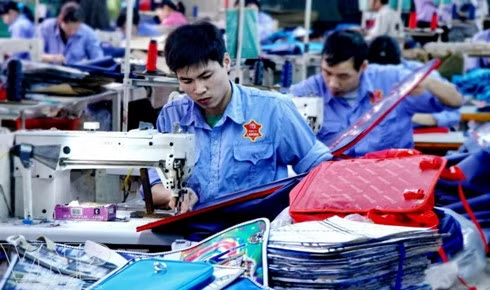
Creating a workforce for the new industrial age of Vietnam

Economies in Vietnam and the other nine countries that comprise the Association of Southeast Asian Nations (ASEAN) could conceivably see a bonanza of new jobs in 2017 and beyond, say many leading economists.

However, these same experts caution that without bold national reform in Vietnam— job applicants will lack the skills to fill the positions. 

From the retail sector to manufacturing, telecommunications and transport, new business models and most importantly – high paying challenging new job opportunities – are rapidly emerging throughout the Southeast Asian country.

These jobs, especially those in business and engineering, say the economists, lack one important ingredient— applicants from the labour pool who have the interpersonal skills and technical talent needed to fill them.

Business leaders in Vietnam reported acute talent shortages in 2016, ranking the country in the bottom half of the 124 countries surveyed by the World Economic Forum as part of the process of developing its human capital index, which measures how effectively countries develop and manage their workforces.

For comparison purposes, Malaysia, in fourth place, ranked highest among the ASEAN member countries.

By 2020, talent shortages in Vietnam and ASEAN overall are expected to get worse, unless effectual remedial action is taken.

All encompassing, Vietnam businesses have the potential for net job growth over the next five years, say the experts, with some job classifications becoming redundant through automation, but offset with a higher number of new roles emerging.

However, the lack of qualified talent in Vietnam is likely to diminish job-growth opportunities. Even roles that remain stable will face – skills instability – as existing jobs begin to require, at least in part, a new higher level of aptitude and ability for working with advanced technology.

Just as significant, nearly all jobs over the next five years will also require much stronger social and collaboration skills, unique human traits that go beyond mastering machines, say the experts.

They note that this could find the Vietnam public and private sectors facing a unique dilemma simultaneously facing both a growth in employment opportunities and a shortage of potential employees possessing the prerequisite skills to occupy both the new and existing roles.

The economist say that the solutions to this challenge will require bold leadership and a future-oriented vision, adding that it is critical for governments and businesses alike to act cohesively to co-create a new education and employment environment.

Businesses in Vietnam can no longer sit idly by doing nothing for themselves, acting as mere passive consumers of ready-made human capital. Instead, they must take the helm and put the development of talent and human capital at the centre of their business strategy.

As well, the young generation must get on a level with their peers around the globe and take greater responsibility for the development of their own skillsets, most importantly – foreign language and collaborative skills – which may mean ridding themselves of their addiction to mobile phones and other selfie obsessions.

The latest official unemployment statistics showed that nearly 1.2 million working-aged people were unemployed in the third quarter of 2016, an increase of 29,000 compared against the same quarter in 2015.

Among those unemployed, 456,000 possessed advanced technical skills, 202,000 held university degrees, 112,000 had received vocational training, while another 73,000 had graduated from vocational colleges.

VOV

Other News

Hanoi ready to implement Capital Law 2026, unlocking new development momentum

Hanoi ready to implement Capital Law 2026, unlocking new development momentum

The effectiveness of the Capital Law 2026 will be measured not by the number of legal documents issued but by tangible improvements in governance and public administration, better services for people and businesses, faster administrative procedures, stronger investment attraction and higher economic growth.

Vietnamese students earn honours at ROBOG Asia Cup 2026

Vietnamese students earn honours at ROBOG Asia Cup 2026

Three teams from Chu Van An Secondary School in Vietnam’s Thai Nguyen province have earned First Prize honours and advanced to the quarterfinals at the ROBOG Asia Cup 2026, a regional robotics and artificial intelligence (AI) competition for students held in Hong Kong, China.

Hanoi sets out new investment blueprint with century-long development vision

Hanoi sets out new investment blueprint with century-long development vision

As of early June, Hanoi had attracted 74.6 billion USD in foreign direct investment (FDI) through more than 9,250 valid projects. FDI inflows in the first six months were projected at 3.2 billion USD, surpassing the annual target by 116%, while nearly 16,000 new businesses were established in the first five months, up 34.4% year-on-year.

Vietnam promotes legal cooperation and rule of law at global forum

Vietnam promotes legal cooperation and rule of law at global forum

Vietnam’s development and international integration have gone hand in hand with the improvement of its legal system, the incorporation of international commitments into domestic legislation, and legal reforms aimed at fostering development, openness and global integration. The country regards international law as an essential instrument for building fair, mutually beneficial relations among nations.

Hanoi to hold investment promotion event on June 29

Hanoi to hold investment promotion event on June 29

At the event, Hanoi authorities plan to grant investment policy decisions and investment registration certificates to 20 exemplary projects in the fields of transportation infrastructure, industrial parks, urban development, social housing, environment, science and technology, and foreign investment attraction.

Hanoi's Red River urban area development draws widespread attention

Hanoi's Red River urban area development draws widespread attention

Located south of the Red River and extending from the historic inner city to newly developing areas in the south and the west, the central urban area along Red River’s right bank covers approximately 45,317 hectares and is projected to accommodate around 6.365 million residents by 2045 and 6.455 million by 2065.

Hanoi's Red River urban area development draws widespread attention

Hanoi's Red River urban area development draws widespread attention

Located south of the Red River and extending from the historic inner city to newly developing areas in the south and the west, the central urban area along Red River’s right bank covers approximately 45,317 hectares and is projected to accommodate around 6.365 million residents by 2045 and 6.455 million by 2065.

Regional cooperation strengthened to combat cross-border drug crime

Regional cooperation strengthened to combat cross-border drug crime

Vietnam, China, Laos and Myanmar face common challenges as drug syndicates increasingly exploit the Mekong River, cross-border transport networks, e-commerce platforms, international logistics services, cyberspace and cryptocurrencies to organise drug transactions and smuggling operations.