Da Nang targets e-government, smart city by 2030

The Central city of Da Nang is poised to complete the building of a smart city connected with the networks of smart cities in the country and in the Association of Southeast Asian Nations (ASEAN) region by 2030.
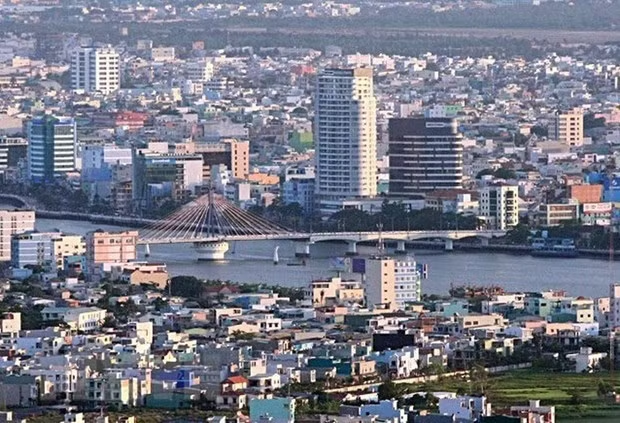
A corner of Da Nang city (Photo: VNA)

A corner of Da Nang city (Photo: VNA)

The Central city of Da Nang is poised to complete the building of a smart city connected with the networks of smart cities in the country and in the Association of Southeast Asian Nations (ASEAN) region by 2030.

To that end, the local authorities are enhancing the application of information technology (IT) as the tool to promote administrative reform, effectively serve management activities and meet the demand of people, organisations and enterprises.

Da Nang aims to maintain its position as one of leading localities in the nation’s index rankings of readiness for the development and application of information and communications technology (Vietnam ICT Index), and of e-government.

Under a plan of actions to realise the goals, the city has defined five spearhead sectors, one of which is to develop information technology, electronics and telecommunications as part of the digital economy. 

The city will upgrade the local e-government architecture framework to be compatible with the national e-government architecture framework (version 2.0) after the Ministry of Information and Communication approves and promulgates the framework.

Accordingly, Da Nang will build a synchronous telecom infrastructure system along with regional and inter-regional core networks, and expand the 5G mobile service to cover the entire city and broadband connection to enterprises and households.

Other tasks include upgrading the e-Government platform; completing the Local Government Service Platform (LGSP); connecting with the National Government Service Platform (NGSP) for sharing data with ministries and central agencies; and putting into operation a data service portal to provide the municipal government’s information to the public and businesses.

The city aims to have at least 30 percent of online public services use digital signature in administrative procedures, and have 100 percent of public services performed online at third- and fourth levels.

During 2021-2025, the city will get itself ready in terms of infrastructure and database for the full implementation of smart city and connection with ASEAN smart city network. The city will continue to promote the use of technologies of the Fourth Industrial Revolution (4IR) in enterprises and society.

Da Nang was the first city in Vietnam to launch an e-Government system in 2014, and transferred the system to 16 cities and provinces in 2016.

The city’s IT infrastructure was available for smart connections for air control, water, garbage, meteorology and energy agencies. It could also provide earthquake and tsunami warnings, and data on flooding, erosion, sewage management and food safety.

Last year, Da Nang topped the Vietnam ICT Index for the 11th consecutive year, and won ICT awards of the Asian-Oceanian Computing Industry Organisation (ASOCIO).

VNA

Other News

Hanoi ready to implement Capital Law 2026, unlocking new development momentum

Hanoi ready to implement Capital Law 2026, unlocking new development momentum

The effectiveness of the Capital Law 2026 will be measured not by the number of legal documents issued but by tangible improvements in governance and public administration, better services for people and businesses, faster administrative procedures, stronger investment attraction and higher economic growth.

Vietnamese students earn honours at ROBOG Asia Cup 2026

Vietnamese students earn honours at ROBOG Asia Cup 2026

Three teams from Chu Van An Secondary School in Vietnam’s Thai Nguyen province have earned First Prize honours and advanced to the quarterfinals at the ROBOG Asia Cup 2026, a regional robotics and artificial intelligence (AI) competition for students held in Hong Kong, China.

Hanoi sets out new investment blueprint with century-long development vision

Hanoi sets out new investment blueprint with century-long development vision

As of early June, Hanoi had attracted 74.6 billion USD in foreign direct investment (FDI) through more than 9,250 valid projects. FDI inflows in the first six months were projected at 3.2 billion USD, surpassing the annual target by 116%, while nearly 16,000 new businesses were established in the first five months, up 34.4% year-on-year.

Vietnam promotes legal cooperation and rule of law at global forum

Vietnam promotes legal cooperation and rule of law at global forum

Vietnam’s development and international integration have gone hand in hand with the improvement of its legal system, the incorporation of international commitments into domestic legislation, and legal reforms aimed at fostering development, openness and global integration. The country regards international law as an essential instrument for building fair, mutually beneficial relations among nations.

Hanoi to hold investment promotion event on June 29

Hanoi to hold investment promotion event on June 29

At the event, Hanoi authorities plan to grant investment policy decisions and investment registration certificates to 20 exemplary projects in the fields of transportation infrastructure, industrial parks, urban development, social housing, environment, science and technology, and foreign investment attraction.

Hanoi's Red River urban area development draws widespread attention

Hanoi's Red River urban area development draws widespread attention

Located south of the Red River and extending from the historic inner city to newly developing areas in the south and the west, the central urban area along Red River’s right bank covers approximately 45,317 hectares and is projected to accommodate around 6.365 million residents by 2045 and 6.455 million by 2065.

Hanoi's Red River urban area development draws widespread attention

Hanoi's Red River urban area development draws widespread attention

Located south of the Red River and extending from the historic inner city to newly developing areas in the south and the west, the central urban area along Red River’s right bank covers approximately 45,317 hectares and is projected to accommodate around 6.365 million residents by 2045 and 6.455 million by 2065.

Regional cooperation strengthened to combat cross-border drug crime

Regional cooperation strengthened to combat cross-border drug crime

Vietnam, China, Laos and Myanmar face common challenges as drug syndicates increasingly exploit the Mekong River, cross-border transport networks, e-commerce platforms, international logistics services, cyberspace and cryptocurrencies to organise drug transactions and smuggling operations.