 |
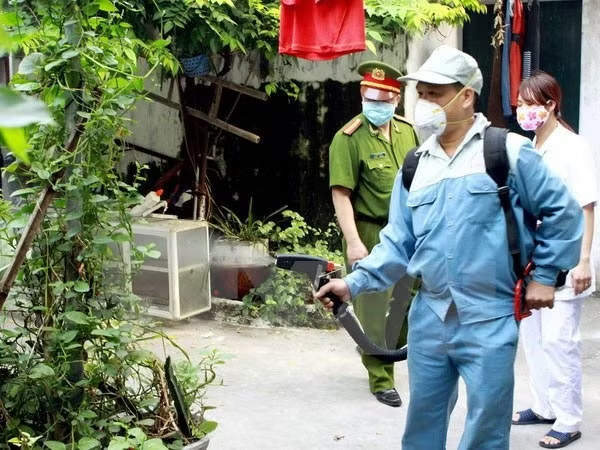
| A medical staff sprays chemical to kill mosquito larvae in the inner Hai Ba Trung District of the capital city. — Photo: VNA/VNS |
Central-level hospitals such as the National Hospital of Tropical Diseases, National Children’s Hospital and Bach Mai Hospital should classify patients to decide who should be hospitalised, she said during an online conference on disease prevention in the rainy season between Ha Noi and HCM City yesterday.
“Avoid receiving everyone and overloading the hospitals, which might lead to negligence of severe patients and fatal consequences,” she said.
“Those whose symptoms are less severe should be transferred to hospitals at lower levels,” she added. “The number of inpatients’ relatives staying at the hospitals should also be limited.”
Some 60,000 dengue cases were recorded in 61 provinces and cities as of yesterday, causing deaths, Kinh te do thi (Economic and Urban Affairs) newspaper reported. Some 55,000 patients have been hospitalised in the first seven months of this year, an increase of 12.6 per cent compared to the same period of last year.
The capital city came third in the country – after HCM City and the central province of Da Nang – with 6,700 dengue patients, with three deaths. Roughly 90 per cent of those infected have recovered.
Deputy director of Ha Noi’s health department Hoang Duc Hanh said that some 1,000 beds are always available at medical units throughout the city for dengue patients.
Nguyen Van Kinh, director of the National Hospital of Tropical Diseases in Ha Noi, said that the hospital conducted careful screenings to avoid overcrowding, hospitalising only about 800 out of 5,000 dengue patients. The remaining ones were advised to go to lower-level hospitals or receive treatment at home, he said.
“Three and a half days is the average treatment duration for dengue inpatients at our hospital, and seven days is the maximum,” Kính added. “They will also be transferred to lower-level hospitals when their symptoms become less severe.”
Le Hung, director of the Dong Da General Hospital in the capital city, said that bed-sharing only occurs on Saturdays and Sundays and in 10 per cent of beds. “We have some 100 beds at the hospital always ready to receive patients,” he said.
Proactive prevention
As dengue fever is often transmitted by aedes aegypti mosquitoes, Health Minister Tien said leaders of localities should emphasise the importance of killing mosquito larvae.
“Spraying chemicals is only a temporary solution, clearing bushes and draining sewers only prevent mosquitoes from transmitting encephalitis,” she explained. “Killing mosquito larvae is at the core of dengue fever prevention.”
The most effective dengue fever prevention measures are emptying containers of stagnant water, flipping down all containers, eating carefully-cooked food and sanitising the environment, she said.
Tran Dac Phu, director of the General Department of Preventive Medicine under the Ministry of Health (MOH), said that the ministry has formed seven working groups to monitor dengue fever’s progress in the 14 provinces with the most patients. A GPS system has been utilised to monitor patients in HCM City, he said.
Fifty mobile disease prevention groups were formed and 90 training workshops on disease monitoring, insect inspection, serous sampling and chemical spraying were held in Ha Noi.
The health sector will continue launching sanitation campaigns in different localities and ask local authorities to organise trash clean-ups once or twice a week, he said.
Zika may return
It is possible the Zika virus disease will re-emerge in Viet Nam, Mai Trong Khoa, deputy director of the Ministry of Health’s Department of Medical Examination and Treatment told Zing online newspaper.
Dengue fever and Zika are easily mistaken as they have similar symptoms such fever, rash, muscle aches, headaches and eyesore, and their incubation periods both last from three to twelve days, he told the newspaper. Testing is the only way to tell them apart, he added.
Twenty-seven cases of Zika were discovered in seven provinces and cities in the first seven months of this year, twenty-one in HCM City, according to statistics from the city’s health department.