 |
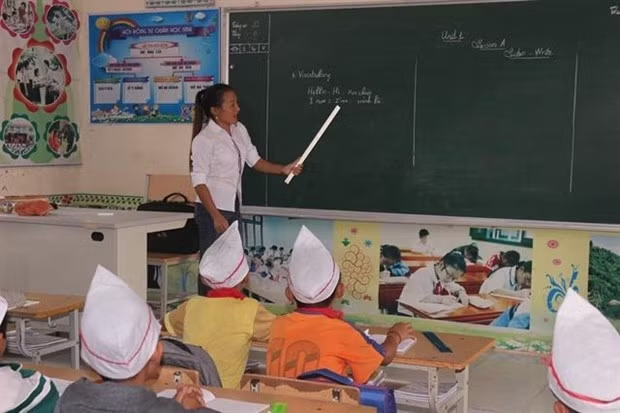
| An English lesson at the Huoi Tu 2 Primary School in Ky Son district, the central province of Nghe An. The province faces severe shortage of teachers. (Source: VNA) |
The new school year is already over a month old, but many schools are suffering teacher shortages.
According to the Ministry of Education and Training, preschools nationwide lacked 49,000 teachers.
The reason for this is that since 2015, the number of preschool students has been rapidly increasing and has reached 1.2 million, but the number of newly-recruited teachers remains far behind the requirement.
Like many localities across the country, the central province of Nghệ An was facing a severe shortage of teachers for the 2019-2020 school year, reported online newspaper baotintuc.vn.
This had led to teachers being forced to cover different subjects they had no expertise in.
Tran Thi Tuyet, a maths and literature teacher at Hung Thong Primary School in Hung Nguyen district, Nghe An province, has also had to stand in to cover art, music and sport.
Her working hours are much longer than those regulated, but she has been left without a choice because the school has been unable to recruit new staff.
Deputy principal Tran Thi Huyen said: “The school is three teachers short in art and physical education, so the other teachers have had to cover these classes.
“Besides, our school has had to open IT classes in accordance with new national criteria,” Huyen said.
Phan Thi Kim Hoa, an English teacher at Hung Nguyen district's Nguyen Thi Minh Khai Secondary School, said: “My profession is English teaching, but I've had to teach art for more than three years.”
“It's been very difficult even though I've attended some training courses. But frankly, sometimes I do not know how to teach,” Hoa said.
This school year, Hung Nguyen district recruited more than 30 teachers, but still lacks 50 others at pre and primary school levels.
The problem is particularly serious in mountainous schools which should be given priority.
The Ta Ca Ethnic Boarding School has no English or IT teachers.
“From third grade, students are meant to study English and IT, but this seems like ‘mission impossible’ in mountainous areas because we cannot recruit teachers for these subjects”, said Le Van Hoang, the school’s vice principal.
“The school is also unable to hire teachers on short-term contracts due to lack of money,” Hoang said.
According to Phan Van Thiet, head of the Ky Son district's Department of Education and Training, there were only seven English and two IT teachers to cover the 29 primary schools in the district.
“The teachers are sent to two national-standard schools as priority,” Thiet said.
“The district was given a recruitment quota but we could not found the teachers,” he added.
Statistics from the Nghe An Department of Education and Training showed the province lacked nearly 4,300 teachers this year.
At primary level, the teacher-class ratio is meant to 1.5, but it's actually only 1.2.
The situation is partly due to a plan to streamline payroll staff.
According to experts, the plan was sound and would help increase labour productivity among public servants.
But the plan has exposed shortcomings in each specific sector, especially the education sector, because at present poor, rural, mountainous and remote areas where populations are scattered are suffering teacher shortages.
At present, thousands of teachers are working under direct contracts with their schools. The streamlining plan says that teachers must be instead on the Government payroll. This means they have to reapply for their jobs or the schools will have to end their contracts.
The consequences of this have been classes being merged together and increased working hours for the remaining teachers.
Some schools have cut classes from 44 to 39, causing student overload.
According to the Ministry of Education and Training, many localities were short of teachers including Kien Giang (1,008), HCM City (1,290), Binh Duong (2,811), Dong Nai (1,762), Gia Lai (2,572) Thanh Hoa (2,877), Nam Dinh 1,169, Thai Binh (3,167), Hung Yen (1,742), Hai Duong (1,823), Bac Ninh (1,479), Vinh Phuc (2,300), Bac Giang (1,019), and Son La (3,355).
Hoang Duc Minh, head of the the ministry's Department of Teachers and Education Managers, said the education sector and local authorities had been looking for solutions to deal with the situation in order to ensure teaching quality.
The Ministry of Education and Training had set up a database to calculate teacher shortages in different areas to guide the Ministry of Internal Affairs to adjust the streamlining plan, Minh said.