Draft circular aims to promote responsible use of technology, AI in higher education

Once issued, the circular is expected to provide a key legal basis for promoting responsible technology adoption, advancing digital transformation and AI in higher education, while strengthening quality assurance, data protection and academic integrity in the digital era.

The Ministry of Education and Training has released a draft circular on the application of technology in higher education for public consultation, aiming to establish a unified legal framework for deploying digital technologies, artificial intelligence (AI) and related solutions across the sector.

The draft applies to higher education institutions, organisations and individuals involved in teaching, research, management and support services, as well as enterprises providing digital platforms and AI solutions.
Draft circular aims to promote responsible use of technology, AI in higher education -0
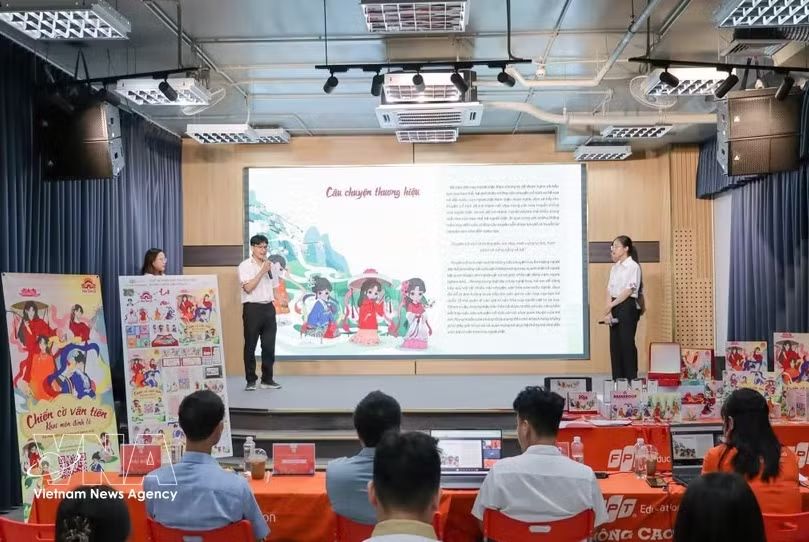
Students at FPT Ha Nam Inter-level School practice their lessons by applying digital technology software. Photo: VNA

Under the draft, technology adoption will be implemented comprehensively across training, assessment, research, institutional governance and student services. Universities may proactively select suitable technological solutions aligned with their development strategies and conditions, while ensuring controlled implementation and academic integrity.

In training activities, institutions may apply digital technologies and AI through various modes, including technology-assisted in-person teaching, fully online learning, blended learning, and data- and AI-driven personalised education. These applications are intended to support teaching organisation, learning management, progress tracking, academic advising, career guidance, and data analytics to improve curricula and teaching methods.

The draft emphasises that AI must serve as a support tool rather than replace lecturers, ensuring transparency, accountability, and compliance with academic integrity standards without distorting learning outcomes.

An AI training course for lecturers at Da Nang University of Physical Education and Sports (Photo: VNA)

For testing and assessment, higher education institutions are permitted to use digital technologies and AI provided they ensure accuracy, objectivity, transparency and fairness, in line with programme learning outcomes. Applications may include question bank development, exam administration and grading, monitoring assessment processes, analysing learning outcomes and competencies, and managing assessment data.

The draft also requires strict identity verification of learners, robust monitoring mechanisms, and the integrity, traceability and secure storage of assessment data. Institutions must publicly disclose assessment criteria and provide mechanisms for explanation and review of results. The use of AI in assessment must likewise support, not replace, academic roles and must not compromise evaluation integrity.

A key component of the draft is the emphasis on safeguarding academic integrity in digital environments. It stipulates that the use of digital technologies and AI in teaching, assessment and research must ensure honesty, objectivity and transparency, respect intellectual property rights, and accurately reflect learners’ capabilities and research outcomes.

Violations include using AI for cheating, plagiarism, unauthorised use of materials, falsifying data, outsourcing academic tasks, or failing to disclose AI use when required.

Higher education institutions must establish internal regulations, define violations and handling procedures, implement monitoring systems, and raise awareness of academic integrity.

In governance, the draft calls for comprehensive digital transformation, with data serving as the foundation for management and decision-making, ensuring transparency and accountability. Institutions are required to develop integrated, standardised and secure data systems to support administration, teaching, research, forecasting and AI applications.

It also requires synchronised digital infrastructure and stronger digital and AI competencies among students, lecturers and administrators.

Once issued, the circular is expected to provide a key legal basis for promoting responsible technology adoption, advancing digital transformation and AI in higher education, while strengthening quality assurance, data protection and academic integrity in the digital era.

VNA

Other News

Vietnam steps up implementation of ethnic affairs strategy through 2030

Vietnam steps up implementation of ethnic affairs strategy through 2030

To accelerate the implementation of the the Ethnic Affairs Strategy by 2030, with a vision toward 2045, the Prime Minister requested ministries, agencies and local authorities to continue thoroughly carrying out the Party and State’s policies on ethnic affairs, enhancing the effectiveness of State management and strengthening oversight of policy implementation.

Security preparations reviewed for APEC 2027 in Phu Quoc

Security preparations reviewed for APEC 2027 in Phu Quoc

The team examined the APEC 2027 Convention Centre, where main conference activities are scheduled; Sun Serenia Hospital, designated to provide healthcare and emergency medical services for delegates; provincial road DT.975, which connects Phu Quoc International Airport to the convention centre; and the area surrounding Phu Quoc International Airport.

Hanoi accelerates seven Red River bridge projects, many exceed 70% completion

Hanoi accelerates seven Red River bridge projects, many exceed 70% completion

According to the municipal Transport Construction Investment Project Management Board, the city is simultaneously implementing seven projects, namely Tu Lien, Ngoc Hoi, Tran Hung Dao, Thuong Cat, Van Phuc, Hong Ha and Me So bridges. Construction is being carried out on multiple fronts, focusing on bored piles, pile caps, piers and superstructure works.

Dien Bien battlefield legacy powers tourism revival

Dien Bien battlefield legacy powers tourism revival

Seventy-two years after the Dien Bien Phu Victory, its legacy still reverberates. The unity, self-reliance, and resilience forged in that historic triumph remain a powerful internal engine, now propelling Dien Bien toward fast and sustainable development.

Hanoi accelerates shift to green buses, targets 100% by 2030

Hanoi accelerates shift to green buses, targets 100% by 2030

In the 2027–2030 period, the city will accelerate the transition towards the complete phase-out of fossil fuel-powered buses. The share of electric and green energy-fueled buses is projected to reach 79–89% by 2029 and 100% by 2030.

36 fishermen safely rescued after boat breaks down near Truong Sa

36 fishermen safely rescued after boat breaks down near Truong Sa

At 8:00 the same day, KN475 began towing the disabled fishing boat toward Da Tay A island. The towing operation was carried out safely, and by 18:30 both the vessel and its crew had arrived at the island without incident, where repairs and additional support procedures were arranged.

Vietnamese language contest in Laos strengthens youth ties, bilateral friendship

Vietnamese language contest in Laos strengthens youth ties, bilateral friendship

Held in response to the launch of the Vietnamese Language Day among overseas Vietnamese communities, the event aimed to enhance the quality of Vietnamese language teaching and learning in Laos while contributing to the great friendship, special solidarity, comprehensive cooperation and strategic cohesion between the two countries.

Vietnamese language contest in Laos strengthens youth ties, bilateral friendship

Vietnamese language contest in Laos strengthens youth ties, bilateral friendship

Held in response to the launch of the Vietnamese Language Day among overseas Vietnamese communities, the event aimed to enhance the quality of Vietnamese language teaching and learning in Laos while contributing to the great friendship, special solidarity, comprehensive cooperation and strategic cohesion between the two countries.

Hanoi launches 10 electric bus routes from April 1

Hanoi launches 10 electric bus routes from April 1

By the end of April, the number of buses using electricity and other green energy sources in the city is expected to reach 822, including 683 electric buses and 139 compressed natural gas (CNG) buses, representing 42.1% of the total number of vehicles.

Publishing sector accelerates digital ecosystem development

Publishing sector accelerates digital ecosystem development

According to the Department of Publishing, Printing and Distribution, the country currently has 52 publishing houses. In 2025, the industry produced more than 51,000 publications, with around 543 million copies and online accesses, generating total revenue of over 4.1 trillion VND (nearly 155.64 million USD).