Navigating Uncertainty, the October 2018 edition of the World Bank East Asia and Pacific Economic Update released here today, underscores however that in recent months a combination of trade tensions, higher US interest rates, a stronger US dollar, and financial market volatility in many emerging economies has increased the uncertainty around the region’s growth outlook. At the same time, inflation has begun to rise across the region, particularly in Myanmar, the Philippines, and Vietnam.
 |
| WB: East Asia and Pacific growth remains resilient despite heightened global uncertainty |
“Robust growth has been and will continue to be the key to reducing poverty and vulnerability in the region,” said Victoria Kwakwa, World Bank Vice President for East Asia and the Pacific. “Protectionism and turbulence in financial markets can hurt the prospects for medium-term growth, with the most adverse consequences for the poorest and most vulnerable. This is a time for policy makers across the region to remain vigilant and proactively enhance their countries’ preparedness and resilience.”
China is expected to slow moderately to 6.5 percent in 2018, after growing faster than anticipated in 2017. Growth in developing EAP, excluding China, is expected to remain stable at 5.3 percent from 2018 to 2020, driven primarily by domestic demand. In Thailand and Vietnam, growth is expected to be robust in 2018 before slowing in 2019 and 2020 as stronger domestic demand only partially offsets the moderation in net export growth. Indonesia’s growth should be stable, thanks to improved prospects for investment and private consumption.
Growth in 2018 in the Philippines will likely slow, but the expected expansion of public investment will boost growth over the medium term. In Malaysia growth is expected to ease, as export growth slows, and public investment is lower following the cancelation of two major infrastructure projects.
In EAP’s smaller economies, growth prospects remain robust, averaging over 6 percent annually in Cambodia, Laos PDR, Mongolia and Myanmar between 2018 and 2020. Growth is expected to resume in Timor-Leste following the resolution of a political impasse, while in Papua New Guinea it is expected to rebound in 2019, following the large earthquake earlier this year. Growth in the Pacific Island countries is expected to remain relatively stable, although highly vulnerable to natural disaster shocks.
“The regional and global integration of most economies in the region intensifies their vulnerability to external shocks. The main risks to continued robust growth include an escalation in protectionism, heightened financial market turbulence, and their interaction with domestic fiscal and financial vulnerabilities,” said Sudhir Shetty, World Bank Chief Economist for the East Asia and Pacific region. “In this context of rising risks, developing EAP economies need to utilize the full range of available macroeconomic, prudential, and structural policies to smooth external shocks and raise potential growth rates,” he added.
The reports points to a four-pronged approach for countries in developing East Asia to address these emerging risks:
•Reduce short-term vulnerabilities and build policy buffers. Pursuing proactive macroprudential policies can help address financial sector vulnerabilities, reduce capital market volatility, and manage exposure to exchange rate movements. Greater exchange rate flexibility can help absorb and adapt to external shocks. Tighter fiscal policies can help preserve or rebuild buffers to cope with a future downturn, without threatening debt sustainability.
•Redouble commitment to an open, rules-based international trade and investment system, including through deeper regional economic integration. Regional economies could gain by deepening existing preferential trade agreements and lowering non-tariff barriers. A further escalation of trade tensions could be avoided by turning to bilateral negotiations or the World Trade Organization.
•Deepen structural reforms, including liberalizing key sectors, improving the business climate, and boosting competitiveness. Leveling the playing field between SMEs and large firms, and between foreign and domestic firms, could also help reduce resource misallocation and create jobs.
•Strengthen economic security and promote economic mobility though programs such as targeted cash transfers, fiscally-sustainable social insurance systems, better access to prenatal and early childhood development, and more resources to schools in geographically-disadvantaged areas so as to reduce gaps in access and quality of education.
For the Pacific island countries, the report stresses the need to focus on maintaining fiscal and debt sustainability while continuing to strengthen their resilience to natural disasters. Continued efforts to strengthen debt policies and debt management, improve natural resource management, and boost the quality of spending will be crucial to improve debt sustainability. Minimizing the effects of future natural disasters will require building fiscal buffers, improving crisis preparedness, management, and mitigation, and expanding targeted social protection mechanisms.
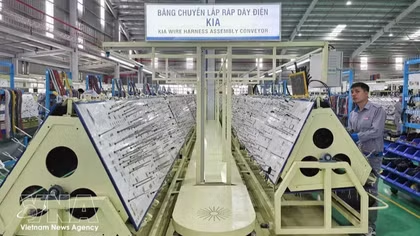
| According to WB's report, Vietnam’s economy continues to perform well, propelled by the sustained global recovery and continued domestic reforms. Robust growth is boosting job creation and income growth, leading to broad-based welfare gains and poverty reduction. Despite improved short-term prospects, external and domestic risks and longer-term challenges remain. These include risks of global financial volatility and rising protectionism as well as domestic vulnerabilities associated with remaining banking sector weaknesses, elevated public debt and limited fiscal space, and subdued productivity growth.Vietnam’s medium-term outlook has improved further, the WB said, adding that real GDP is now projected to expand by 6.8 percent in 2018 (up from 6.5 percent in the previous projection) before moderating to 6.6 percent in 2019 and 6.5 percent in 2020 due to the envisaged cyclical moderation of global demand. The WB expects the country’s inflation to remain around the 4-percent government target, predicated on some tightening of the monetary stance to counter price pressures emanating from domestic input price pressures and rising global commodity prices. |