Ensuring human rights in re-education of offenders

Re-educating convicted felons is a special education activity to help people in prison improve their awareness, attitude, and behavior in preparation for re-integrating into the community.

Vietnam supports humane treatment of prisoners through its policies, laws, and practical assistance programs.

In its platform, the Communist Party of Vietnam says: “People are the center of a country’s development strategy, and the subject of development. Human rights are respected, protected, and linked with the benefits of the nation and the people’s right of mastery”.
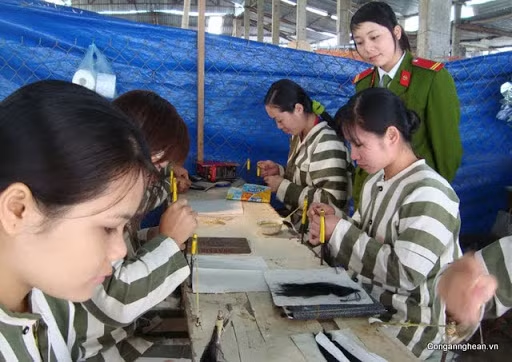
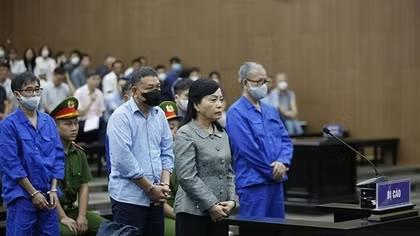
Photo: Congannghean.vn

The Vietnamese state has signed virtually all international treaties on basic human rights. These rights are the foundation for Vietnam’s amnesty and re-education programs and support for convicted felons re-integrating into the community.

Investing in re-education of felons

Since 1957 Vietnam has participated in four treaties of the Geneva Convention that establish standards of international law for humanitarian treatment in war and protection of war victims.

In 1981, when Vietnam was still subject to the US’s embargo, it signed the Convention on Elimination of All Forms of Racial Discrimination, the Convention on Elimination of All Forms of Discrimination Against Women, the Covenant on Economic, Cultural, and Social Rights, and the Covenant on Civil and Political Rights. In 1990, Vietnam signed the Convention on the Rights of the Child.

In 2014, Vietnam ratified the Convention against Torture and Other Cruel, Inhuman or Degrading Treatment or Punishment (commonly known as the UN Convention against Torture).

This required the government to invest in upgrading prisons, detention centers, improve prison conditions for detainees, and organize training classes for the disabled.

Ratification was pursuant to the 2013 Constitution’s chapter on human rights, and the fundamental rights and obligations of citizens.

To ensure the human rights of prisoners, the Vietnamese government issued a decree promulgating prison regulations and a decree amending and supplementing articles of the 1988 government custody regulations.

The amended 1988 Ordinance on the Enforcement of Imprisonment Penalties stipulates that detention centers must classify inmates according to the nature and seriousness of their crime. Female, juvenile inmates must be kept in a separate cell zone.

Detention centers must be carefully safeguarded, well-lit, and ensure sanitary. During their imprisonment term, prisoners should receive a medical check-up at least once a year, be involved in sports and cultural activities and have access to books, radio and TV.

Helping prisoners re-integrate into the community

In addition to ensuring their basic rights, Vietnam’s laws also mandate assistance to help prisoners re-integrate into the community.

The amended 1988 Ordinance provides that inmates can be made to work, learn a job, or study the law no more than 8 hours a day; the pay for inmates’ labor must, after deducting costs, be added to their food rations and welfare benefits; and reward funds must be distributed to inmates with outstanding work results or re-invested in work programs, education, and job training for inmates. Part of the reward fund must be used to help inmates re-integrate after they complete their prison terms.

If a felon exhibits good behavior during his incarceration, he may be freed ahead of his scheduled release date in accordance with the Law on Amnesty on the occasion of the Lunar New Year or Vietnamese National Day.

Between 2009 and 2015, Vietnam granted amnesty to 63,500 prisoners. In recent years, the Vietnamese state has promulgated many policies involving vocational training for inmates. Most of the inmates pardoned in 2015 were trained for a career before re-integrating. 

VOV

Other News

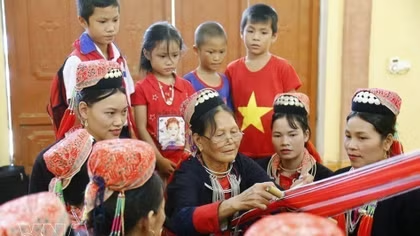
Vietnam steps up implementation of ethnic affairs strategy through 2030

Vietnam steps up implementation of ethnic affairs strategy through 2030

To accelerate the implementation of the the Ethnic Affairs Strategy by 2030, with a vision toward 2045, the Prime Minister requested ministries, agencies and local authorities to continue thoroughly carrying out the Party and State’s policies on ethnic affairs, enhancing the effectiveness of State management and strengthening oversight of policy implementation.

Security preparations reviewed for APEC 2027 in Phu Quoc

Security preparations reviewed for APEC 2027 in Phu Quoc

The team examined the APEC 2027 Convention Centre, where main conference activities are scheduled; Sun Serenia Hospital, designated to provide healthcare and emergency medical services for delegates; provincial road DT.975, which connects Phu Quoc International Airport to the convention centre; and the area surrounding Phu Quoc International Airport.

Hanoi accelerates seven Red River bridge projects, many exceed 70% completion

Hanoi accelerates seven Red River bridge projects, many exceed 70% completion

According to the municipal Transport Construction Investment Project Management Board, the city is simultaneously implementing seven projects, namely Tu Lien, Ngoc Hoi, Tran Hung Dao, Thuong Cat, Van Phuc, Hong Ha and Me So bridges. Construction is being carried out on multiple fronts, focusing on bored piles, pile caps, piers and superstructure works.

Dien Bien battlefield legacy powers tourism revival

Dien Bien battlefield legacy powers tourism revival

Seventy-two years after the Dien Bien Phu Victory, its legacy still reverberates. The unity, self-reliance, and resilience forged in that historic triumph remain a powerful internal engine, now propelling Dien Bien toward fast and sustainable development.

Hanoi accelerates shift to green buses, targets 100% by 2030

Hanoi accelerates shift to green buses, targets 100% by 2030

In the 2027–2030 period, the city will accelerate the transition towards the complete phase-out of fossil fuel-powered buses. The share of electric and green energy-fueled buses is projected to reach 79–89% by 2029 and 100% by 2030.

36 fishermen safely rescued after boat breaks down near Truong Sa

36 fishermen safely rescued after boat breaks down near Truong Sa

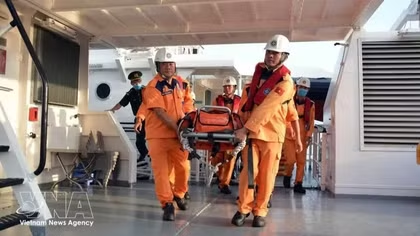
At 8:00 the same day, KN475 began towing the disabled fishing boat toward Da Tay A island. The towing operation was carried out safely, and by 18:30 both the vessel and its crew had arrived at the island without incident, where repairs and additional support procedures were arranged.

Vietnamese language contest in Laos strengthens youth ties, bilateral friendship

Vietnamese language contest in Laos strengthens youth ties, bilateral friendship

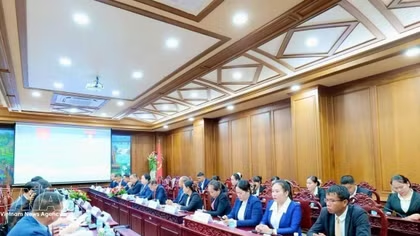
Held in response to the launch of the Vietnamese Language Day among overseas Vietnamese communities, the event aimed to enhance the quality of Vietnamese language teaching and learning in Laos while contributing to the great friendship, special solidarity, comprehensive cooperation and strategic cohesion between the two countries.

Vietnamese language contest in Laos strengthens youth ties, bilateral friendship

Vietnamese language contest in Laos strengthens youth ties, bilateral friendship

Held in response to the launch of the Vietnamese Language Day among overseas Vietnamese communities, the event aimed to enhance the quality of Vietnamese language teaching and learning in Laos while contributing to the great friendship, special solidarity, comprehensive cooperation and strategic cohesion between the two countries.

Hanoi launches 10 electric bus routes from April 1

Hanoi launches 10 electric bus routes from April 1

By the end of April, the number of buses using electricity and other green energy sources in the city is expected to reach 822, including 683 electric buses and 139 compressed natural gas (CNG) buses, representing 42.1% of the total number of vehicles.