EU-Canada free trade agreement in trouble

Three days after the parliament of the French Community of Belgium rejected the Comprehensive Economic and Trade Agreement (CETA) between the EU and Canada, thousands of Europeans took to the street to protest the deal.

The deal, which is a result of 7 years negotiations, is in jeopardy. 

On October 12, the Legislative Assembly of the French Community of Belgium approved a resolution vetoing the signing of a free trade agreement between the European Union and Canada. 

With 68 “yes” votes and 23 “no” votes, the Belgian regional parliament wants to prevent CETA from coming into force. 
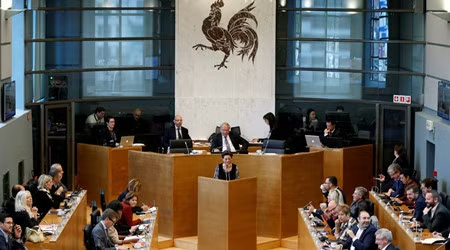
The Belgian government can only approve CETA when the deal is approved by all legislative assemblies at the federal, regional, and community levels. The rejection by French community of 4.5 million people is making the deal at risk. 

CETA needs the EU’s approval before being officially signed by an EU representative and Canadian Prime Minister Justin Trudeau on October 27, in Brussels.

On October 15, thousands of people demonstrated in France, Spain, and Poland to protest CETA and a more ambitious agreement between the EU and the US. 

Protesters were concerned of lowering the European standards on consumption and environmental protection and reducing jobs. 

They said the signing of CETA will create a dangerous precedent and pave the way for a similar deal with the US: the Trans-Atlantic Trade and Investment Partnership (TTIP). 

On September 20, from 9,000 to 15,000 CETA protesters gathered at the head office of the EU in Brussels. 

Protests were staged by trade unions and organizations, including the Federation for Human Rights, the Green Peace organization, the Farmers’ Union, and the Federation of French Language Students. 

They expressed their concerns over the possible impact on the rights of workers and other social rights and warned that a series of proposals stated in CETA may lead to pressure on the collective bargaining agreements. 

A source from the European Committee also expressed pessimism about the prospect of CETA approval, fearing that the deal will damage internal political issues.

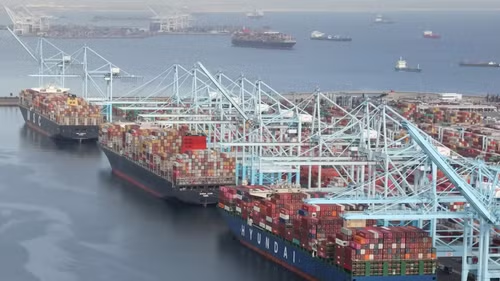
CETA is expected to increase the exchanges of goods and services between the EU and Canada by 20% and the GDP of the EU by more than 12 billion euros per year. 

But economic benefits appear unattractive to Europeans as long as their civil rights are threatened by the deal.
VOV5

Other News

Vietnam supports UNESCO's people-centred approach, multilateral cooperation: official

Vietnam supports UNESCO's people-centred approach, multilateral cooperation: official

Van affirmed Vietnam’s support for the UNESCO80 reform roadmap, focusing on the organisation’s core mandate, priority areas, interdisciplinary approach, and the special status of the Vietnam National Commission for UNESCO, and UNESCO representative offices, alongside efforts to diversify resources and strengthen global partnerships to enhance the organisation’s effectiveness.

Regional media highlight significant step in Vietnam’s leadership structure

Regional media highlight significant step in Vietnam’s leadership structure

Under General Secretary and President Lam’s leadership, Vietnam is expected to maintain a balanced foreign policy, strengthen its regional standing and accelerate economic development, thereby improving living standards and creating new opportunities for international investors, according to the India-based platform Devdiscourse.

Laos identifies 10 key tasks to build independent, self-reliant economy

Laos identifies 10 key tasks to build independent, self-reliant economy

Laos will step up agricultural production to ensure food security, meet domestic demand and expand exports; encourage the development of agro-processing industries, including those related to rubber, aquatic products, cassava and sugarcane, as well as fertiliser and animal feed production, in order to increase added value and create jobs in rural areas.

Malaysia steps up cyber security resilience

Malaysia steps up cyber security resilience

To ensure accountability, Malaysia plans to finalise the Cybercrime Bill this year which addresses both cyber-dependent and cyber-enabled offences, introducing stricter penalties and prison terms to enhance deterrence.

US public opinion positive about PM Pham Minh Chinh’s visit

US public opinion positive about PM Pham Minh Chinh’s visit

Public opinion in the US is generally positive about Vietnamese Prime Minister Pham Minh Chinh’s trip to the US from September 17-23 to attend the 78th session of the United Nations General Assembly, which took place immediately after the upgrading of the Vietnam - US relations to a comprehensive strategic partnership on the occasion of US President Joe Biden’s official visit to Vietnam.