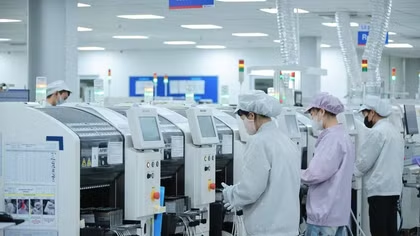
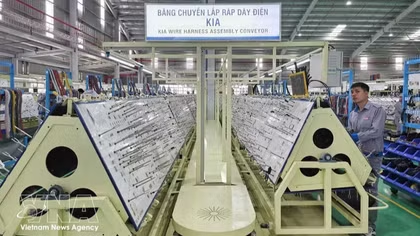
An Italy- invested Piaggio motorcycle assembly line in Vinh Phuc province
Stimulating flows of trade and investment
In contrast to a decline in imports from major markets such as the Republic of Korea (RoK), which reached US$28.7 billion, down by 8.3%, and ASEAN at US$19.4 billion, down 9.2%, the past eight months has seen the EU increase imports from the nation, with a value of US$ 9.5 billion, an annual rise of 4.7%.
Most notably, the implementation of the EVFTA from August 1 has served to stimulate trade and investment flows, with EU businesses taking advantage of the benefits of the trade pact to enjoy a range of economic upsides.
The prolonged impact of the novel coronavirus (COVID-19) has served to hinder trips by EU firms to the country. Due to there being no clear end to the epidemic, investment and trade connection activities have been occurring in a variety of ways, with as many as 100 Dutch businesses launching a range of online investment and trade activities with Vietnamese enterprises during the first week of September.
Joost Vrancken Peeters, chairman of the Netherlands-Vietnam Chamber of Commerce (NVCC), said that the European country attaches great importance to the Vietnamese market, as reflected by the capital amount invested into the Vietnamese market over the years.
As a means of making the most of the EVFTA, the Netherlands has conducted research on shifting investment and the diversification of supply sources. These are considered to be the main drivers and obstacles of Dutch enterprises when investing in the nation as they strive to find ways in which to overcome issues to open up investment activities.
Among the 27 EU member states already involved in investment activities locally, the Netherlands takes the lead in terms of registered capital. Indeed, by the end of 2019 the European nation had 344 projects worth a total of US$10.05 billion, making up 39.43% of the total EU investment capital in the Southeast Asian nation.
Furthermore, the Netherlands is also the EU's second largest trading partner in Vietnam, with bilateral trade in 2018 reaching US$7.8 billion, behind only Germany
In addition to the involvement of Dutch firms, Bulgaria also has a modest trade and investment relationship with the country and is actively seeking to increase commitments in line with the EVFTA.
Yana Topalova, the Bulgarian Deputy Minister of Economics, said that trade is very important for the Eastern European nation due to Vietnam significantly increasing its influence in the region as well as worldwide.
“Bulgarian businesses want to exploit the EVFTA to build strong trade ties from value chain creation. The Bulgarian Ministry of Economics and Government will continue to give incentives to Vietnamese businesses who invest in and have trade links with Bulgaria,” said Deputy Minister Topalova.
Vietnam seen as bridge to connect with ASEAN
Whilst EU firms seek to exploit the Vietnamese market due to fresh opportunities to promote investment and trade exchange through the EVFTA, many EU businesses also consider the country as a destination for investment connections to Southeast Asia.
According to experts, with the scale and development potential of EU countries, coupled with the establishment of the ASEAN Economic Community in late 2015, the country has the opportunity to become a transshipment area that connects commercial and investment activities of the EU in the region.
Nguyen Hai Minh, Vice President of the European Chamber of Commerce in Vietnam (EuroCham), affirmed the sectors that EU enterprises are paying special attention to. Many are utilising the EVFTA to promote exports whilst accelerating the implementation of investment projects in the nation due to EU businesses using relevant business and trade activities to build a bridge with ASEAN partners.
In the long run, the trend of increasing Vietnamese exports to the EU will certainly continue, because once the market is opened, additional European firms will seek to invest in the country, therefore leading to more businesses from third countries seeking to invest in the Southeast Asian nation.
At present, there is a list of enterprises exporting agricultural products from France, Belgium, and Poland, all of which are completing procedures in a bid to enter the Vietnamese market, although the tax reduction schedule for some items goes up to 10 years.
In line with commitments set out in the EVFTA, the country has immediately eliminated tariffs on 48.5% of tariff lines, accounting for 64.5% of imports from the EU. After seven years, 91.8% of tariff lines, equivalent to 97.1% of export turnover from the EU, will be abolished by the nation. After 10 years, the tariff removal will be approximately 98.3% of tariff lines, equivalent to 99.8% of import turnover.
Currently, a number of craft associations in EU nations are carrying out support activities aimed at helping firms shorten the time of procedure finalisation, gain licenses to export goods to Vietnam, whilst also taking advantage of incentives for products that have a roadmap for early tax reduction.
In terms of the agricultural sector, EU businesses are focusing on selling agricultural products, beef, and grains, all of which are in high demand in the country.