Polls suggest the vote will produce a more fragmented parliament than ever before, with the two centre-right and centre-left groups that have dominated Europe’s politics forecast to lose their joint majority for the first time, and nationalist and populist forces to make gains.
Both pro- and anti-EU politicians see the elections as a route to controlling Europe’s agenda. The French president, Emmanuel Macron, who is locked in domestic struggle with far-right leader Marine Le Pen, said the vote comes at “the most perilous moment for Europe since the second world war”.
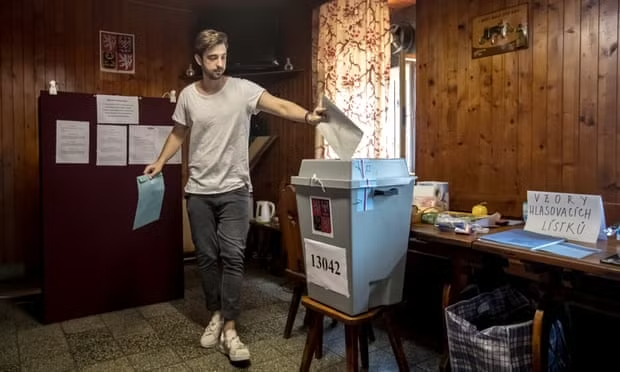 |
| A man casts his vote in Prague, the Czech Republic, on Saturday. Photograph: Martin Divíšek/EPA |
Urging young people to vote in a YouTube broadcast hours before the campaign formally closed, the pro-European centrist – who defeated Le Pen in the second round of France’s 2017 presidential election, but whose popularity has waned amid anti-government protests – insisted on Friday it was “26 May or never!”
With the centre-right EPP and centre-left S&D groups set to shed seats and fall short of a joint majority without the backing of a third – and possibly a fourth – partner in the 751-seat parliament, the influence of the pro-European Liberals (ALDE) and Greens is likely to increase.
But the performance of Europe’s far-right populist parties, who along with an array of conservative nationalists and far-left Eurosceptics are on course to win as many as a third of the parliament’s seats, will be closely watched, even if observers doubt they will be able to form a coherent opposition bloc.
Among other national contests that could prove key, Italian deputy prime minister Matteo Salvini’s hardline anti-immigration policies are increasingly contested not just by his EU partners and the centre-left opposition, but by his coalition partners, the anti-establishment Five Star Movement (M5S). His polling has recently slid.
Salvini’s hopes of forging a populist parliamentary alliance between his far-right League, Le Pen’s National Rally, Germany’s Alternative für Deutschland (AfD) and other nationalist parties have also been hit by a corruption scandal that forced Austria’s Freedom Party (FPO) out of government last week and has severely dented its popularity.
“A European election campaign has never felt like this before,” said Gualtieri Pinci after casting his vote at a polling station in central Rome. “Right up until the moment I entered the booth, I didn’t know who to vote for. Politically, everything is very confusing, no party has a clear vision, just lots of vague declarations. I like Europe and regret what I see happening in the UK.”
Turnout in Italy was at 16.72% by around midday. Salvini flouted the rules on electoral silence with a flurry of tweets hash-tagged #voteleaguetoday. “The Europe of finance has failed, today Italy is raising its head,” he wrote in one. “With the Democratic Party and leftwing governments, bureaucrats and bankers won.”
In Germany, Angela Merkel’s centre-left SPD coalition partners could finish third behind the chancellor’s centre-right CDU party, putting pressure on her government, while in Spain, prime minister Pedro Sánchez is looking to repeat the triumph of his Socialist party in last month’s general election as he seeks for form an administration.
In Spain voters are heading to the ballot box for a “Super-Sunday” of European, regional and municipal elections today, less than a month after the country’s third general election in under four years.
By 2pm local time, participation stood at 34.8%, well up on the 23.9% at the same point five years ago.
The ruling socialist party, led by acting prime minister Pedro Sánchez, will be hoping for a honeymoon effect after it won the most votes last month, but fell short of a majority in congress.
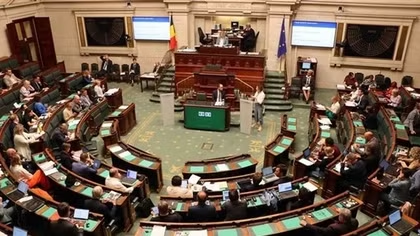
The European parliament, which along with the council of ministers – government members from all 28 member states – can amend or block EU legislation, also has considerable clout in approving and supervising the European commission.
As the bloc faces multiple challenges – including migration, the climate crisis, faltering economic growth, indebted banks, the rise of China, a hostile and unpredictable US president, Brexit and its own internal divisions – the parliament’s role could prove critical in shaping the bloc’s next five years.
More than 426 million people across the continent are eligible to vote in the elections. The UK and the Netherlands fired the starting gun on Thursday, followed by Ireland and the Czech Republic on Friday.
Latvia, Malta and Slovakia joined in on Saturday, while the remainder – including EU giants France and Germany, and keenly watched Italy – cast their ballots on Sunday. Turnout could be critical to the outcome, but may struggle to reach 45%.
Early exit polls and partial results from countries that have already voted are expected from about 5pm UK time, with more complete results and projections for how the parliament will look following later.