EU’s stronger trade protection more likely

The European Union (EU) appears to be ready to impose anti-dumping tariffs as the Netherlands and Austria on November 11 signaled that they supported the EU’s anti-dumping measure.

If approved by the majority of EU members by the end of 2016, the EU’s trade policy will have a significant change. 

The UK has over the years said that the imposition of anti-dumping tariff on imported goods was unnecessary for fear of trade protectionism. 
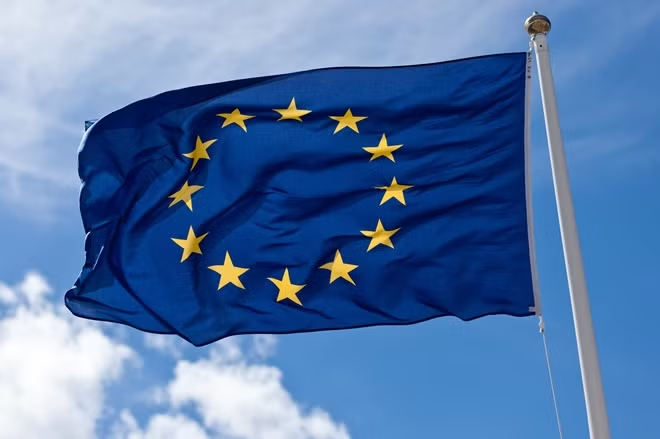
The EU’s trade policy will have a significant change. (Photo: Internet)

However, after Brexit, a small group of countries led by the UK changed their mind, facilitating the EU to approve anti-dumping duties. 

Slovak Minister of Economy Peter Ziga said, "Europe cannot be naive and must protect its interests especially when it comes to dumping." 

He suggested the EU adjust its trade protection measures which have been in place for 15 years because the world market has changed deeply and comprehensively.

The European Commission, France, and Germany have calculated the dumping margins to protect domestic production, including the steel industry, whose jobs have dropped 20% from 2008.  

The proposed method for calculating dumping margins is viewed as neutral and fair for both market and non-market economies. 

The new method will be applied to all cases once the EU’s revised regulations on anti-dumping duties take effect. 

EU Trade Commissioner Cecilia Malmstrom described the measure as important because it shows the EU’s compliance with its WTO commitments.

Analysts say the first country to be impacted may be China which the EU has accused of selling their steel products at unfairly low prices to gain its competitive edge. But there are concerns of Beijing’s trade retaliation. 

On October 10, when the EU imposed anti-dumping duties on two types of steel imported from China, the Chinese Ministry of Trade said the premature steps taken such as trade protection and restriction of fair competitions are not on the right direction for the EU steel industry’s development.

One month is left until the EU members will vote on its anti-dumping duties decision.
VOV5

Other News

Vietnam supports UNESCO's people-centred approach, multilateral cooperation: official

Vietnam supports UNESCO's people-centred approach, multilateral cooperation: official

Van affirmed Vietnam’s support for the UNESCO80 reform roadmap, focusing on the organisation’s core mandate, priority areas, interdisciplinary approach, and the special status of the Vietnam National Commission for UNESCO, and UNESCO representative offices, alongside efforts to diversify resources and strengthen global partnerships to enhance the organisation’s effectiveness.

Regional media highlight significant step in Vietnam’s leadership structure

Regional media highlight significant step in Vietnam’s leadership structure

Under General Secretary and President Lam’s leadership, Vietnam is expected to maintain a balanced foreign policy, strengthen its regional standing and accelerate economic development, thereby improving living standards and creating new opportunities for international investors, according to the India-based platform Devdiscourse.

Laos identifies 10 key tasks to build independent, self-reliant economy

Laos identifies 10 key tasks to build independent, self-reliant economy

Laos will step up agricultural production to ensure food security, meet domestic demand and expand exports; encourage the development of agro-processing industries, including those related to rubber, aquatic products, cassava and sugarcane, as well as fertiliser and animal feed production, in order to increase added value and create jobs in rural areas.

Malaysia steps up cyber security resilience

Malaysia steps up cyber security resilience

To ensure accountability, Malaysia plans to finalise the Cybercrime Bill this year which addresses both cyber-dependent and cyber-enabled offences, introducing stricter penalties and prison terms to enhance deterrence.

US public opinion positive about PM Pham Minh Chinh’s visit

US public opinion positive about PM Pham Minh Chinh’s visit

Public opinion in the US is generally positive about Vietnamese Prime Minister Pham Minh Chinh’s trip to the US from September 17-23 to attend the 78th session of the United Nations General Assembly, which took place immediately after the upgrading of the Vietnam - US relations to a comprehensive strategic partnership on the occasion of US President Joe Biden’s official visit to Vietnam.