 |
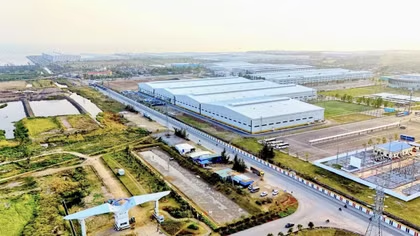
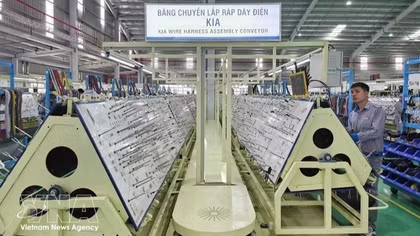
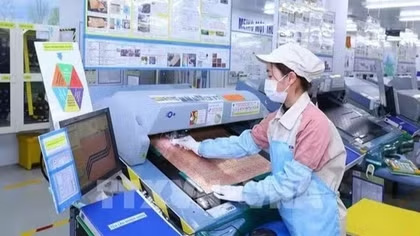
Foreign-invested enterprises (FDI) in Vietnam have been maintaining production despite difficulties caused by the COVID-19 outbreak while preparing plans to recover after the pandemic ends.
Like domestic enterprises, the disruption of China’s manufacturing network and falling demand from foreign partners have forced foreign-invested firms to scale down operations.
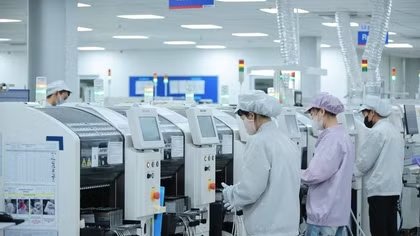
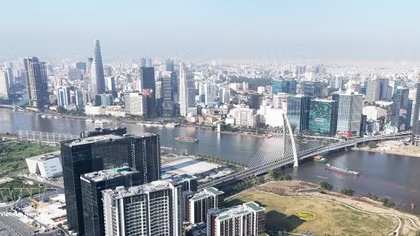
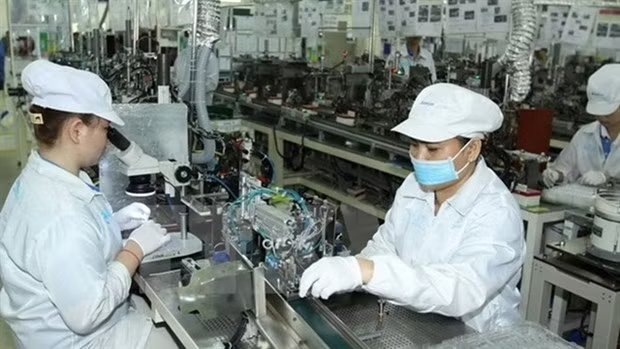
Denmark-invested Sonion Vietnam Co Ltd, an electronics manufacturer in Saigon Hi-Tech Park (SHTP) in HCM City, has re-organised production by reducing operating capacity and trying to decrease the number of defective products.
According to Jason King, Sonion Vietnam’s general director, the pandemic impacting the company is inevitable but it will quickly restore full operation and compensate for the productivity shortage as soon as the Government brings the outbreak under control.
Having previously suspected the Vietnamese Government’s outbreak control measures were overreacting, Kim Dong Hwan, general director of Deayoung Electronics Vina, now strongly believes Vietnam will successfully control the pandemic and production will soon recover.
While the shortage of inputs has cut production and postponed plans for recruitment and personnel training, Hwan said the company still encouraged employees to work and focus on improving productivity and avoiding defective goods to ensure the number of orders.
“Production was reorganized to focus on the multi-purpose production process, improving facilities to enable joint production and utilizing the best available resources,” Hwan said, adding that the company was also seeking new markets and preparing alternative plans for markets seriously affected by the outbreak.
After the pandemic, Deayoung Electronics Vina will prioritize research and development of products to serve the global market as demand for electronic components will surge after the world manufacturing industry resumes operation, he said.
Kim Yun Yeop, deputy general manager of Samsung HCMC CE Complex, is also optimistic about new opportunities after the pandemic. While most Samsung factories globally are affected by the virus outbreak, Samsung’s factories in Vietnam have maintained stable production, though some workers at one factory have been quarantined due to one reported infection.
“At present when the market demand has decreased, it’s favorable to implement social distancing without affecting orders. We’ve tried to take maximum measures to protect the workers’ health, keep stability so that after the pandemic is over, we will quickly increase the global market share which is affected by the outbreak,” Yeop was quoted as saying on baochinhphu.vn.
Le Bich Loan, deputy director of the SHTP Management Board, said the park authority was working with companies to tackle their problems and facilitate their production after the pandemic.
“After the pandemic is over, production demand will increase sharply and workers will have to work overtime. We have proposed the Prime Minister extend overtime hours for workers,” Loan said.
According to HCM City’s Department of Labor, War Invalids and Social Affairs, businesses need to prove the need to increase working hours due to the sudden increase in orders. However, in the current context, this could be allowed because of force majeure reasons, she said.
Despite the grim situation, the production value of the foreign direct investment enterprises in SHTP in the first quarter exceeded 4 billion USD, up 19.3 percent year-on-year, equivalent to 20 percent of the yearly plan.
Up to now, no job losses have happened among more than 45,600 employees at the Hi-Tech park, though about 1,950 employees have had to take leave due to work rotations or raw material shortages. Loan said businesses had reached an agreement with workers to let them return to work right after the pandemic.
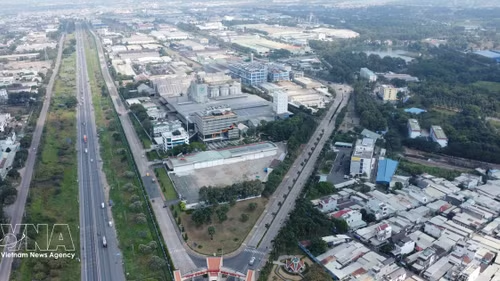
Meanwhile, FDI enterprises in Dong Nai province are also maneuvering to maintain production and apply measures to prevent and control the outbreak while preparing to restore and expand production to compensate for their losses after the pandemic is over.
A representative of Hyosung Vietnam Co Ltd, the biggest FDI enterprise in the province with total capital of nearly 1.5 billion USD, said since early this month, the company’s employees had been working on rotation. Though some factories had to halt production, it was expected that at the beginning of the third quarter, the pandemic would be put under control so production and export activities would recover.
Wu Ming Ying, chairman of Taiwan Business Association in Dong Nai province, said: “About 60 percent of Taiwanese enterprises in Dong Nai said they were affected by the COVID-19 pandemic. However, enterprises only reduce capacity and working hours and still maintain production. When the pandemic is controlled in the world, they will restore production and expand exports.”