Female workers still barred from some jobs

When Bui Thi Mai of Nam Dinh Province was unable to find a job that allowed her to make use of her two-year medical diploma, she settled for a job as a factory worker at a local industrial park.
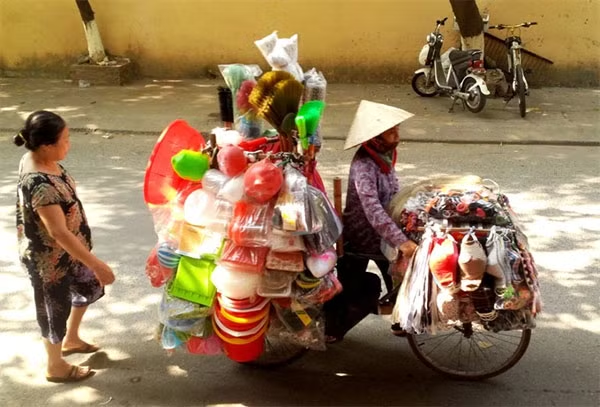
A street hawker sells household appliances in Hanoi. Street hawkers in Vietnam belong to the informal sector whose jobs are unprotected and unmonitored by the State. — VNS Photo Doan Tung
A street hawker sells household appliances in Hanoi. Street hawkers in Vietnam belong to the informal sector whose jobs are unprotected and unmonitored by the State. — VNS Photo Doan Tung 

The job search was tough. She found several well-paid jobs with reasonable work hours, but the recruiters specified that they would only hire male candidates.

“A lot of jobs had physical requirements for female candidates, like you have to be at least 1.5-metre tall and weigh at least 42kg,” Mai told the Lao Dong (Labour) newspaper. “I weighed about 40kg at that time, so I was unqualified right from the start.”

Female labourers in Vietnam face gender discrimination in work and life, according to a recent report published by the Network of Actions for Migrant Workers (M.net). Several employers deliberately recruit either only male candidates, or female ones that have already had children so that they will not have to pay them their birth allowance, the report said.

A recent study conducted by the network shows that despite having the same qualifications and job levels, the average income of female workers in Vietnam is 10.7 per cent lower than their male counterparts.

The discrepancy is wider in jobs that require higher levels of education. In 2016, while the difference between the incomes of male and female high school graduates was 8.1 per cent, it stood at 19.7 per cent for those with university degrees. The income of women in managerial positions is about 12 per cent lower than their male counterparts, according to the report.

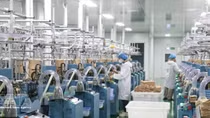
More women are working in more hazardous environment than men, the report said. About 59 per cent of waged male workers have labour contracts, while only 50 per cent of their female counterparts do. More than 68 per cent of female workers in shoe export factories have had gynecological infections due to the hot, unhygienic environment, high work pressure and the lack of hygiene facilities for women, according to the report.

The working conditions are worse for female workers in the informal sector, such as domestic helpers and street hawkers. Earning only VND4-6 million (US$176-264) per month, more often than not, these workers are unaware that they need to have labour contracts and that they have other rights and benefits apart from getting paid.

“We don’t know about the different types of insurance. No one ever told us about them,” said Tran Thi Chuc, 37, a domestic helper in Hanoi.

“I do wonder how I will make a living 10 years from now when I lose all my physical strength,” she added. “But I did not dare ask my employer for anything more than salary.”

Duong Thi Van, 36, a street hawker selling flowers in Bac Giang Province, said that she thinks only women would agree to the menial jobs such as housekeeping, hawking and washing dishes at restaurants.

“The nature of these jobs make us more self-deprecating and suffer from more disadvantages than men,” she said.

Ngo Thi Ngoc Anh, director of the Community Development and Family – Gender Research Centre (GFCD), said that a fair and just perspective from policy makers is much needed to create equal opportunities for all labourers in the country.

“It is absolutely important to give informal labourers access to social security policies such as social insurance and voluntary life insurance,” she said.

Pham Minh Huan, former Deputy Minister of Labour, Invalids and Social Affairs, said that ensuring the rights for formal and informal labourers is a long-term problem that needs to be tackled thoroughly.

He advised that the scope of the Labour Code be expanded to the informal sector so as to better protect informal labourers.

The employers play a major part in ensuring equal opportunities for female labourers, he added.

“They should embrace social responsibility, and not think of using female labourers without considering how they would ensure their benefits,” he said. 

VNS

Other News

Vietnam steps up implementation of ethnic affairs strategy through 2030

Vietnam steps up implementation of ethnic affairs strategy through 2030

To accelerate the implementation of the the Ethnic Affairs Strategy by 2030, with a vision toward 2045, the Prime Minister requested ministries, agencies and local authorities to continue thoroughly carrying out the Party and State’s policies on ethnic affairs, enhancing the effectiveness of State management and strengthening oversight of policy implementation.

Security preparations reviewed for APEC 2027 in Phu Quoc

Security preparations reviewed for APEC 2027 in Phu Quoc

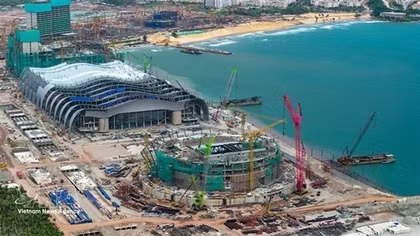
The team examined the APEC 2027 Convention Centre, where main conference activities are scheduled; Sun Serenia Hospital, designated to provide healthcare and emergency medical services for delegates; provincial road DT.975, which connects Phu Quoc International Airport to the convention centre; and the area surrounding Phu Quoc International Airport.

Hanoi accelerates seven Red River bridge projects, many exceed 70% completion

Hanoi accelerates seven Red River bridge projects, many exceed 70% completion

According to the municipal Transport Construction Investment Project Management Board, the city is simultaneously implementing seven projects, namely Tu Lien, Ngoc Hoi, Tran Hung Dao, Thuong Cat, Van Phuc, Hong Ha and Me So bridges. Construction is being carried out on multiple fronts, focusing on bored piles, pile caps, piers and superstructure works.

Dien Bien battlefield legacy powers tourism revival

Dien Bien battlefield legacy powers tourism revival

Seventy-two years after the Dien Bien Phu Victory, its legacy still reverberates. The unity, self-reliance, and resilience forged in that historic triumph remain a powerful internal engine, now propelling Dien Bien toward fast and sustainable development.

Hanoi accelerates shift to green buses, targets 100% by 2030

Hanoi accelerates shift to green buses, targets 100% by 2030

In the 2027–2030 period, the city will accelerate the transition towards the complete phase-out of fossil fuel-powered buses. The share of electric and green energy-fueled buses is projected to reach 79–89% by 2029 and 100% by 2030.

36 fishermen safely rescued after boat breaks down near Truong Sa

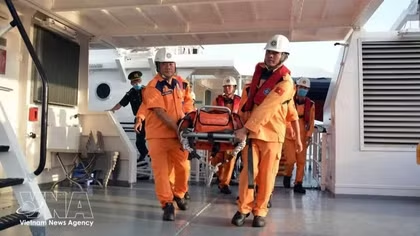
36 fishermen safely rescued after boat breaks down near Truong Sa

At 8:00 the same day, KN475 began towing the disabled fishing boat toward Da Tay A island. The towing operation was carried out safely, and by 18:30 both the vessel and its crew had arrived at the island without incident, where repairs and additional support procedures were arranged.

Vietnamese language contest in Laos strengthens youth ties, bilateral friendship

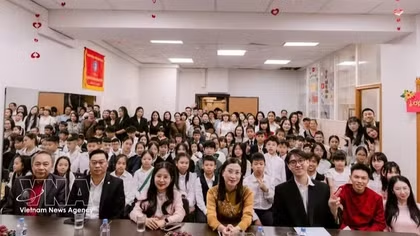
Vietnamese language contest in Laos strengthens youth ties, bilateral friendship

Held in response to the launch of the Vietnamese Language Day among overseas Vietnamese communities, the event aimed to enhance the quality of Vietnamese language teaching and learning in Laos while contributing to the great friendship, special solidarity, comprehensive cooperation and strategic cohesion between the two countries.

Vietnamese language contest in Laos strengthens youth ties, bilateral friendship

Vietnamese language contest in Laos strengthens youth ties, bilateral friendship

Held in response to the launch of the Vietnamese Language Day among overseas Vietnamese communities, the event aimed to enhance the quality of Vietnamese language teaching and learning in Laos while contributing to the great friendship, special solidarity, comprehensive cooperation and strategic cohesion between the two countries.

Hanoi launches 10 electric bus routes from April 1

Hanoi launches 10 electric bus routes from April 1

By the end of April, the number of buses using electricity and other green energy sources in the city is expected to reach 822, including 683 electric buses and 139 compressed natural gas (CNG) buses, representing 42.1% of the total number of vehicles.