“Cuba is willing to devote blood for Vietnam” is among famous statements of Cuban revolutionary leader Fidel Castrol, a name that Vietnamese people always keep in their mind with love, admiration and deep sympathy.
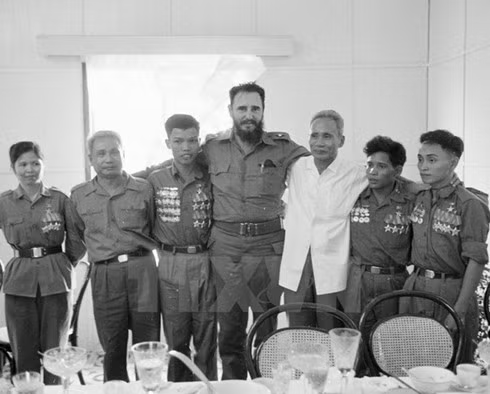 |
| Late Cuban leader Fidel Castro (middle), late Prime Minister Pham Van Dong (in white) and Vietnamese reporters in Quang Tri in 1973 |
For decades, Fidel Castro had been a symbol of revolutionary heroism, spirit of undaunted struggle and desire for freedom and happiness.
Under the leadership of Fidel, Cuba was the pioneer in the world movement of supporting Vietnam’s struggle for independence as well as national construction. Cuba was also the first country to recognize the National Liberation Front of South Vietnam in December 1961, as well as the first and only to set up its embassy to the front in September 1963.
During that period, Cuba also faced many difficulties. However, during a meeting in Havana with the participation of tens of thousands of people, Fidel Castro stated that “unfortunately, we - Cuban people – do not have enough milk and sugar to send to Vietnamese people. If we have, we will send not only milk and sugar but also our blood”.
The year 1976 was named “Heroic Vietnam Year” by Cuba as part of its support to Vietnam. In 1972 when the dyke system in the northern of Vietnam was destroyed by the US enemy, Cuba took August 28 as the “Dyke Day” and launched a campaign to denounce the crimes of the imperialism.
The leader reaffirmed that “our solidarity with, our trust in Vietnamese people and leaders is unconditional and absolute.”
In September 1973, Fidel Castro was the first and only foreign leader to visit the southern liberation area of Vietnam when the war was ongoing, bringing a great encouragement to Vietnamese soldiers and people and a promise to help realise President Ho Chi Minh’s wish to build a more prosperous country. This showed the special sentiments of him and Cuban people towards Vietnam and its national liberation.
The image of the Cuban commander-in-chief, in his olive uniform, standing in an enemy’s blockhouse raising the flag of the National Liberation Front of South Vietnam, became an extremely impressive image and a source of encouragement to Vietnamese people then.
During hardest period of the anti-US revolution, Fidel’s saying “Cuba is willing to devote blood for Vietnam” melt the hearts of Vietnamese and Cuban people as well as peace-lovers around the world. The Cuban leader and people considered Vietnam’s struggle as their own.
Also in his first visit to Vietnam, Fidel Castro presented Vietnam with five important socio-economic works: Thang Loi Hotel in Hanoi, Vietnam-Cuba Hospital in Quang Binh, Xuan Mai Road, Ba Vi cow breeding farm, and a Luong My chicken factory.
He also gifted Vietnam cow and chicken breed, along with more than 6 million USD for buying modern production equipment. At the same time, Cuba also sent experts to Vietnam to join the construction of Ho Chi Minh Trail and train more than 1,000 Vietnamese university students and post-graduates. Cuba also supported Vietnam in joining the United Nations.
Fidel Castro’s next visits to Vietnam were in December 1995 and February 2003, during which the friendship and cooperation between the two countries witnessed new development milestones.
Through the visits, the Cuban leader always affirmed that Cuba sees Vietnam as its close brother and friend, and the solidarity, friendship and comprehensive partnership between the two countries will continue to thrive.
Despite the long distance, the warm sentiments and faithful friendship that Fidel Castro given to Vietnam will stay forever in the hearts of generations of Vietnamese people. For them, Fidel Castro is always a great friend.


Singapore is considering introducing daily limits on social media use for young people, along with other mandatory measures aimed at curbing addictive features and potentially harmful online interactions involving those under 18.

In January-May, bilateral trade between Vietnam and Russia was around 2.16 billion USD, up 6.6%. The two Governments are aiming for 10 billion USD in two-way trade on the back of the Vietnam-Eurasian Economic Union Free Trade Agreement.
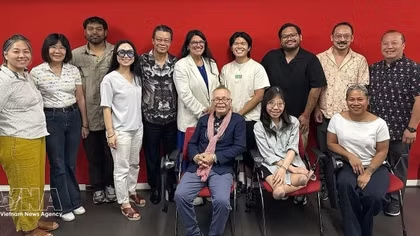
A delegation from the Vietnam Association for Victims of Agent Orange/dioxin's chapter in Ho Chi Minh City (VAVA HCMC) visited the US directly inform American friends about the long-term consequences of AO/dioxin in Vietnam and seek the support of progressive groups, veterans, legal experts and youth organisations in efforts to care for the victims.
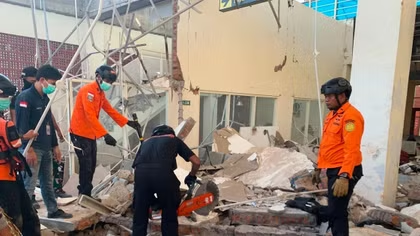
The earthquake struck off Flores Island near Mbay town in Nagekeo district, East Nusa Tenggara province, triggering strong aftershocks. Several houses and other structures were damaged, while landslides disrupted roads in some areas.
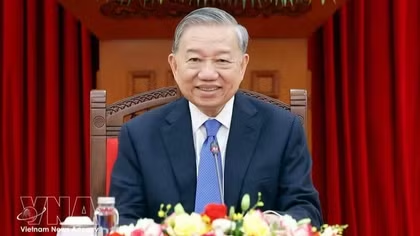
The jury unanimously voted on July 24 to confer the prestigious award on the Vietnamese leader, citing his role in "strengthening peace and cooperation among nations."
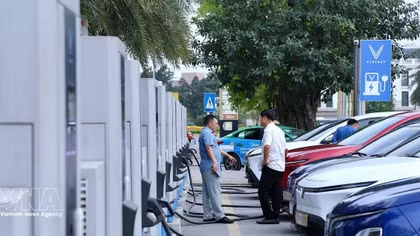
Vietnam has adopted a more comprehensive approach to developing its EV industry by maintaining long-term investment incentives, investing in industrial infrastructure, developing human resources, and gradually building a high-tech manufacturing ecosystem, according to a recent article on The Jakarta Post.
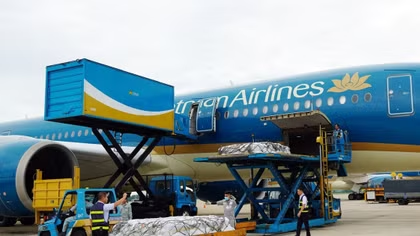
The embassy said on its official X account that the flight carrying the victims' mortal remains departed Ho Chi Minh City on July 13 and arrived in Mumbai later the same day. Authorities in the Indian states of Andhra Pradesh, Kerala and Tamil Nadu coordinated the transportation of the remains to their final destinations.
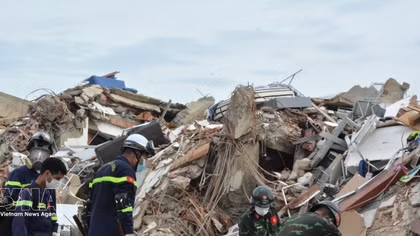
All members of the Vietnamese rescue team in Venezuela have maintained strict discipline, a strong sense of responsibility and unwavering focus when carrying out search, rescue and disaster recovery tasks, with the determination to successfully fulfil the international humanitarian mission entrusted by the Party, State and military.
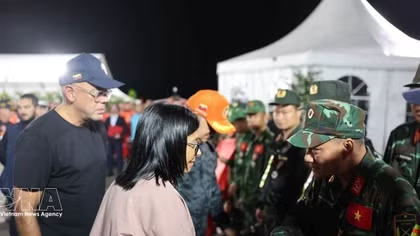
Through Vietnamese Ambassador to Venezuela Vu Trung My, Acting President Delcy Rodriguez sent a letter of gratitude and presented the "Hero of Venezuela" medal to Party General Secretary and State President To Lam.

PSNews - Nearly six decades after its founding, ASEAN is entering a new phase of transformation. Geopolitical turbulence, intensifying competition among major powers, non-traditional security challenges, and rapid technological change are raising fundamental questions about the region’s future trajectory. In this context, the ASEAN Future Forum (AFF) 2026 is more than a platform for regional countries to discuss current issues; it is designed to identify strategic pathways for ASEAN in the years ahead.
Under the new rules, social media platforms are required to implement age-verification systems and prevent users under 16 from creating accounts. The regulations apply to platforms with at least eight million users in Malaysia, including Facebook, Instagram, TikTok and YouTube.
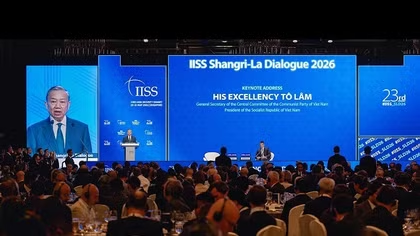
Associate Professor Dr. Neak Chandarith said General Secretary and President To Lam demonstrated a clear understanding of global challenges and presented a balanced voice that advocates sovereignty, equality and fairness for small and middle-sized nations amid an increasingly uncertain international environment.
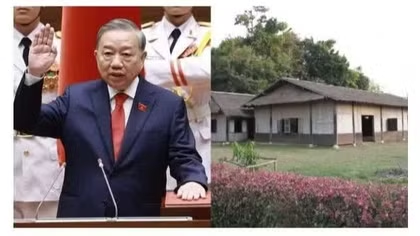
President Ho Chi Minh arrived in Thailand in 1928 while Vietnam was still under French colonial rule. During his time in Udon Thani, he reportedly lived among the local Vietnamese community while organising political activities and seeking support for Vietnam’s independence movement.
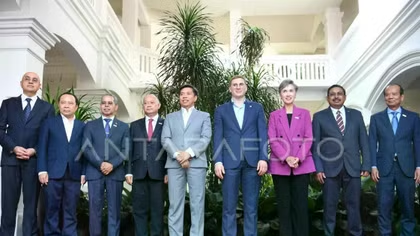
Ministers and industry leaders identified opportunities to strengthen cooperation in AI development and governance, including how the US AI Exports Programme can support ASEAN member states’ AI policy development.
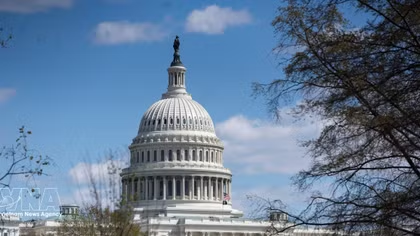
Jennifer Wicks McNamara was nominated by President Donald Trump to replace Marc E. Knapper, whose term ended earlier this year.
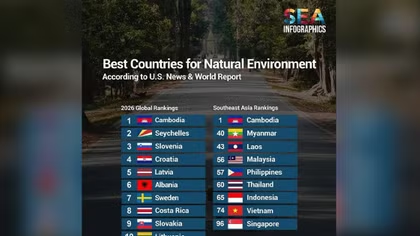
Cambodia currently manages 73 protected natural areas covering more than seven million hectares, equivalent to about 41% of the country’s total land area. These protected areas play a vital role in forest conservation, wildlife habitat protection and biodiversity preservation through stricter law enforcement and conservation measures.
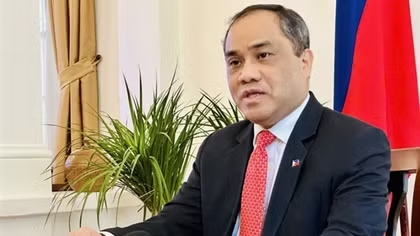
"We hope that the Prime Minister will be able to share his thoughts and his opinions on how the region will be able to sustain its economic growth and development, notwithstanding the challenges we are facing arising from various regional conflicts happening", said Philippine Ambassador to Vietnam Francisco Noel R. Fernandez III.
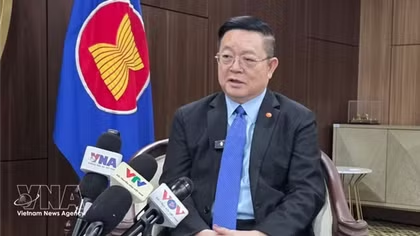
Vietnam is expected to maintain active contributions across ASEAN’s three pillars - the political-security community, the economic community, and the socio-cultural community; while further enhancing regional connectivity through infrastructure projects and stronger economic linkages.
Van affirmed Vietnam’s support for the UNESCO80 reform roadmap, focusing on the organisation’s core mandate, priority areas, interdisciplinary approach, and the special status of the Vietnam National Commission for UNESCO, and UNESCO representative offices, alongside efforts to diversify resources and strengthen global partnerships to enhance the organisation’s effectiveness.
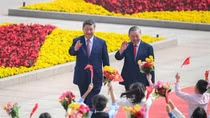
Major outlets including China Central Television, Xinhua News Agency, People's Daily and China Daily on April 15 prominently reported on the high-level engagements, highlighting their significance for bilateral relations.