While financial resources are constrained from the state side, channelling investment into green projects through the issuance of green bonds may be what it takes for the economic development of the ASEAN bloc in general and Vietnam in particular to be greener and more socially and environmentally sustainable.

Great capital demand
According to the United Nations Environment Programme, global capital demand for implementing sustainable development goals is estimated at US$5-7 trillion a year, with a US$2.5 trillion annual financing gap for key infrastructure sectors and related areas in developing markets.
In a bid to shift Vietnam’s economic growth into a sustainable lane from its current carbon-intensive and environmentally-unfriendly expansion, the country would need roughly US$30.7 billion by 2020 and possibly US$21.2 billion for the following 10 years to support its Intended Nationally Determined Contribution (INC), according to the German development agency GIZ.
Some 30% of the credit requirement for green growth would come from the state budget, consisting of central and provincial funds as well as official development assistance (ODA), whilst the remainder will have to be sourced from the private sector, according to Pham Hoang Mai, director general of the Department of Science, Education, Natural Resources and Environment under the Ministry of Planning and Investment (MPI).
Local commitment
With this in mind, the capital market can play a vital role to contribute to the Vietnam Green Growth Strategy (VGGS), approved by the government for the 2011-2020 period. Simply put, it will channel funds specifically for green projects and green companies, create a platform for green products’ derivatives trading, as well as leverage private sector investment by means of issuing green bonds, possibly facilitated by both the corporate and the local government sectors.
Actions taken so far by local capital market regulators include strengthening the environmental and social disclosures through the introduction of guidelines and handbooks for sustainability reporting for listed companies, as well as mandatory environmental and social (E&S) disclosure in the annual reports of listed companies.
On the other hand, the development of green products and services is aided by the use of Sustainability Indexes for portfolio investment references and green bond issuance plans at provincial governments and enterprises.
On an international scale, both local bourses (HSX and HNX) joined the Sustainable Stock Exchange Initiative in 2014, in an effort toward the sustainable development of the global capital market. Moreover, the country also actively contributed toward the ASEAN Capital Markets Forum (ACMF) in promoting sustainable development and green capital markets. The ASEAN Green Bond Standards (AGBS) have been circulated to listed companies as well as central and local agencies across Vietnam.
According to the State Securities Commission (SSC), aside from introducing the standards to market players, the commission is working on specific guidelines for the local securities market in line with AGBS and looking into further cooperation with ACMF members on an ASEAN green asset class.
In addition, training for local participants on green bonds will be provided, with regards to initiating green bond projects and subsequent issuances as well as integrating the environmental, social, and corporate governance risks and impact assessments along the stages of issuance and project implementation. The authority also looks into a regulatory framework for green bonds at a later point in time.
Meanwhile, for issuers of green bond like banks, Kyle Kelhofer, IFC country manager for Vietnam, Cambodia, and Laos, noted that should a commercial bank move forward with a green bond project, it will go ahead of its competitors in terms of “differentiating itself as being more progressive, more sophisticated, and more sensitive to everybody.”
“So I think it is a great opportunity not just for clients in Vietnam but also for finance entities and partners, as they are able to work with a bank that is sophisticated enough to properly classify green assets and issue green bonds. Plus, the issuance of green bonds is one of the checkmark approvals,” said Kelhofer. “Secondly, there are funds out there in the international market that are keen on investing in green instruments.”
In the view of the IFC’s country head, it is definitely possible to have one or two cases of green bond issuance within the next six to twelve months. “It is how Vietnam can leverage another financial tool to lower the cost of capital. We all want to have our loans less costly, not only to attract both foreign and domestic investment.”
Also, it is a good stamp of approval on the sophistication of the Vietnamese economy and its business climate. Vietnam is a very fast emerging market,” Kelhofer added.
Foreign attraction
The issuance of green bonds is expected to attract foreign investors interested in the field of green investments in Vietnam.
In a previous interview with VIR, Thomas Debelic, senior representative of Commerzbank AG’s representative office for Vietnam, Cambodia, and Laos, noted that European companies which bear the characteristics of family-owned small- to medium-sized enterprises and a renewable energy orientation have started exploring access to the Vietnamese market, or are even already preparing their market entry with sustainable products and services in the field of photovoltaic energy, green building or wastewater treatment.
“Commerzbank has already started communication and an exchange of experiences in the field of green banking. Topics like the emission of green bonds were taken up with Vietnamese government institutions. We are confident that the green initiative in Vietnam will meet foreign investors’ interests and prove successful in the coming years,” said Debelic at the time.
The objective of the ASEAN Capital Markets Forum (ACMF) is to promote sustainable growth and link ASEAN markets with one another. Therefore, the capital market is an important source of funding for the economy, contributing to sustainable growth through the allocation of funds to environmentally-friendly projects.
The ASEAN Green Bond Standards (AGBS) were developed and launched in November 2017 to set common standards for the issuance of ASEAN green bonds, to contribute to the common goals of integration and connectivity and towards growth in ASEAN.
Following the launch of AGBS, there have been four issuances of bonds and Islamic bonds (sukuk bonds) that are labelled as ASEAN Green Bonds, carried out by companies in Malaysia, Singapore, and Indonesia. Funds raised from these green bond issuances will be allocated to environment-related projects such as renewable energy, waste management, and green buildings, transportation, and airports, which meet the criteria for sustainability standards.

Under Document No. 10065/VPCP-KGVX, the Deputy PM agreed with proposals by the Ministry of Home Affairs for a one-day holiday for Vietnamese Culture Day in 2026, and a seven-day Tet holiday and a four-day National Day holiday in 2027.
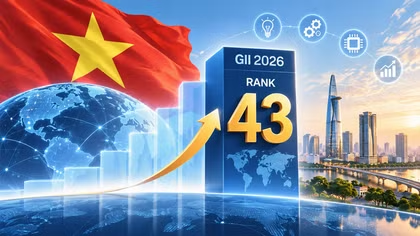
By 2030, Vietnam aims to rank among the world’s top 40 in the GII; raise total social investment in R&D to at least 2% of GDP, with non-State funding accounting for over 60%; increase international scientific publications by an average of 10% annually; and raise the number of patent applications and granted patents by an average of 16-18% annually.

The State Bank of Vietnam set the daily reference exchange rate at 25,624 VND/USD on October1, down 3 VND from the previous day.

Quang Ninh's GRDP grew 15.04% in the third quarter, also leading the country.

Vietnam needs flexible incentives and specialised green financial instruments, stronger inter-sectoral coordination, improved local governance capacity and a more complete MRV data system, said Ramla Khalidi, Resident Representative of the United Nations Development Programme (UNDP) in Vietnam.
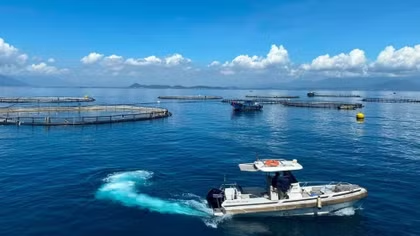
As the country enters a new development phase with greater demands for stronger marine-economy growth, institutional bottlenecks have emerged and need to be addressed.
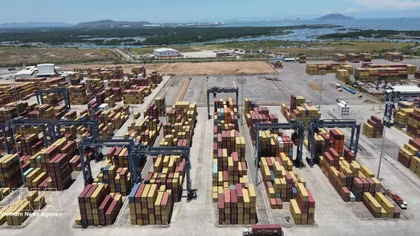
Experts from the Institute of Vietnam and World Economy under the Vietnam Academy of Social Sciences noted the quality of recent growth as the high growth rate has been recorded against an increasingly higher comparative base.

Vietnam's Halal exports remain modest at around 900 million USD a year, accounting for less than 1% of the global market. Most exports are still raw agricultural and seafood products. Only around 1,000–1,300 Vietnamese businesses obtained or maintained Halal certification during 2024–2026.
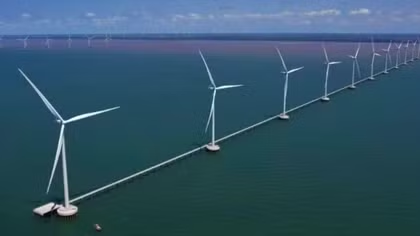
Vietnam needs a comprehensive policy framework to remove legal and procedural bottlenecks and create conditions for offshore wind power projects to access long-term investment capital, helping to unlock the country’s substantial offshore wind potential, said insiders.
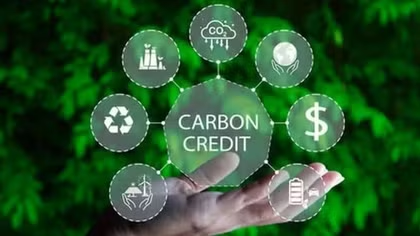
Under a decision of the municipal People’s Committee on establishing an inter-agency working group, departments and agencies are responsible for identifying facilities subject to greenhouse gas inventories, developing emissions-reduction plans and studying projects capable of generating carbon credits.
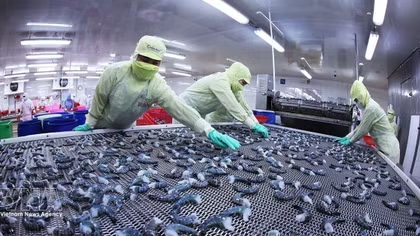
According to data from the Vietnam Customs cited by the Vietnam Association of Seafood Exporters and Producers (VASEP), shrimp exports reached 478.5 million USD in August, up 4.2% from the same month last year. The eight-month total stood at 3.3 billion USD, representing a year-on-year increase of 12%.
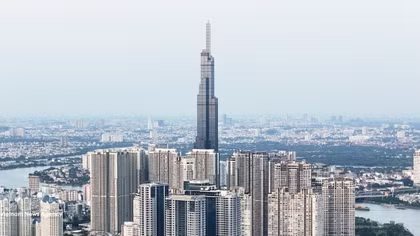
Vietnam is seen as a potential market, with considerable room for growth in real estate, particularly commercial property, compared with some regional markets. Strong Vietnam-Russia ties and opportunities to establish foreign-invested enterprises are also considered favourable for Russian investors.

For 2021-2030, the Civil Aviation Authority of Vietnam proposed bringing forward the investment in a parallel taxiway system and a connecting taxiway north of Runway No. 2 at Phu Quoc International Airport, in order to connect with the aircraft maintenance and repair facility (hangar) planned for the northern area of the airport.
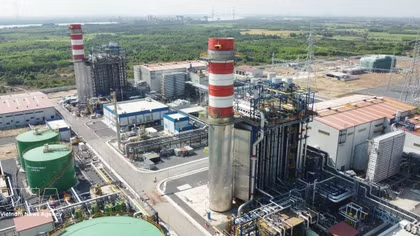
For LNG-fired power to fulfill its role in Vietnam’s energy transition, bottlenecks in institutions, infrastructure, electricity pricing, PPAs, power dispatch and financing must be addressed together.
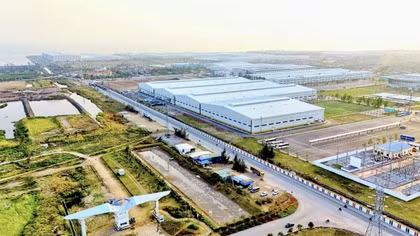
From policy and infrastructure to industrial real estate, Vietnam’s FDI advantages are broadening towards a more integrated production ecosystem, offering investors a stronger combination of conditions for high-value, technology-intensive and long-term projects.
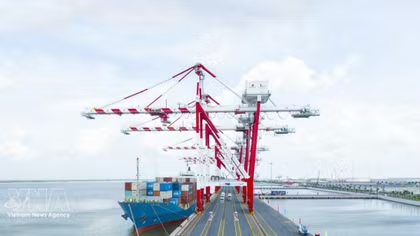
As trade expands, systemic bottlenecks across transport networks, warehousing, ports, border gates, and industrial zones are becoming more apparent. Experts emphasise the need to shift from a fragmented, project-by-project approach toward strategic management structured around trade corridors and integrated supply chains.

The company will buy non-performing loans from credit institutions and foreign bank branches, recover and dispose of debts and collateral, restructure loans and support lenders in resolving bad debts.
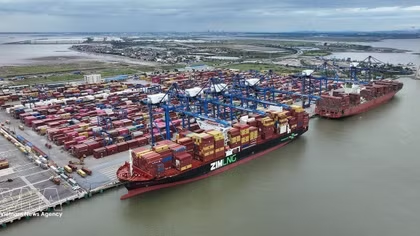
Do Ngoc Hung, Trade Counsellor and head of the Vietnam Trade Office in the US, said what stands out is not only the growth in trade volume but also the increasingly deep economic ties between the two countries.
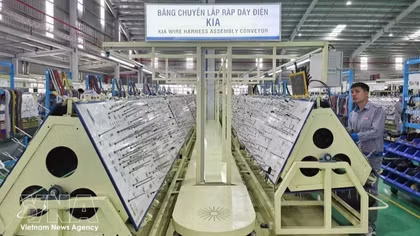
According to the Ministry of Finance, State budget revenue in the first eight months of 2026 was estimated at 2.02 quadrillion VND (77.7 billion USD), equivalent to 80% of the annual estimate and up 16% year-on-year. Domestic revenue reached 1.75 quadrillion VND, accounting for 86.6% of total revenue and rising 16.6%.

Hanoi aims to achieve average annual export growth of at least 12% during 2026-30, with the city seeking to diversify export markets, boost high-tech and value-added products and reduce reliance on traditional markets.