Hanoi eyes ban on non-resident motorbikes in inner city

Hanoi's Department of Transport is considering a ban on non-resident motorbikes entering the inner city from 2021, among several other measures to tighten management over personal vehicles in the capital.

The department is welcoming professional feedback on the first draft of its recently announced plan that looks to restrict the number of personal vehicles in the capital.

The plan, drafted by the department under the direction of the city’s administration, introduced a three-step restriction on motorbikes in the capital by the year 2025.

In the first phase beginning 2020, motorbikes will have restricted access to the Old Quarter area during the weekend and on national holidays.
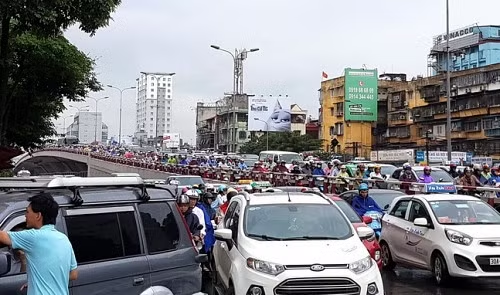
Vehicles stuck in traffic at an intersection in Hanoi at rush hour

From 2021, all motorbikes not registered in Hanoi will not be allowed to enter the capital’s inner city area, which is enclosed by Ring Road 1, from 7:00 am to 7:00 pm every day. The motorbike restriction in the Old Quarter area will also be expanded to all weekdays.

In the second phase that begins in 2023, the restriction on non-local motorbikes will be expanded to include the areas enclosed by Ring Road 2, while other old streets such as Tran Hung Dao and Ly Thuong Kiet will also be restricted for motorbikes.

From 2025, the third phase will include an additional ban on motorbikes in some areas inside Ring Road 3.

The plan also introduced measures to restrict personal cars, which includes a toll on cars entering downtown areas at rush hour, retrieving permits for car parks in the four districts of Hoan Kiem, Ba Dinh, Dong Da, and Hai Ba Trung, and raising parking fees for cars in downtown areas.

Hanoi has already laid out a plan to improve its public transport by 2020 as an alternative to personal vehicles.

According to the plan, over 500 new buses will be put into operation every year, while three Bus Rapid Transit (BRT) and five urban railway routes are expected to be finished by 2020.

Transit and parking areas will be built near public transport stations to improve accessibility and encourage their use.

According to Hanoi’s transportation planning approved by the country’s prime minister, public transport in the city must be able to handle 20 percent of its citizens’ commuting demand by 2020, and up to 40 percent by 2025.

Hanoi currently has 500,000 cars, five million motorbikes, one million bicycles, and over 10,000 electric bicycles, excluding numerous unregistered vehicles.

According to estimations by the transport department, with the annual sales increases of 7.6 percent for motorbikes and 12.9 percent for cars, by 2020, Vietnam’s capital will have had to handle at least 938,000 cars and over 6.2 million motorbikes, exceeding the current capacity of its roads by five times.

The transport department has estimated that this number will have risen again to 1.3 million cars by 2025 and 7.3 million motorbikes are expected to be registered in the city.


Tuoi Tre News

Other News

Hanoi ready to implement Capital Law 2026, unlocking new development momentum

Hanoi ready to implement Capital Law 2026, unlocking new development momentum

The effectiveness of the Capital Law 2026 will be measured not by the number of legal documents issued but by tangible improvements in governance and public administration, better services for people and businesses, faster administrative procedures, stronger investment attraction and higher economic growth.

Vietnamese students earn honours at ROBOG Asia Cup 2026

Vietnamese students earn honours at ROBOG Asia Cup 2026

Three teams from Chu Van An Secondary School in Vietnam’s Thai Nguyen province have earned First Prize honours and advanced to the quarterfinals at the ROBOG Asia Cup 2026, a regional robotics and artificial intelligence (AI) competition for students held in Hong Kong, China.

Hanoi sets out new investment blueprint with century-long development vision

Hanoi sets out new investment blueprint with century-long development vision

As of early June, Hanoi had attracted 74.6 billion USD in foreign direct investment (FDI) through more than 9,250 valid projects. FDI inflows in the first six months were projected at 3.2 billion USD, surpassing the annual target by 116%, while nearly 16,000 new businesses were established in the first five months, up 34.4% year-on-year.

Vietnam promotes legal cooperation and rule of law at global forum

Vietnam promotes legal cooperation and rule of law at global forum

Vietnam’s development and international integration have gone hand in hand with the improvement of its legal system, the incorporation of international commitments into domestic legislation, and legal reforms aimed at fostering development, openness and global integration. The country regards international law as an essential instrument for building fair, mutually beneficial relations among nations.

Hanoi to hold investment promotion event on June 29

Hanoi to hold investment promotion event on June 29

At the event, Hanoi authorities plan to grant investment policy decisions and investment registration certificates to 20 exemplary projects in the fields of transportation infrastructure, industrial parks, urban development, social housing, environment, science and technology, and foreign investment attraction.

Hanoi's Red River urban area development draws widespread attention

Hanoi's Red River urban area development draws widespread attention

Located south of the Red River and extending from the historic inner city to newly developing areas in the south and the west, the central urban area along Red River’s right bank covers approximately 45,317 hectares and is projected to accommodate around 6.365 million residents by 2045 and 6.455 million by 2065.

Hanoi's Red River urban area development draws widespread attention

Hanoi's Red River urban area development draws widespread attention

Located south of the Red River and extending from the historic inner city to newly developing areas in the south and the west, the central urban area along Red River’s right bank covers approximately 45,317 hectares and is projected to accommodate around 6.365 million residents by 2045 and 6.455 million by 2065.

Regional cooperation strengthened to combat cross-border drug crime

Regional cooperation strengthened to combat cross-border drug crime

Vietnam, China, Laos and Myanmar face common challenges as drug syndicates increasingly exploit the Mekong River, cross-border transport networks, e-commerce platforms, international logistics services, cyberspace and cryptocurrencies to organise drug transactions and smuggling operations.