Hanoi: First tunnel boring machine for metro line construction installed

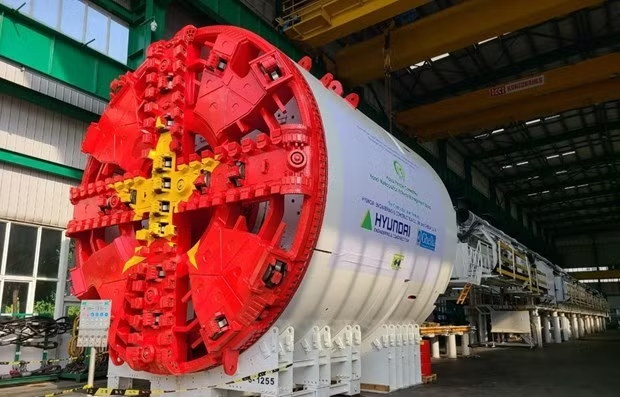
After two months of transportation and installation, the last component of a tunnel boring machine (TBM) will be placed at the S9 underground station of Metro Line No 3, Nhon - Hanoi Train Station, on December 30.
Part of the first tunnel boring machine for the building of Metro Line No 3, Nhon - Hanoi Train Station (Photo courtesy of MRB)

After two months of transportation and installation, the last component of a tunnel boring machine (TBM) will be placed at the S9 underground station of Metro Line No 3, Nhon - Hanoi Train Station, on December 30.

This TBM, the first of its kind to be used in Hanoi, was designed specifically for the construction of the Nhon - Hanoi Train Station metro line. Made by German manufacturer Herrenknecht, it is over 100m long and weighs about 850 tonnes.

It is able to bore about 10m of tunnel each day in ideal conditions, according to the Hanoi Metropolitan Railway Management Board (MRD).

Another TBM is being transported to Vietnam.

After installation is finished, the machines will begin boring from the S9 station on Kim Ma street to the S12 station at the Hanoi Train Station, located at the end of Tran Hung Dao street, with the total length of 4km.

Tunnel segments will be installed upon the boring progress.

MRB deputy head Le Trung Hieu affirmed that local houses will not be affected during the boring process as the TBMs include earth pressure balance shields that minimises impact on geological features.

The MRB is working to make sure the progress is on schedule as requested by the Prime Minister so that the remaining 4.5km-long underground section will become operational in late 2022, he added.

It reported that 67.77 percent of the pilot metro line has been completed, with 81.97 percent of the elevated section done.

In October, the first train, designed and produced in France, of this metro line arrived at the Nhon depot. Its four carriages have been installed and being examined to prepare for trial operation.

Metro Line No 3 is scheduled to have its 8.5km-long elevated section, from Nhon to the S8 station at the University of Transport and Communications, put into commercial operation in late 2021. The remaining 4km-long underground section will run in late 2022.

The project is invested with 1.176 million EUR (over 1.4 million USD) in total, including official development assistance loans from the French Government, the French Development Agency (AFD), the Asian Development Bank (ADB), and the European Investment Bank (EIB).

VNA

Other News

Hanoi ready to implement Capital Law 2026, unlocking new development momentum

Hanoi ready to implement Capital Law 2026, unlocking new development momentum

The effectiveness of the Capital Law 2026 will be measured not by the number of legal documents issued but by tangible improvements in governance and public administration, better services for people and businesses, faster administrative procedures, stronger investment attraction and higher economic growth.

Vietnamese students earn honours at ROBOG Asia Cup 2026

Vietnamese students earn honours at ROBOG Asia Cup 2026

Three teams from Chu Van An Secondary School in Vietnam’s Thai Nguyen province have earned First Prize honours and advanced to the quarterfinals at the ROBOG Asia Cup 2026, a regional robotics and artificial intelligence (AI) competition for students held in Hong Kong, China.

Hanoi sets out new investment blueprint with century-long development vision

Hanoi sets out new investment blueprint with century-long development vision

As of early June, Hanoi had attracted 74.6 billion USD in foreign direct investment (FDI) through more than 9,250 valid projects. FDI inflows in the first six months were projected at 3.2 billion USD, surpassing the annual target by 116%, while nearly 16,000 new businesses were established in the first five months, up 34.4% year-on-year.

Vietnam promotes legal cooperation and rule of law at global forum

Vietnam promotes legal cooperation and rule of law at global forum

Vietnam’s development and international integration have gone hand in hand with the improvement of its legal system, the incorporation of international commitments into domestic legislation, and legal reforms aimed at fostering development, openness and global integration. The country regards international law as an essential instrument for building fair, mutually beneficial relations among nations.

Hanoi to hold investment promotion event on June 29

Hanoi to hold investment promotion event on June 29

At the event, Hanoi authorities plan to grant investment policy decisions and investment registration certificates to 20 exemplary projects in the fields of transportation infrastructure, industrial parks, urban development, social housing, environment, science and technology, and foreign investment attraction.

Hanoi's Red River urban area development draws widespread attention

Hanoi's Red River urban area development draws widespread attention

Located south of the Red River and extending from the historic inner city to newly developing areas in the south and the west, the central urban area along Red River’s right bank covers approximately 45,317 hectares and is projected to accommodate around 6.365 million residents by 2045 and 6.455 million by 2065.

Hanoi's Red River urban area development draws widespread attention

Hanoi's Red River urban area development draws widespread attention

Located south of the Red River and extending from the historic inner city to newly developing areas in the south and the west, the central urban area along Red River’s right bank covers approximately 45,317 hectares and is projected to accommodate around 6.365 million residents by 2045 and 6.455 million by 2065.

Regional cooperation strengthened to combat cross-border drug crime

Regional cooperation strengthened to combat cross-border drug crime

Vietnam, China, Laos and Myanmar face common challenges as drug syndicates increasingly exploit the Mekong River, cross-border transport networks, e-commerce platforms, international logistics services, cyberspace and cryptocurrencies to organise drug transactions and smuggling operations.