HCM City to arrange different hours for each commuter group to curb congestion

The Ho Chi Minh City administration has ordered the arrangement of exclusive scheduling for certain commuter groups, a plan previously rejected by local authorities to ease the city’s congestion.

The increase in personal vehicles and risk of traffic gridlock in the southern metropolis is leading many to call for effective measures to curb the aching problem, including one proposal to create specific time windows for different commuter groups, according to delegates at a meeting chaired by the municipal People’s Committee.

According to Colonel Tran Duc Tai, deputy director of the city’s Department of Police, about 1,000 new vehicles are registered in the city each day while the total number of vehicles hitting the streets daily is approximately 10 million.

According to a Department of Transport report, about 37 congestion hotspots exist across the southern hub and the Department of Labor, Invalids and Social Affairs should arrange different working hours for different groups of workers and students to alleviate these issues.
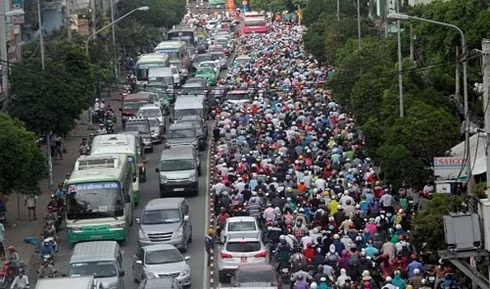
The proposition is aimed at reducing the number of vehicles travelling at any one time on the city’s street.

Accordingly, class times should start at 8:00 am while office workers will begin their day at 8:30 am; local supermarkets can then open at 9:00 am, the transport department listed the examples.

The plan will certainly be met with criticism, though it will have some benefits tolocal residents, Le Van Khoa, vice-chairman of the city’s administration said before adding that it still needed to be subjected to thorough discussion.

Khoa ordered the labor department to pilot the scheme with certain groups before expanding it to a larger scale.

Meanwhile, Cao Thanh Binh, deputy head of the Economics and Budget Committee under the municipal People’s Council, worried that the changes would impact the daily routine of citizens.

The plan was previously rejected by the council as there was not sufficient evaluation of its effect on society.

“In order to execute the scheme, careful assessment of its impact on society, local economy, and lives of citizens must be conducted,” the official stated.

Applicable on students

Thus far, the plan has been applied to the school hours of students in the city in order to curb traffic jams, an official from the municipal Department of Education and Training said at the gathering.

High school students are currently scheduled to start class at 7:00 am while elementary pupils begin half an hour later.

Local kindergartens are set to receive kids at between 7:30 and 8:00 am.

The department will continue to review solutions aimed at establishing different hours for schools busy streets, the education official said, proposing that more school buses be provided to limit personal vehicles at school entrances.

According to Bui Xuan Cuong, director of the transport department, the Traffic Safety Committee will work with the labor department to evaluate the proposition before reporting to the People’s Committee.


Tuoitrenews

Other News

Hanoi ready to implement Capital Law 2026, unlocking new development momentum

Hanoi ready to implement Capital Law 2026, unlocking new development momentum

The effectiveness of the Capital Law 2026 will be measured not by the number of legal documents issued but by tangible improvements in governance and public administration, better services for people and businesses, faster administrative procedures, stronger investment attraction and higher economic growth.

Vietnamese students earn honours at ROBOG Asia Cup 2026

Vietnamese students earn honours at ROBOG Asia Cup 2026

Three teams from Chu Van An Secondary School in Vietnam’s Thai Nguyen province have earned First Prize honours and advanced to the quarterfinals at the ROBOG Asia Cup 2026, a regional robotics and artificial intelligence (AI) competition for students held in Hong Kong, China.

Hanoi sets out new investment blueprint with century-long development vision

Hanoi sets out new investment blueprint with century-long development vision

As of early June, Hanoi had attracted 74.6 billion USD in foreign direct investment (FDI) through more than 9,250 valid projects. FDI inflows in the first six months were projected at 3.2 billion USD, surpassing the annual target by 116%, while nearly 16,000 new businesses were established in the first five months, up 34.4% year-on-year.

Vietnam promotes legal cooperation and rule of law at global forum

Vietnam promotes legal cooperation and rule of law at global forum

Vietnam’s development and international integration have gone hand in hand with the improvement of its legal system, the incorporation of international commitments into domestic legislation, and legal reforms aimed at fostering development, openness and global integration. The country regards international law as an essential instrument for building fair, mutually beneficial relations among nations.

Hanoi to hold investment promotion event on June 29

Hanoi to hold investment promotion event on June 29

At the event, Hanoi authorities plan to grant investment policy decisions and investment registration certificates to 20 exemplary projects in the fields of transportation infrastructure, industrial parks, urban development, social housing, environment, science and technology, and foreign investment attraction.

Hanoi's Red River urban area development draws widespread attention

Hanoi's Red River urban area development draws widespread attention

Located south of the Red River and extending from the historic inner city to newly developing areas in the south and the west, the central urban area along Red River’s right bank covers approximately 45,317 hectares and is projected to accommodate around 6.365 million residents by 2045 and 6.455 million by 2065.

Hanoi's Red River urban area development draws widespread attention

Hanoi's Red River urban area development draws widespread attention

Located south of the Red River and extending from the historic inner city to newly developing areas in the south and the west, the central urban area along Red River’s right bank covers approximately 45,317 hectares and is projected to accommodate around 6.365 million residents by 2045 and 6.455 million by 2065.

Regional cooperation strengthened to combat cross-border drug crime

Regional cooperation strengthened to combat cross-border drug crime

Vietnam, China, Laos and Myanmar face common challenges as drug syndicates increasingly exploit the Mekong River, cross-border transport networks, e-commerce platforms, international logistics services, cyberspace and cryptocurrencies to organise drug transactions and smuggling operations.