HCM City to build more reservoirs to store rainwater, control floods

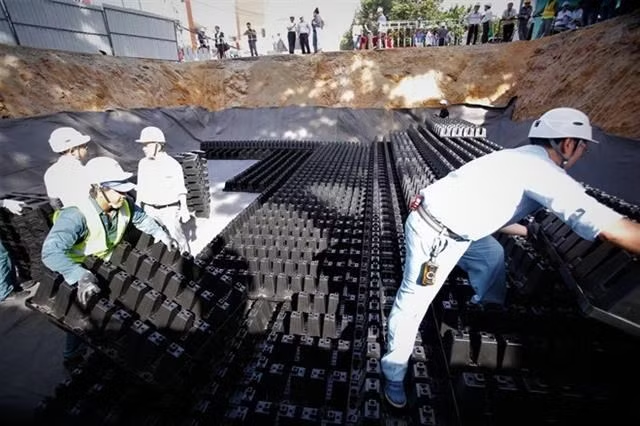
Ho Chi Minh City plans to spend hundreds of billions of VND on building more than 100 reservoirs to store rainwater and control flooding by 2020 under a flood-control programme.
A reservoir on Hoang Van Thu Street in HCM City’s Tan Binh district. (Photo: VNS)

A reservoir on Hoang Van Thu Street in HCM City’s Tan Binh district. (Photo: VNS)

However, many existing reservoirs are yet to be connected with each other for the flood-control programme. The reservoirs, which will have pump and culvert systems, will collect rainwater.

The biggest, with a capacity of 20,000cu.m, will be built at the Go Vap Flower Village, while the second largest, measuring around 5,000cu.m, will be at Hoang Van Thu Park in Tan Binh district. The others will be smaller, with a capacity of 1,500-2,000cu.m each.

Tan Binh district currently has a big reservoir but its water level has never reached its full capacity.

According to an expert from the HCM City Urban Drainage Co. Ltd., the Hoang Van Thu Reservoir has a capacity of more than 35,000cu.m of water.

Experts from the HCM City Urban Drainage Co. Ltd. suggested that the reservoir should be connected with the city’s sullage pits so that rainwater could be drained into the reservoir to reduce flooding, but the proposal was shot down.

The Hoang Van Thu Reservoir has yet to be used to regulate rainwater and combat flooding around Tan Son Nhat International Airport, an expert said.

Many other reservoirs in inner districts too are not connected with the reservoir network for flood control, including those at Le Thi Rieng Park in District 10, Dam Sen Tourism Park in District 11, Phu Lam Park in District 6, Van Thanh in Binh Thanh District, Song Tan and Huong Tram in District 7, and Ky Hoa in District 10.

According to figures from the HCM City Urban Drainage Co. Ltd., the Hoang Van Thu and Van Thanh reservoirs have a combined capacity of over 40,000cu.m, while Ky Hoa can hold over 6,400cu.m of water.

Experts from the HCM City Urban Drainage Co. Ltd. said these reservoirs could help prevent flooding but have not been connected with the drainage network or used for flood prevention.

The managers of many of the reservoirs do not allow them to be connected with drainage networks in inner districts because the drains carry both rainwater and wastewater, which could pollute them.

They said the reservoirs were built to enhance the city’s looks rather than for regulating rainwater or controlling floods.

Wastewater treatment and separating rainwater from wastewater is the job of other agencies, they added.

VNS/VNA

Other News

Hanoi ready to implement Capital Law 2026, unlocking new development momentum

Hanoi ready to implement Capital Law 2026, unlocking new development momentum

The effectiveness of the Capital Law 2026 will be measured not by the number of legal documents issued but by tangible improvements in governance and public administration, better services for people and businesses, faster administrative procedures, stronger investment attraction and higher economic growth.

Vietnamese students earn honours at ROBOG Asia Cup 2026

Vietnamese students earn honours at ROBOG Asia Cup 2026

Three teams from Chu Van An Secondary School in Vietnam’s Thai Nguyen province have earned First Prize honours and advanced to the quarterfinals at the ROBOG Asia Cup 2026, a regional robotics and artificial intelligence (AI) competition for students held in Hong Kong, China.

Hanoi sets out new investment blueprint with century-long development vision

Hanoi sets out new investment blueprint with century-long development vision

As of early June, Hanoi had attracted 74.6 billion USD in foreign direct investment (FDI) through more than 9,250 valid projects. FDI inflows in the first six months were projected at 3.2 billion USD, surpassing the annual target by 116%, while nearly 16,000 new businesses were established in the first five months, up 34.4% year-on-year.

Vietnam promotes legal cooperation and rule of law at global forum

Vietnam promotes legal cooperation and rule of law at global forum

Vietnam’s development and international integration have gone hand in hand with the improvement of its legal system, the incorporation of international commitments into domestic legislation, and legal reforms aimed at fostering development, openness and global integration. The country regards international law as an essential instrument for building fair, mutually beneficial relations among nations.

Hanoi to hold investment promotion event on June 29

Hanoi to hold investment promotion event on June 29

At the event, Hanoi authorities plan to grant investment policy decisions and investment registration certificates to 20 exemplary projects in the fields of transportation infrastructure, industrial parks, urban development, social housing, environment, science and technology, and foreign investment attraction.

Hanoi's Red River urban area development draws widespread attention

Hanoi's Red River urban area development draws widespread attention

Located south of the Red River and extending from the historic inner city to newly developing areas in the south and the west, the central urban area along Red River’s right bank covers approximately 45,317 hectares and is projected to accommodate around 6.365 million residents by 2045 and 6.455 million by 2065.

Hanoi's Red River urban area development draws widespread attention

Hanoi's Red River urban area development draws widespread attention

Located south of the Red River and extending from the historic inner city to newly developing areas in the south and the west, the central urban area along Red River’s right bank covers approximately 45,317 hectares and is projected to accommodate around 6.365 million residents by 2045 and 6.455 million by 2065.

Regional cooperation strengthened to combat cross-border drug crime

Regional cooperation strengthened to combat cross-border drug crime

Vietnam, China, Laos and Myanmar face common challenges as drug syndicates increasingly exploit the Mekong River, cross-border transport networks, e-commerce platforms, international logistics services, cyberspace and cryptocurrencies to organise drug transactions and smuggling operations.