HCM City to use underground space at metro stations

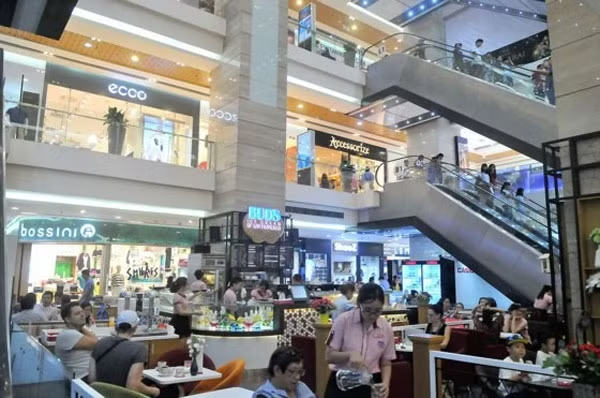
HCM City authorities have been asked to develop a master plan for urban underground spaces to prepare for the opening of subway lines in the city.

Speaking at a conference on underground space planning, Hoang Tung, deputy director of the Department of Planning and Architecture, said that underground work would need a huge amount of investment and time, affecting water resources and the environment.

“It’s necessary to clearly define the objectives and scope of the plan, which should be specific and suited to each stage of the city’s development,” he said.

The plan must also ensure an efficient use of land as well as compatible connections with existing structures on the ground, he said, adding that it must also meet the requirements of “underground water, security and defense”.

A representative from the HCM City-based University of Architecture said that underground construction was complicated to handle compared to work above ground.

Initially the department proposed conducting comprehensive research on the downtown area (covering an area of 930ha) and Thu Thiem new urban area, according to Tung.

The department proposed organising a tender for the selection of international consultants to ensure the quality of the plan.

Experts agree that it is necessary to consult foreign consultants who will offer planning ideas, spatial design and management regulations.

But initial data collection should be done by Vietnamese consultants who have collected information and data on geology and other underground works in the city.

Metro routes  

“The plan for urban underground spaces must be done based on the metro routes,” said Dr. Vo Kim Cuong, former director of the Department of Planning and Architecture. 

He said the core issue of underground development was to study where the construction work would be done, depending on factors like geology, environment and water resources.

Therefore, geological and hydrological surveys and assessments must be carried out first.

Ha Ngoc Truong, vice chairman of the HCM City Road, Bridge and Port Association, who is also the consultant for the city’s two metro lines, said that most stations would be underground on the metro lines connecting Ben Thanh Station in District 1 to Tham Luong Station in District 12.

Truong said the scope of the research for underground planning should not be limited to the downtown area and Thu Thiem new urban area, but should be based on the metro lines.

The plan should also carefully consider factors such as environment, flood control and fires, among others.

Architect Khuong Van Muoi said that when the metro lines are opened for use, urban traffic will change significantly, so it is also important to adjust the current traffic structure accordingly.

Meanwhile, the Management Authority for Urban Railways of HCM City said it had already determined the locations of the metro stations, so the department of Planning and Architecture should base its underground planning around these sites.

Metro line No 1, running 20 kilometres between Ben Thanh Terminal in District 1 and Suoi Tien Amusement Park in District 9, includes a 2.6-km underground section from Ben Thanh to Ba Son Terminal in District 1.

The metro is the first to be included in the plan of underground space now being drafted by city authorities.

HCM City will be the first city to have a comprehensive plan for underground space, a long-held vision that was not taken seriously until now. 

“The plan for underground space will improve the city’s appeal and combat the worsening congestion on the ground,” said Nguyen Dinh Hung, deputy director of the Department of Planning and Architecture.

“The need for connection between underground spaces is becoming increasingly urgent, now that the city will have public underground spaces as part of its future metro network,” he said.

The Department of Planning and Architecture said that it would continue to research and complete the proposal for the urban underground space plan as well as consult the city People’s Committee to complete the plan. 
VNS

Other News

Vietnam steps up implementation of ethnic affairs strategy through 2030

Vietnam steps up implementation of ethnic affairs strategy through 2030

To accelerate the implementation of the the Ethnic Affairs Strategy by 2030, with a vision toward 2045, the Prime Minister requested ministries, agencies and local authorities to continue thoroughly carrying out the Party and State’s policies on ethnic affairs, enhancing the effectiveness of State management and strengthening oversight of policy implementation.

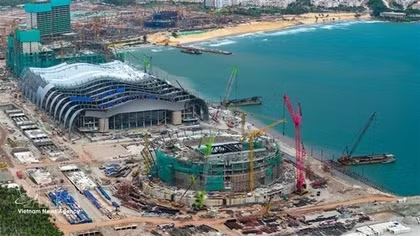
Security preparations reviewed for APEC 2027 in Phu Quoc

Security preparations reviewed for APEC 2027 in Phu Quoc

The team examined the APEC 2027 Convention Centre, where main conference activities are scheduled; Sun Serenia Hospital, designated to provide healthcare and emergency medical services for delegates; provincial road DT.975, which connects Phu Quoc International Airport to the convention centre; and the area surrounding Phu Quoc International Airport.

Hanoi accelerates seven Red River bridge projects, many exceed 70% completion

Hanoi accelerates seven Red River bridge projects, many exceed 70% completion

According to the municipal Transport Construction Investment Project Management Board, the city is simultaneously implementing seven projects, namely Tu Lien, Ngoc Hoi, Tran Hung Dao, Thuong Cat, Van Phuc, Hong Ha and Me So bridges. Construction is being carried out on multiple fronts, focusing on bored piles, pile caps, piers and superstructure works.

Dien Bien battlefield legacy powers tourism revival

Dien Bien battlefield legacy powers tourism revival

Seventy-two years after the Dien Bien Phu Victory, its legacy still reverberates. The unity, self-reliance, and resilience forged in that historic triumph remain a powerful internal engine, now propelling Dien Bien toward fast and sustainable development.

Hanoi accelerates shift to green buses, targets 100% by 2030

Hanoi accelerates shift to green buses, targets 100% by 2030

In the 2027–2030 period, the city will accelerate the transition towards the complete phase-out of fossil fuel-powered buses. The share of electric and green energy-fueled buses is projected to reach 79–89% by 2029 and 100% by 2030.

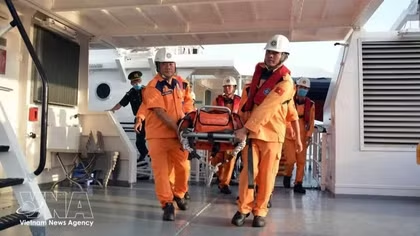
36 fishermen safely rescued after boat breaks down near Truong Sa

36 fishermen safely rescued after boat breaks down near Truong Sa

At 8:00 the same day, KN475 began towing the disabled fishing boat toward Da Tay A island. The towing operation was carried out safely, and by 18:30 both the vessel and its crew had arrived at the island without incident, where repairs and additional support procedures were arranged.

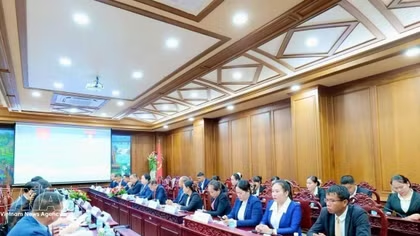
Vietnamese language contest in Laos strengthens youth ties, bilateral friendship

Vietnamese language contest in Laos strengthens youth ties, bilateral friendship

Held in response to the launch of the Vietnamese Language Day among overseas Vietnamese communities, the event aimed to enhance the quality of Vietnamese language teaching and learning in Laos while contributing to the great friendship, special solidarity, comprehensive cooperation and strategic cohesion between the two countries.

Vietnamese language contest in Laos strengthens youth ties, bilateral friendship

Vietnamese language contest in Laos strengthens youth ties, bilateral friendship

Held in response to the launch of the Vietnamese Language Day among overseas Vietnamese communities, the event aimed to enhance the quality of Vietnamese language teaching and learning in Laos while contributing to the great friendship, special solidarity, comprehensive cooperation and strategic cohesion between the two countries.

Hanoi launches 10 electric bus routes from April 1

Hanoi launches 10 electric bus routes from April 1

By the end of April, the number of buses using electricity and other green energy sources in the city is expected to reach 822, including 683 electric buses and 139 compressed natural gas (CNG) buses, representing 42.1% of the total number of vehicles.