Heritage resources fuel Hue's new growth ambitions

Hue is simultaneously stepping up efforts to attract investment into tourism, services and cultural industries. In the first five months of 2026, the city secured more than 19 trillion VND in newly registered investment capital, with projects planned in coastal tourism, lagoon-based ecotourism, cultural spaces along the Perfume River, convention and exhibition centres, night-time economy projects and cultural innovation hubs.

As Hue enters a new phase of development as a centrally governed city, local authorities are seeking to transform its centuries-old cultural heritage into a new growth engine, with tourism expected to unlock the economic value of culture and support the city’s ambition of achieving double-digit growth.

Heritage assets drive tourism growth

After experiencing the “Imperial Citadel by Night” programme, French visitor Marie Laurent said Hue stood out from other heritage destinations she had visited around the world. It is not just a collection of ancient monuments; it is a living cultural space, she said.

Few localities in Vietnam possess such a rich combination of tangible and intangible heritage. Hue is home to the Complex of Hue Monuments, Royal Court Music, the Nguyen Dynasty Woodblocks and Imperial Archives, alongside living traditions such as Hue folk singing, royal cuisine, craft villages, traditional festivals and the iconic Hue ao dai. These cultural assets are complemented by diverse landscapes stretching from Chan May–Lang Co Bay and the Tam Giang–Cau Hai Lagoon to the forests of western Hue.
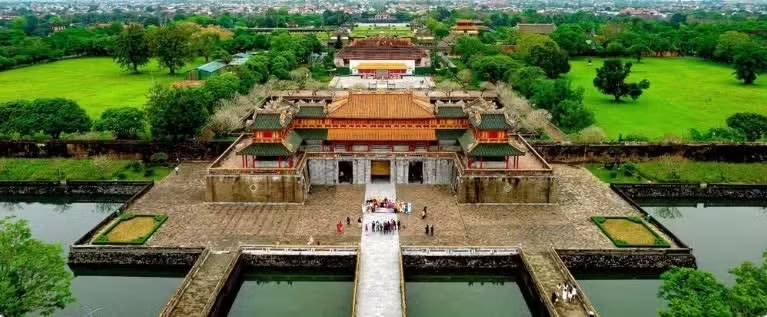
dai-noi-hue.jpg
Seen from above, Hue Imperial Citadel glows brilliantly at the heart of the heritage city. (Photo: nhandan.vn)

According to Dr. Cung Trong Cuong of the Hue City Institute for Development Studies, the city’s advantage lies not only in the number of heritage sites but also in their cultural depth. Visitors can experience history through architecture, music, cuisine and community life, a combination rarely found in other heritage cities in the region, he said.

In recent years, the Hue Festival, night tours of the Imperial Citadel, the Huong (Perfume) river pedestrian zone, craft village experiences and community-based tourism have helped revitalise the city’s tourism sector. Hue welcomed around 4 million visitors in 2024, generating nearly 8 trillion VND (304 million USD) in tourism revenue. In the first five months of 2026 alone, the city received nearly 3.6 million visitors and earned about 8.3 trillion VND, up almost 70% year-on-year.

Despite these gains, experts believe Hue has yet to fully capitalise on its heritage advantages. Average visitor stays remain relatively short and spending levels modest, while tourism products, though culturally rich, are not yet diverse enough to encourage longer stays.

The city also faces challenges related to tourism infrastructure, a shortage of high-quality entertainment and service facilities, limited international-standard human resources and weak regional connectivity. At the same time, growing demands for heritage preservation and restoration require substantial investment.

Turning heritage into an economic engine

Hue is now moving beyond a preservation-focused approach and placing greater emphasis on leveraging heritage for economic development.

Chairman of the Hue People's Committee Nguyen Khac Toan has identified tourism and services as key drivers of growth in the city’s new development phase. The objective is not only to attract more visitors but also to increase the economic value generated from cultural products, destinations and tourism experiences.

According to Hoang Viet Trung, Director of the Hue Monuments Conservation Centre, the long-term vision is to transform heritage sites into living cultural spaces. Programmes such as “Imperial Citadel by Night”, royal guard-changing performances, court ceremony reenactments and the application of digital technologies are helping bring heritage closer to visitors while creating new economic opportunities.

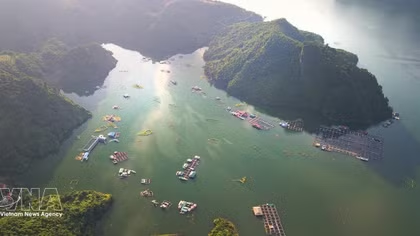
The city is also expanding tourism development beyond its historic core. Vice Chairman of the Hue People's Committee Tran Huu Thuy Giang said plans focus on four strategic areas: the central heritage urban zone, the Tam Giang–Cau Hai Lagoon, the Chan May–Lang Co coastal area and the western ecological region. Together, these areas are expected to form a more diverse and sustainable tourism ecosystem.

Hue is simultaneously stepping up efforts to attract investment into tourism, services and cultural industries. In the first five months of 2026, the city secured more than 19 trillion VND in newly registered investment capital, with projects planned in coastal tourism, lagoon-based ecotourism, cultural spaces along the Perfume River, convention and exhibition centres, night-time economy projects and cultural innovation hubs.

According to Director of the Hue Department of Tourism Tran Thi Hoai Tram, the sector is prioritising improvements in destination quality, longer visitor stays and higher tourist spending. Heritage tourism, green tourism, community-based tourism and experiential travel are expected to be the key growth segments supporting Hue’s next stage of development.

en.vietnamplus.vn

Other News

Ta Xua named Asia's leading emerging tourism destination 2026

Ta Xua named Asia's leading emerging tourism destination 2026

In recent years, Ta Xua, dubbed "the paradise of clouds", has emerged as one of the mountainous destinations attracting strong interest from young travellers, particularly for its spectacular sea of clouds stretching across the mountains in the northwestern region.

Digital transformation key to preserving, promoting ethnic cultural values

Digital transformation key to preserving, promoting ethnic cultural values

Training local young people in filming, audio recording, digital storytelling, data preservation and responsible use of AI can help build a new generation of cultural custodians. This, in turn, can help transform cultural heritage into a resource for economic development while contributing to the country’s broader development.

Indigenous culture becomes tourism asset in northern highlands

Indigenous culture becomes tourism asset in northern highlands

With growing recognition of indigenous knowledge, customs and cultural values as unique assets, ethnic communities in the northern mountainous region are shifting from simply providing tourism services to becoming creators and owners of tourism products, confidently telling their own cultural stories

UNESCO ready to work with Vietnam to implement International Decade of Culture for Sustainable Development initiative: Representative

UNESCO ready to work with Vietnam to implement International Decade of Culture for Sustainable Development initiative: Representative

Jonathan Wallace Baker, UNESCO Representative to Vietnam, noted that the official proclamation of the 2027–2036 period as the "International Decade of Culture for Sustainable Development" comes at a particularly important moment. As the international community works to accelerate progress towards the 2030 Agenda while beginning to consider what comes after 2030, the Decade provides a ten-year framework to strengthen the place of culture in development.

Traditional culture finds new life in contemporary Vietnam

Traditional culture finds new life in contemporary Vietnam

Under Resolution 80-NQ/TW, dated January 7, 2026, November 24 was designated Vietnam Culture Day, to be observed annually. The occasion aims to give the public opportunities to participate in, create and enjoy cultural activities, helping spread positive values and foster pride in Vietnamese culture.

Vietnam prioritises MICE tourism as strategic product

Vietnam prioritises MICE tourism as strategic product

For the MICE tourism sector in both Ho Chi Minh City and Vietnam, growth can no longer be driven merely by increasing the number of events; instead, the focus must shift to enhancing the value of each event and the competitiveness of each destination.

Potential of ethnic minority women's football

Potential of ethnic minority women's football

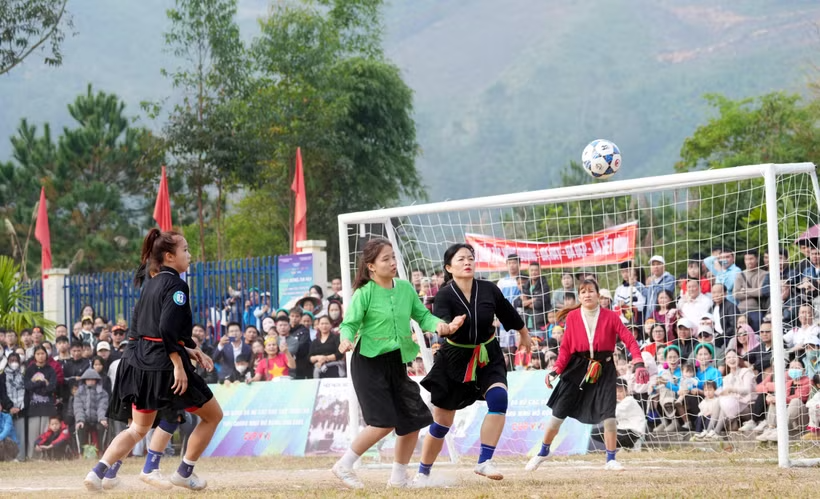
Women’s football movements in local communities have been quietly growing, but they’ve now built up enough momentum to inspire organisers to launch the first Vietnam Ethnic Minority Women’s Football – VTV Cup in 2026.

Phong Nha - Ke Bang named among Vietnam's 11 most beautiful destinations

Phong Nha - Ke Bang named among Vietnam's 11 most beautiful destinations

According to the magazine, boat trips into Phong Nha Cave and strolls through Paradise Cave (both family-friendly) offer a tantalising glimpse of their astonishing scale, but the real adventure lies deeper within the park, where cavers wade through underground rivers and weave among stalagmites.

Tourism seeks new growth momentum under Resolution 26

Tourism seeks new growth momentum under Resolution 26

Tourism effectiveness should be measured not only by visitor numbers and revenue, but also by spending, length of stay, repeat visits, job quality, visitor satisfaction and environmental carrying capacity, said experts.

Vietnam welcomes nearly 2 million international visitors in August, up 19.7% from July and 18.4% year-on-year. (Illustrative photo: VNA)

Vietnam tourism maintains strong growth, expands international markets

The National Statistics Office under the Ministry of Finance reported that Vietnam welcomed nearly 2 million international visitors in August, up 19.7% from July and 18.4% year-on-year. The figure represented 63.6% of the tourism sector’s full-year target of 25 million arrivals.

First ladies of Vietnam, Myanmar visit Van Phuc silk village

First ladies of Vietnam, Myanmar visit Van Phuc silk village

Ngo Phuong Ly, the spouse of General Secretary of the Communist Party of Vietnam Central Committee and President To Lam, said the two countries share similarities in silk weaving and can enrich their cultural heritage through exchanges and experience sharing.