- Sustainable agriculture development in ASEAN integration
- What are the pros, cons of a national brand for agriculture?
- Vietnamese, Lao provinces implement hi-tech agriculture project
Many hi-tech agricultural projects have been launched across the nation, most involving technology transfer from more advanced economies looking to tap demand generated by higher living standards.
A notable one among these is implemented by VinEco Agricultural Investment, Development and Productions LLC. (VinEco), a member of Vingroup Joint Stock Company (Vingroup). It is the current supplier for Vingroup’s retail chain Vinmart and its outlets, stocking their shelves every day with a variety of fresh produce.
Since early 2015, the company has been at the frontline of Vietnam’s hi-tech, large-scale, certified agricultural production, with focus on clean, standardised crops using technology from Israel, Japan and other developed countries. They now operate a total of 14 farms in different regions in the country, five of them in the northern provinces.
Lai Duc Luu, Production Manager at VinEco Tam Dao Farm in Vinh Phuc province, talked about the positive effects that hi-tech farming had on agricultural production and marketing in the country, and how consumers responded.
Luu said that their production process was scientifically planned and implemented in strict compliance with national and global standards, starting from research to seeds selection, irrigation, to harvest, storage and final distribution. The technology had been obtained from Israeli company Teshuva Agricultural Projects (TAP).
The entire farm spans across acres of open fields, greenhouses, post harvest factories and cold-storage areas using computerised automatic technologies from beginning to end.
Attention is paid to different regions’ topographical and geological conditions to ensure the final products’ qualification.
At the VinEco farm, automation and technological control begin at the planting stage. On an automated belt, seeds are planted in specially-made foam boxes, stuffed with bedding materials, including compressed minerals, sawdust, rice bran and husk, before being placed in incubation chambers with tight temperature, humidity and light controls for less than 24 hours.
Foam boxes will then be placed in greenhouses for the seedlings to mature growth, or to become a variety of sprouts, a favourite among VinEco customers at the moment.
Inside its greenhouses, the farm employs a drip and sprinkler irrigation system, transferred in whole from Israel by the company Netafim. Luu described this irrigation system as “an advanced automatic technique for slowly and regularly dripping water onto the soil, from a system of small diameter plastic pipes fitted with outlets called emitters or drippers”.
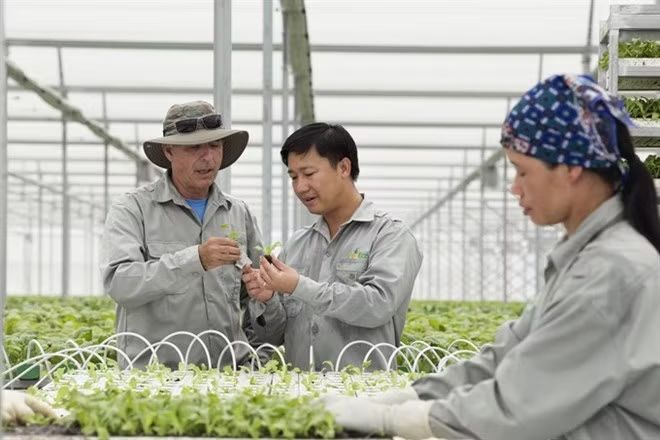 |
This advanced irrigation method relies on a network of sprinklers spraying water over the greenhouse crops with high pressure pumps through small nozzles, saving up to 30 to 50 percent of water compared to traditional furrow irrigation, cutting down 90 percent of manual labour.
Not only does the new greenhouse irrigation system ensure a balanced, distributed water flow to each individual plant’s roots, it also provides an ideal level of moisture and air circulation for the vegetables, Luu said. The process is fully computerised using motion sensors that require minimum manual control.
Besides the drip irrigation, a fertigation system is also applied to directly provide crops with the precise amount of fertiliser needed at different growth stages, thus optimising crop growth through strict control of nutrient supply.
These advanced technological systems supposedly simulate the best conditions to maximise crop yield and quality while minimising the amount of care, water and fertiliser used, according to Pham Van Hoi, supervisor of the farm’s greenhouses.
Hoi explained that the new farming method of exposing the sprouts to sunlight in the greenhouse environment, instead of growing them in the shade like before, had been a great improvement. The presence of UV light helps reduce harmful fungi on the leave surface, ensuring clean and off-the-stem edible greens.
Luu said the new production methods helped produce much higher quality products and significantly increasing consumption. At the moment, productivity on his farm had increased to a minimum of ten and a maximum of fifteen tonnes of vegetables per day, depending on the seasons, from two to five tonnes worth since the first batch in late 2015.
The automatic process does not stop at the monitored greenhouses, but extends to the harvesting and packaging stages as well. Once the vegetables are mature, they are manually taken to a warehouse where a cutting machine churns out batches of greens on to metal trays in seconds.
The freshly cut vegetables will then be put into plastic boxes with specific QR codes printed on the labels, allowing consumers to scan them and trace their place of origin, i.e. VinEco’s farm. Afterward, these boxes are shipped directly to Vinmart stores and their smaller counterparts, Vinmart , within hours of harvesting to guarantee freshness and quality.
Thanks to these modern production methods, a huge selection of sprout, leafy and root vegetables are readily available for purchase at Vingroup’s retail outlets. The positive response from consumers over the last two years has prompted the firm to expand its farms and increased production since its launch in 2015.
Luu said as VinEco increases its farming area and number of greenhouses, it will also expand its focus towards exporting its best-selling sprouts.
Avner Shohet, CEO of TAP, told that since the completion of its first greenhouse for VinEco’s Tam Dao Farm, there has been growing demand for the clean and hi-tech products among both end consumers and high end restaurants.
“Vietnam is essentially agrarian but unlike other East Asian countries it maintains stringent quality standards which also apply to its agricultural production. I think that the key point for the development of hi-tech agriculture in Vietnam is training. It is very important to train farmers to adapt advanced technology. It is very important to teach and train them in post-harvest process, food safety and sustainability,” said Shohet.
More and more farmers and enterprises are adopting Vietnamese Good Agriculture Practice (VietGAP) standards set by the Ministry of Agriculture and Rural Development (MARD).
A significant part of domestic agricultural production is now monitored based on several criteria including food safety, environmental protection, labour welfare and product quality.
Under the Government’s Decision 176/QĐ-TTg, by 2020, Vietnam will be home to 200 hi-tech agricultural businesses and 10 hi-tech agricultural zones, and the sector will register an annual growth rate of over 3.5 percent.
Thus far, the Government’s vision of hi-tech agriculture as a breakthrough solution for ensuring food security, boosting exports and sustainable development seems well founded.