Ho Chi Minh City considers encouraging residents to walk to work

The Ho Chi Minh City administration is considering calling on its residents, particularly public servants, to walk to school or work to contribute to the joint efforts to curb traffic congestion.

City-dwellers should take up walking if they live within 3km from schools or workplaces, the city’s deputy chairman Le Van Khoa suggested at a meeting on February 16.

Khoa put his proposal up for feedback from the meeting delegates, who are representatives of municipal departments and agencies and district-level administrations, and received 100 percent supporting votes.
The deputy chairman said walking will help residents strengthen their health and reduce their transportation cost, while bringing in many benefits for the society such as reducing traffic jams and air pollution.

Nguyen Van Danh, deputy director of the city’s Department of Construction said he totally supports the idea but is concerned about its feasibility.

Danh elaborated that it is difficult to get people to go to work on foot because most of sidewalks citywide are either occupied by street stalls or improperly used as motorbike parking spaces by shops and restaurants.

Danh thus suggested that the city should first try to clear the sidewalks on selected streets before carrying out the proposal.

In the meantime, Bui Thi Diem Thu, deputy director of the municipal Department of Education and Training, is concerned that walking in the hot and humid weather is inconvenient for female teachers as they have to wear ao dai, the traditional Vietnamese long dress.

She also added that most parents will not feel comfortable letting their children walking to school on fears of robbery or kidnapping.

Responding to Thu’s concerns, Khoa said that female teachers can wear casual clothes while walking and get changed when they arrive at schools.

Other delegates suggested that the required distance be lowered to 2km or 1km.

Despite these concerns, as the majority of delegates already voted support of the idea, Khoa tasked the city’s traffic safety committee with preparing the official draft of the proposal to submit to the municipal administration for consideration by the end of next month.

“We should have things get done as soon as possible,” he pressed.

Also at Friday’s meeting, Khoa suggested that in 2017, 50 percent of schools in the city must have school buses to transport students instead of having them go to school on their own vehicles to further reduce traffic congestions.

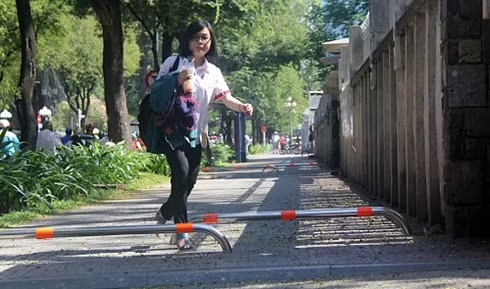
The city’s deputy chairman also addressed the controversial installations of barriers to prevent motorists from crossing over to the sidewalks on many streets in District 1 over the last few weeks.

The barriers have been complained for causing inconvenience for pedestrians, especially the disabled and elderly.

Responding to these concerns, Khoa asked the city’s transport department to review the appropriate distance between barriers and install them accordingly so that people on wheelchairs can access and move along the sidewalk more easily.


Tuoitrenews

Other News

Hanoi ready to implement Capital Law 2026, unlocking new development momentum

Hanoi ready to implement Capital Law 2026, unlocking new development momentum

The effectiveness of the Capital Law 2026 will be measured not by the number of legal documents issued but by tangible improvements in governance and public administration, better services for people and businesses, faster administrative procedures, stronger investment attraction and higher economic growth.

Vietnamese students earn honours at ROBOG Asia Cup 2026

Vietnamese students earn honours at ROBOG Asia Cup 2026

Three teams from Chu Van An Secondary School in Vietnam’s Thai Nguyen province have earned First Prize honours and advanced to the quarterfinals at the ROBOG Asia Cup 2026, a regional robotics and artificial intelligence (AI) competition for students held in Hong Kong, China.

Hanoi sets out new investment blueprint with century-long development vision

Hanoi sets out new investment blueprint with century-long development vision

As of early June, Hanoi had attracted 74.6 billion USD in foreign direct investment (FDI) through more than 9,250 valid projects. FDI inflows in the first six months were projected at 3.2 billion USD, surpassing the annual target by 116%, while nearly 16,000 new businesses were established in the first five months, up 34.4% year-on-year.

Vietnam promotes legal cooperation and rule of law at global forum

Vietnam promotes legal cooperation and rule of law at global forum

Vietnam’s development and international integration have gone hand in hand with the improvement of its legal system, the incorporation of international commitments into domestic legislation, and legal reforms aimed at fostering development, openness and global integration. The country regards international law as an essential instrument for building fair, mutually beneficial relations among nations.

Hanoi to hold investment promotion event on June 29

Hanoi to hold investment promotion event on June 29

At the event, Hanoi authorities plan to grant investment policy decisions and investment registration certificates to 20 exemplary projects in the fields of transportation infrastructure, industrial parks, urban development, social housing, environment, science and technology, and foreign investment attraction.

Hanoi's Red River urban area development draws widespread attention

Hanoi's Red River urban area development draws widespread attention

Located south of the Red River and extending from the historic inner city to newly developing areas in the south and the west, the central urban area along Red River’s right bank covers approximately 45,317 hectares and is projected to accommodate around 6.365 million residents by 2045 and 6.455 million by 2065.

Hanoi's Red River urban area development draws widespread attention

Hanoi's Red River urban area development draws widespread attention

Located south of the Red River and extending from the historic inner city to newly developing areas in the south and the west, the central urban area along Red River’s right bank covers approximately 45,317 hectares and is projected to accommodate around 6.365 million residents by 2045 and 6.455 million by 2065.

Regional cooperation strengthened to combat cross-border drug crime

Regional cooperation strengthened to combat cross-border drug crime

Vietnam, China, Laos and Myanmar face common challenges as drug syndicates increasingly exploit the Mekong River, cross-border transport networks, e-commerce platforms, international logistics services, cyberspace and cryptocurrencies to organise drug transactions and smuggling operations.