- EU offers Brexit trade talks, sets tough transition terms
- UK PM May's hand moves closer to Brexit trigger
- Brexit bill: Theresa May faces another defeat in House of Lords to stop 'no deal' EU exit, peers warn
Recently, President of the European Council Donald Tusk said that in order to preserve control over the enclave after Brexit, Britain will have to make an agreement with Spain.
Former Spanish Foreign Minister Jose Garcia-Margalio even said that the Spanish flag would soon fly over Gibraltar again.
Meanwhile, UK Prime Minister Theresa May said that London remained committed to support for Gibraltar and would never negotiate its sovereignty. Former Tory leader Michael Howard said that the UK prime minister would be prepared to go to war to protect Gibraltar as ex-Prime Minister Margaret Thatcher once did for the Falklands.
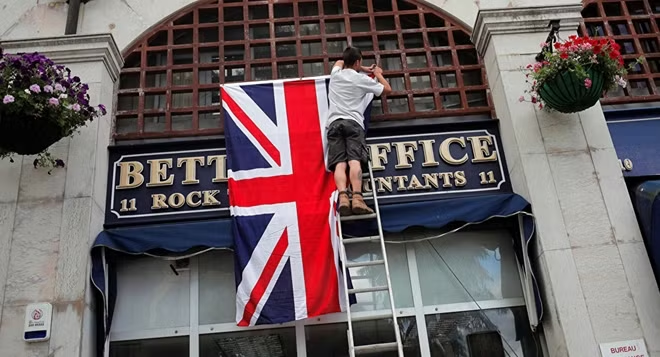 |
| Photo: Reuters |
Gibraltar is a British Overseas Territory of 6.8 sq km, located on the southern end of the Iberian Peninsula. It was captured from Spain by an Anglo-Dutch force in 1704 during the War of the Spanish Succession and was subsequently ceded to Great Britain under the Treaty of Utrecht in 1713.
Gibraltar is a militarily strategic stronghold, being at the entrance to the Mediterranean and has been the subject of a long-running dispute between Madrid and London.
The revival of the Gibraltar dispute caught London off-guard. Spanish diplomats managed to persuade their colleagues in Brussels that the Gibraltar issue could not be resolved automatically under the procedure of Britain’s withdrawal from the EU.
According to the Sun, Prime Minister May said she could not rule out talks with Madrid over Gibraltar’s future. Gibraltar’s First Minister Fabian Picardo spoke against Spain’s sovereignty over the territory. He said that London should rule out giving Spain any say in deciding the future of the enclave because Madrid dictating terms on the issue would be "totally unfair."
The possibility of making concessions to Spain has sparked public outrage in the UK.
In early-March, the House of Lords issued a report entitled "Brexit: Gibraltar." It read: "We fully endorse the UK government’s commitment never to enter into sovereignty discussions against the will of the Gibraltarian people."
Defense Secretary Michael Fallon said London is prepared to go "all the way" to make sure Gibraltar remains part of the UK.
Among the EU country members, Spain is one of the most loyal to the idea of a United Europe. By pressuring London over Gibraltar, Madrid may also help Brussels resolve certain problems related to the Brexit procedure.
The European Commission is demanding that Britain pay up to €60 billion ($64 billion) to settle its account before leaving the bloc, including compensation for financial commitments London had before the Brexit vote.
The UK does not want to settle such a bill, and Brussels may use the Gibraltar issue to complicate as much as possible the withdrawal procedure.
"The tiny piece of land is becoming a bargaining chip in the emerging diplomatic game between Britain and the European authorities. While not considering the military option, Brussels could harm London’s interests by delaying Brexit," journalist and political commentator Igor Gashkov wrote in a piece for Sputnik.
From Brussels’ point of view, such a scenario would work out perfectly. If after two years of negotiations there is no deal on Brexit Britain will de facto lose its preferences in the European market. In this case, trade ties between the UK and the EU will be regulated by the norms of the World Trade Organization (WTO).