In all occasions, a xoi fix satisfies cravings

If rice is Vietnam’s staple crop, xoi (sticky rice) is the nation’s choice dish, as much as the famous pho (rice noodle soup), if not more so.

It is a breakfast favourite, and the most popular late night-early dawn snack or meal.

It is sold by vendors in early morning markets and it can be found in fanciest restaurants serving traditional Vietnamese food.

There are any number of specialty xoi restaurants, as well as push carts that stand on street corners or bicycles that go around the streets well past midnight, long after restaurants and other eateries have closed.

Xoi, as the name suggests, is made with glutinous rice, steamed or cooked. There are those who love having this regularly for breakfast and those who have it at any time of the day or night, but almost every Vietnamese will have it at least once a month.
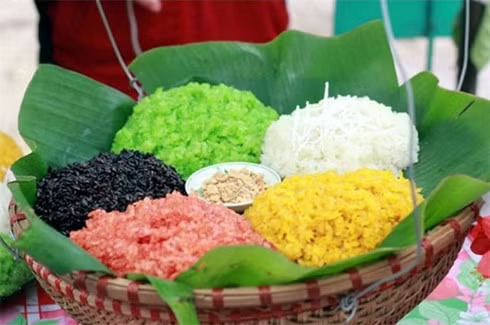
But xoi is not one dish. There are many varieties, each with its distinct taste, colour and/or flavour.
Food expert Vo Quoc, head of Mon Ngon Restaurant and Cooking Class, said: “Each region has its own (collection of) xoi dishes. Vegans and vegetarians can enjoy xoi with muoivung (ground sesame and peanuts) or sugar, while others have a wide range of meat choices, including xoi thitkho tau (sticky rice with Chinese braised pork) and xoi with liver pate, sausage, fried eggs, char siu, chickens or roasted piegons.”
On full moon days, New Year holidays, weddings, death anniversaries and other occasions, xoi is a must-have dish on the feast’s platters.
The ways to make sticky rice depend on the variety, family recipes or individual creativity that housewives bring into play.
However, the most popular method is to soak the glutinous rice in warm water for many hours until it expands; wash and mix the rice with a little salt and other ingredients separately; place them in an autoclave (called cho in the north and xung in the south); pour boiling water into the bottom of the autoclave and place it on a pot so that the ingredients are steamed without touching the water.
Later, the sealed autoclave and the pot are placed on a stove and boiled over low heat until the sticky rice is well-cooked and limber.
Now, busy women use electric rice cookers with the steaming function, but the majority preference is for xoi cooked the traditional way.
Xoi dau xanh (green bean sticky rice) is one of the most popular xoi dishes because it can be served with many different ingredients, including meat. Since it is easy to cook, it is a popular choice among housewives as well.
VNA

Other News

Vietnam secure berth at FIFA U17 World Cup 2026 for first time

Vietnam secure berth at FIFA U17 World Cup 2026 for first time

Vietnam national U17 football team secured a place at the FIFA U17 World Cup 2026 for the first time after defeating United Arab Emirates national U17 football team 3-2 on in the final Group C match of the AFC U17 Asian Cup 2026 in Saudi Arabia on early May 14 (Vietnam time).

Vietnam’s most beautiful railway station twins with French counterpart

Vietnam’s most beautiful railway station twins with French counterpart

A twinning agreement between Da Lat Railway Station in Vietnam and Trouville-Deauville Railway Station in France was signed at the French Embassy in Vietnam on May 7, creating new opportunities for cooperation in station management and operations, as well as cultural and tourism promotion between the two sides.

Hanoi gains two more craft villages in World Crafts Cities network

Hanoi gains two more craft villages in World Crafts Cities network

The recognition of Chuyen My and Son Dong craft villages as members of the World Crafts Cities network represents international acknowledgement of the cultural value, artisanal techniques, creativity and sustainable vitality of Vietnam’s traditional craft villages, he said.

Thang Long - Hanoi Festival 2026 to return in September

Thang Long - Hanoi Festival 2026 to return in September

Co-hosted by the municipal People’s Committee, the Department of Culture and Sports, and domestic and foreign agencies, the whole spectacle is meant to honour the city’s millennia-old heritage while reafffirming its strategy of establishing culture as a development engine.

Spreading Vietnamese cultural identity in digital space

Spreading Vietnamese cultural identity in digital space

In the context of deep international integration, cultural identity serves as both a “shield” against assimilation and a defining marker of a nation’s image. Protecting and promoting uniquely Vietnamese cultural values has therefore become a pressing task, particularly in an increasingly complex digital environment.

ITE HCMC 2026 to promote Vietnam’s tourism on global map

ITE HCMC 2026 to promote Vietnam’s tourism on global map

With its large scale, the ITE HCMC 2026 aims to promote tourism cooperation between Vietnam and priority markets such as Northeast Asia, Western Europe, North America, Southeast Asia, and Oceania while also boosting visitor arrivals from the Indian market

Vietnamese puppetry seeks renewal amid preservation challenges

Vietnamese puppetry seeks renewal amid preservation challenges

Although widely regarded as a cultural “speciality” attracting tourists, Vietnamese puppetry is facing multiple challenges in preservation and development, requiring renewed efforts to both safeguard its identity and adapt to contemporary cultural currents.

Project on digital transformation in cultural sector approved

Project on digital transformation in cultural sector approved

By 2030, the project targets the establishment of shared digital platforms across 100% of cultural sectors. All digitised cultural heritage will be standardised under the national data framework and shared in accordance with regulations, while 80% of public digital heritage assets are expected to receive digital identifiers to clarify ownership and management, encouraging organisations and individuals to do the same and support market development.

Vietnam eyes becoming region’s leading tourism destination

Vietnam eyes becoming region’s leading tourism destination

Vietnam has in recent years undergone a notable transformation in its tourism development strategy, placing a strong emphasis on nature-based and eco-tourism. This shift is not merely aligned with global trends, but represents a necessary step towards safeguarding valuable natural resources, while appealing to a growing segment of environmentally conscious travellers.