Despite global fluctuations some big international retailers are making ambitious plans to expand their foothold in the Vietnamese market, mainly due to a stable growth structure in Vietnam.
Key market for retailers
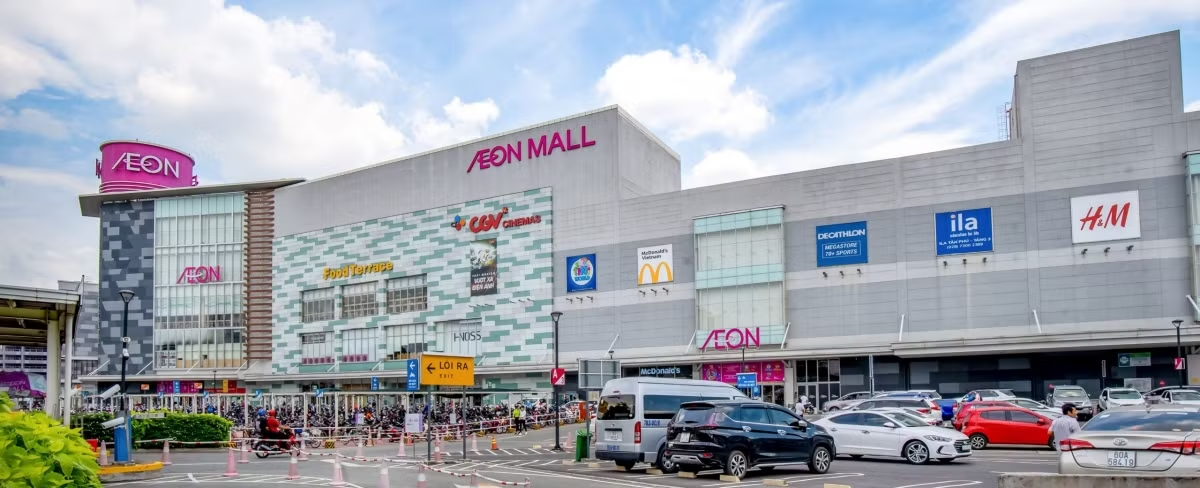
When referring to big foreign retailers in Vietnam then three names immediately crop up, namely, Lotte from the Republic of Korea (RoK), Aeon from Japan, and Central Retail from Thailand. Currently all three of these giant retailers are planning to expand in Vietnam as they consider it a key market.
Lotte considers Vietnam as its third most important market after RoK and Japan. Aeon wants to triple the number of its commercial centers in Vietnam by 2025.
Their plan to expand in the Vietnamese retail market was revealed by Nikkei in early October. A senior Aeon manager said that they view Vietnam as its most important market overseas.
Central Retail also wants to expand its market share in Vietnam and has announced plans to spend about Baht 300 billion in increasing its retail network to at least 710 stores by 2026, from current 340 stores.
The general director of Central Retail Vietnam said that the company aims to have revenue of Baht 100 billion by 2026. Last year Central Retail earned Baht 38.6 billion and considers the Vietnamese market as its largest revenue source, outside of Thailand.
The reasons that make Vietnam more and more attractive in the eyes of foreign retailers, is because of a stable economic growth, at a time when the global markets are constantly fluctuating.
Recently, the Financial Times published an article titled "Seven economic wonders in an anxious world", stating Vietnam among seven outstanding countries along with Indonesia, India, Greece, Portugal, Saudi Arabia, and Japan. Previously, the World Bank (WB) had forecast that Vietnam's economy would grow by 7.2% this year.
In fact, Vietnam's GDP growth in the third quarter of 2022 reached 13.67%, with the 9-month GDP increasing by 8.83%, the highest increase in the 2021 to 2022 period. Consumer purchasing power is recovering strongly in Vietnam.
In the first nine months of 2022, the total retail sales of consumer goods and services reached more than VND4.1 trillion, up 21% compared to the same period last year. Many businesses have now achieved outstanding business results as before the COVID-19 pandemic.
Another important reason is that Vietnam has committed to joining the CPTPP, which will officially come into effect by 2024 and will remove the regulations on Economic Needs Test (ENT) for retail businesses from CPTPP member countries.
This regulation requires that foreign retailers must apply for permission every time they open a store with an area of over 500 square meters. This requirement can now be removed which is a huge relief for retail giants.
Pressure on domestic enterprises
While foreign retailers are constantly making their growth plans for the Vietnamese market, domestic retailers are also taking great strides.
According to statistics of 2016, 50% of the retail market share in Vietnam belongs to foreign enterprises, but up to now domestic enterprises account for about 70% to 80% of market shares across the country.
Most of the domestic businesses have ambitious plans to expand their market share. For instance, Nova Consumer plans to expand its distribution channel to 450,000 retail centers in the future, and Thaco plans to open 20 Emart supermarkets by 2026 to become the number one hypermarket in Vietnam.
However, not all domestic enterprises can paint a rosy picture in the post-pandemic scenario. Bach Hoa Xanh has had to downsize, and in the last few months more than 400 Bach Hoa Xanh stores have been closed. The enterprise feels this is a step back to prepare for their fast expansion strategy for the whole country in 2023.
The reason is that Bach Hoa Xanh was recently discovered selling Chinese mushrooms disguised under VietGap. The retailer has apologized and stopped importing goods from dishonest suppliers, but that has not been enough to convince consumers who have turned away.
Similar to Bach Hoa Xanh, the Masan retail chain was recently discovered selling vegetables disguised as VietGap vegetables. The retailer also immediately apologized and stopped importing such goods, but some damage has been done to its image. Currently Masan has more than 3,000 outlets nationwide of its Winmart and Winmart plus stores.
Since 2021, Masan has set up many utilities into Winmart plus mini supermarkets. Masan aims to open 30,000 mini-mall stores nationwide by 2025, serving 30 million to 50 million customers per year with revenue of around US$7 billion to US$8 billion each year.
Businesses can plan expansions, but consumer confidence was somewhat shaken by the lame explanations of these retail companies. Along with the challenges of regaining back consumer confidence, and accelerating their expansion plans, these enterprises must also calculate their financial capacity.
While strong financial resources are always strong points of foreign retailers, when Vietnam made more commitments, such as giving up ENT for retailers from the CPTPP countries, the pressure on enterprises becomes even greater.