 |
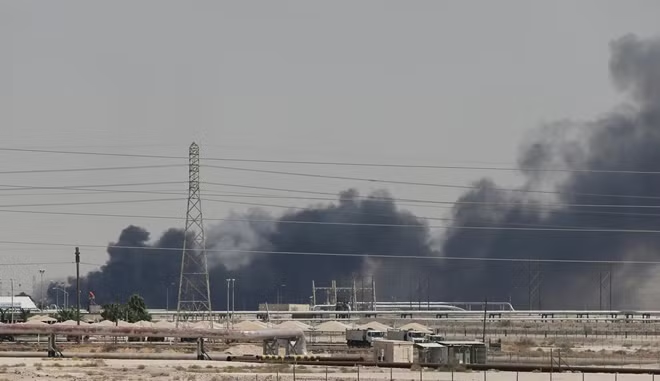
| Smoke is seen following a fire at Aramco facility in the eastern city of Abqaiq, Saudi Arabia, September 14, 2019. |
Yemen’s Iran-aligned Houthi group claimed responsibility for Saturday’s attacks that knocked out more than half of Saudi oil output or more than 5% of global supply, but U.S. Secretary of State Mike Pompeo accused Iran of the attack on the world’s energy supply.
The drone strikes on plants in the heartland of Saudi Arabia’s oil industry, including the world’s biggest petroleum processing facility, were expected to send oil prices up $3-$5 per barrel on Monday as tensions rise in the Middle East.
Iranian foreign ministry spokesman Abbas Mousavi, speaking on state TV, dismissed the U.S. allegation as “pointless”. A senior Revolutionary Guards commander warned that the Islamic Republic was ready for “full-fledged” war.
“Everybody should know that all American bases and their aircraft carriers in a distance of up to 2,000 kilometers around Iran are within the range of our missiles,” the semi-official Tasnim news agency quoted commander Amirali Hajizadeh as saying.
State oil giant Saudi Aramco said the attack cut output by 5.7 million barrels per day, about half the kingdom’s production, at a time when Aramco is trying to ready itself for what is expected to be the world’s largest share sale.
Aramco gave no timeline for output resumption but said early Sunday it would give a progress update in around 48 hours. A source close to the matter told Reuters the return to full oil capacity could take “weeks, not days”.
Traders and analysts said crude may spike to as high as $100 if Riyadh fails to quickly bring back supply.
The kingdom, the world’s top oil exporter, ships more than 7 million barrels of oil to global destinations every day.
Riyadh said it would compensate for the loss by drawing on reserves which stood at 188 million barrels in June, according to official data. The United States said it was also ready to tap emergency oil reserves if needed.
The Saudi bourse opened down 2.3% on Sunday but later pared some losses. Saudi petrochemical firms announced a significant reduction in feedstock supplies.
“Abqaiq is the nerve center of the Saudi energy system. Even if exports resume in the next 24-48 hours, the image of invulnerability has been altered,” Helima Croft, global head of commodity strategy at RBC Capital Markets, told Reuters.
Saudi authorities have yet to blame any party for the strike, but linked it to a recent series of attacks on Saudi oil assets and crude tankers in Gulf waters.
SAUDI READY TO ACT
Pompeo said there was no evidence the attack came from Yemen, where a Saudi-led coalition has been battling the Houthis for over four years in a conflict widely seen as a proxy war between rivals Sunni Muslim Saudi Arabia and Shi’ite Iran.
Riyadh has accused Iran and its proxies of being behind previous attacks on oil pumping stations and the Shaybah oilfield, charges Tehran denies.
Some Iraqi media outlets said the attack originated from there, where Iran-backed paramilitary groups wield increasing power. Iraq denied this on Sunday and vowed to punish anyone using Iraq as a launchpad for attacks.
Regional tensions have escalated since Washington quit an international nuclear deal and extended sanctions on Iran to choke off its vital oil exports.
France, condemning Saturday’s attack, said such actions “can only worsen regional tensions and risk of conflict”. Turkey, an ally of Iran, called for the avoidance of “provocative steps” that could harm regional stability.
The attack comes after U.S. President Donald Trump said a meeting with Iranian President Hassan Rouhani was possible at the United Nations General Assembly in New York this month. Tehran ruled out talks until sanctions are lifted.
“Amid all the calls for de-escalation, Iran has now launched an unprecedented attack on the world’s energy supply,” Pompeo said in a Twitter post on Saturday.
Saudi de facto ruler Crown Prince Mohammed bin Salman told Trump by telephone on Saturday that Riyadh was willing and able to deal with the “terrorist aggression”.
A senior Emirati official said the UAE, Riyadh’s main partner in the Western-backed military coalition in Yemen, would fully support Saudi Arabia as the assault “targets us all”.
The UAE, concerned about the rising tensions with Iran and Western criticism of the war, has scaled down its military presence in Yemen, leaving Riyadh to try to neutralize the Houthis to prevent Iran from gaining influence along its border.
Riyadh accuses Iran of arming the Houthis, a charge both of them deny.
Iran’s foreign minister Mohammed Javad Zarif tweeted that Washington and its allies were “stuck in Yemen” and that blaming Tehran “won’t end the disaster”.
The conflict has been in military stalemate for years. The alliance has air supremacy but has come under global scrutiny over civilian deaths and a humanitarian crisis that has pushed millions to the brink of famine.
The Houthis, more adept at guerrilla warfare, have stepped up missile and drone attacks on Saudi cities, thwarting U.N. peace efforts.