Iran says will not renegotiate nuclear deal, warns against changes

Iran’s foreign minister said on Thursday U.S. demands to change its 2015 nuclear agreement with world powers were unacceptable as a deadline set by President Donald Trump for Europeans to “fix” the deal loomed.

Trump has warned that unless European allies rectify the “terrible flaws” in the international accord by May 12, he will refuse to extend U.S. sanctions relief for the oil-producing Islamic Republic.
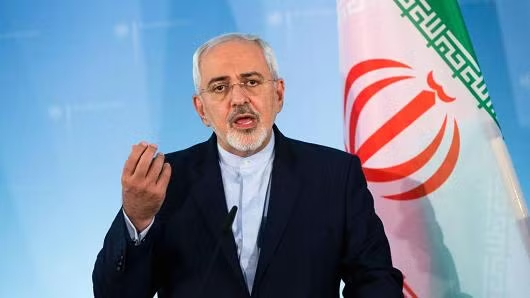
Iran’s foreign minister said on Thursday U.S. demands to change its 2015 nuclear agreement with world powers were unacceptable as a deadline set by President Donald Trump for Europeans to “fix” the deal loomed.

“Iran will not renegotiate what was agreed years ago and has been implemented,” Foreign Minister Mohammad Javad Zarif said in a video message posted on YouTube.

Britain, France and Germany remain committed to the accord as is, but now, in efforts to keep Washington in it, want to open talks on Iran’s ballistic missile program, its nuclear activities beyond 2025 - when key provisions of the deal expire - and its role in Middle East crises such as Syria and Yemen.

A senior adviser to Iranian Supreme Leader Ayatollah Ali Khamenei also warned Europeans on Thursday over “revising” the nuclear deal, under which Iran strictly limited its enrichment of uranium to help allay fears this could be put to producing atomic bomb material, and won major sanctions relief in return.

“Even if U.S. allies, especially the Europeans, try to revise the deal..., one of our options will be withdrawing from it,” state television quoted Ali Akbar Velayati as saying.

The European signatories to the deal have been trying to persuade Trump to save the pact, reached under his predecessor Barack Obama. They argue it is crucial to forestalling a destabilizing Middle East arms race and that Iran has been abiding by its terms, a position also taken by U.S. intelligence assessments and the U.N. nuclear watchdog agency.

Zarif said: “Let me make it absolutely clear and once and for all: we will neither outsource our security nor will we renegotiate or add onto a deal we have already implemented in good faith.”
Reuters

Other News

Vietnam supports UNESCO's people-centred approach, multilateral cooperation: official

Vietnam supports UNESCO's people-centred approach, multilateral cooperation: official

Van affirmed Vietnam’s support for the UNESCO80 reform roadmap, focusing on the organisation’s core mandate, priority areas, interdisciplinary approach, and the special status of the Vietnam National Commission for UNESCO, and UNESCO representative offices, alongside efforts to diversify resources and strengthen global partnerships to enhance the organisation’s effectiveness.

Regional media highlight significant step in Vietnam’s leadership structure

Regional media highlight significant step in Vietnam’s leadership structure

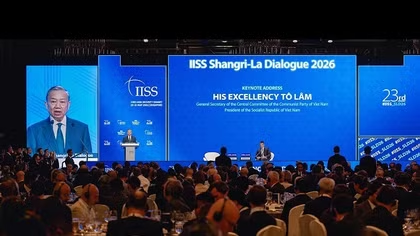
Under General Secretary and President Lam’s leadership, Vietnam is expected to maintain a balanced foreign policy, strengthen its regional standing and accelerate economic development, thereby improving living standards and creating new opportunities for international investors, according to the India-based platform Devdiscourse.

Laos identifies 10 key tasks to build independent, self-reliant economy

Laos identifies 10 key tasks to build independent, self-reliant economy

Laos will step up agricultural production to ensure food security, meet domestic demand and expand exports; encourage the development of agro-processing industries, including those related to rubber, aquatic products, cassava and sugarcane, as well as fertiliser and animal feed production, in order to increase added value and create jobs in rural areas.

Malaysia steps up cyber security resilience

Malaysia steps up cyber security resilience

To ensure accountability, Malaysia plans to finalise the Cybercrime Bill this year which addresses both cyber-dependent and cyber-enabled offences, introducing stricter penalties and prison terms to enhance deterrence.

US public opinion positive about PM Pham Minh Chinh’s visit

US public opinion positive about PM Pham Minh Chinh’s visit

Public opinion in the US is generally positive about Vietnamese Prime Minister Pham Minh Chinh’s trip to the US from September 17-23 to attend the 78th session of the United Nations General Assembly, which took place immediately after the upgrading of the Vietnam - US relations to a comprehensive strategic partnership on the occasion of US President Joe Biden’s official visit to Vietnam.