- Suicide attack on Pakistani shrine kills 72, claimed by Islamic State
- Erdogan, Trump agree to act jointly against Islamic State in Syria
- Two Islamic State car bombs in Baghdad kill at least 14: sources
- Islamic State kills 24 with Baghdad car bomb, attack police stations in Samarra
Residents said the fighters have been opening passages in the walls between houses to allow them to move from block to block undetected, disappear after hit-and-run operations and track government troop movements.
They have also opened sniper holes in buildings overlooking the Tigris river bisecting the city into east and west, they said.
"They opened these holes and threatened us not to close them," one resident told Reuters by telephone, asking not to be identified by name or location because Islamic State executes anyone caught communicating with the outside world.
The militants are essentially under siege in western Mosul, along with an estimated 650,000 civilians, after U.S.-backed forces surrounding the city dislodged them from the east in the first phase of an offensive that concluded four weeks ago.
The westward road that links the city to Syria was cut at the end of November. The militants are still in charge of the road that links Mosul to Tal Afar, a town they control 60 km (40 miles) to the west, however.
Coalition aircraft and artillery have been bombarding selected targets in the west, included workshops in the eastern industrial zone where Islamic State is thought to build car bombs and booby traps. Ground forces have paused to redeploy and build new fortifications and staging posts along Mosul's western flank, as well as rest and repair damaged hardware.
Iraqi Prime Minister Haider al-Abadi told a meeting of the armed forces commanders on Thursday that the offensive could start "very soon".
MORE DIFFICULT IN THE WEST
Commanders expect the battle in the west to be more difficult than in the east because, among other things, tanks and armored vehicles cannot pass through its narrow streets and alleyways.
Western Mosul contains the old city center, with its ancient souks, Grand Mosque and most government administrative buildings. The city's airport is also located there.
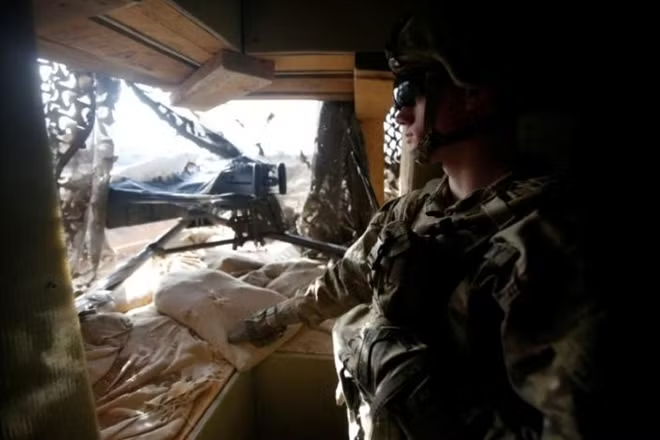 |
| A member of the U.S. army forces takes position at the U.S. section of a base for Iraqi army and Kurdish peshmerga forces in Makhmour, southeast of Mosul. REUTERS/Khalid al Mousily |
"The narrow alleys and densely populated districts, along with the defensive tunnels built by Daesh -- all this is definitely going to make the battle tough and complicated," said Colonel Sattar Karim of the Iraqi army's 9th Division, using an Arabic acronym of Islamic State.
It was from the pulpit of the Mosul Grand Mosque that Islamic State leader Abu Bakr al-Baghdadi declared a "caliphate" over parts of Syria and Iraq in 2014.
The city -- Iraq's second biggest -- is the largest urban center captured by Islamic State in both countries and its de facto capital in Iraq. Raqqa is its capital in Syria.
The Sunni group imposed a radical version of Islam in Mosul, banning cigarettes, televisions and radios, and forcing men to grow beards and women to cover from head to toe. Citizens who failed to comply risked death.
Capturing the city would effectively end the militants' ambitions for territorial rule in Iraq. They are expected to continue to wage an insurgency, however, carrying out suicide bombings and inspiring lone-wolf actions abroad.
OVERWHELMING FORCE
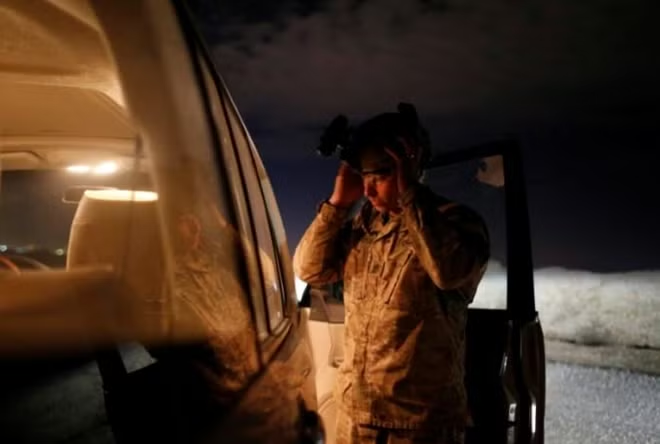 |
| A member of the U.S. army forces participates in combat training in the northern Iraqi city of Erbil. REUTERS/Ammar Awad |
Islamic State was thought to have up to 6,000 fighters in Mosul when the government's offensive started in mid-October. Of those, more than one thousand have been killed, according to Iraqi estimates.
The remainder now face a 100,000-strong force made up of Iraqi armed forces, including elite paratroopers and police, Kurdish forces and Iranian-trained Shi'ite paramilitary groups.
The United States, which has deployed more than 5,000 troops in the fighting, leads an international coalition providing critical air and ground support, including artillery fire, to the Iraqi and Kurdish forces.
In the next phase, the Iraqi military's plan is to wear down the fighters and overwhelm them by moving on all fronts.
"Daesh will not be able to stand against thousands of attacking troops with air and artillery cover," said federal police captain Haider Radhi.
The police's target will be to capture the airport, located on Mosul's southern limits, and secure it for army engineers who will quickly rehabilitate the runway and the other facilities so that it can be used as a close support base for troops, he said.
Intelligence gathering and the cooperation of the civilian population will be key for advancing troops to avoid booby traps and to find weapons caches placed across the city as part of Islamic State's urban warfare plan, said Baghdad-based analyst and former army general Jasim al-Bahadli.
However, the narrowness of the streets will limit the militants' ability to attack advancing troops with suicide car bombs, one of the group’s most effective weapons, along with mortar and sniper fire.
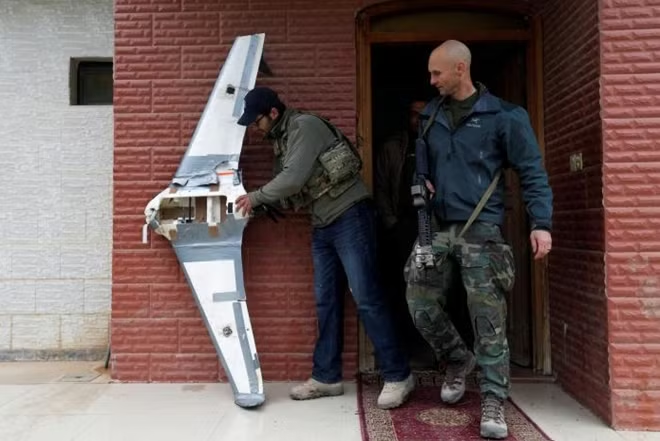 |
| U.S. Special Operations Forces members inspect a drone used by Islamic State militants to drop explosives on Iraqi forces, in Mosul. REUTERS/Muhammad Hamed |
"Car bombs will be used in some areas of the western side where the streets are wide enough," said Bahadli. "In the others, we can expect the group to send walking bombers" who will run or walk toward the troops and detonate explosive belts.
Karim, the army colonel, said the militants are using churches, schools, hospitals and homes as weapon caches to avoid airstrikes.
"The job will not be easy to determine who's an enemy and who's a friend," he said.