- Israel to re-assess U.N. ties after settlement resolution, says Netanyahu
- U.S. intended to allow passage of U.N. draft critical of Israel
- Israeli air strike kills four Islamic State-linked gunmen on Golan
- Minister To Lam pays a courtesy visit to Israeli Prime Minister
Separately, the envoys of 10 other nations were called in to the Israeli Foreign Ministry to be reprimanded on Sunday, and Netanyahu had more harsh words for Washington over Friday's U.N. vote.
An Israeli spokesman gave no details of when Netanyahu would meet U.S. Ambassador Daniel Shapiro.
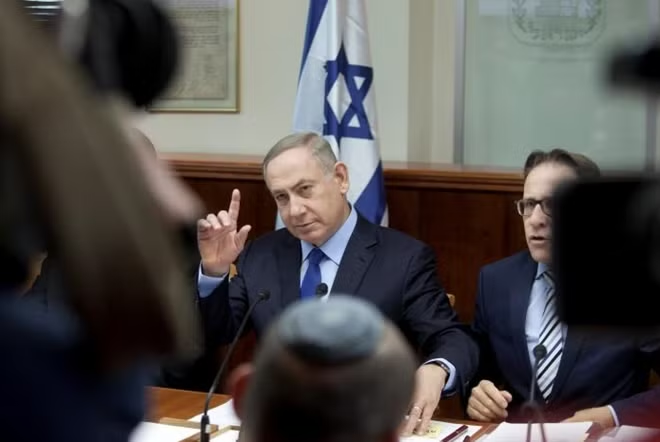 |
| Israeli Prime Minister Benjamin Netanyahu attends the weekly cabinet meeting at his Jerusalem office December 25, 2016. REUTERS/Dan Balilty/Pool |
The resolution was passed in the 15-member Security Council because the U.S. broke with its long-standing approach of diplomatically shielding Israel and did not wield its veto power, instead abstaining.
Netanyahu put his personal imprint on Israel's show of anger by repeating at the weekly cabinet meeting what an unidentified Israeli government official contended on Friday - that the administration of U.S. President Barack Obama had conspired with the Palestinians to push for the resolution's adoption.
The White House has denied the allegation.
"According to our information, we have no doubt the Obama administration initiated it (the resolution), stood behind it, coordinated the wording and demanded it be passed," Netanyahu told the cabinet in public remarks.
Another official said Netanyahu had ordered that for the coming three weeks, until President-elect Donald Trump takes office, cabinet ministers refrain from traveling to or meeting officials of countries that voted in favor of the resolution.
The envoys from 10 of the 14 countries that voted for the resolution and have embassies in Israel - Britain, China, Russia, France, Egypt, Japan, Uruguay, Spain, Ukraine and New Zealand - were summoned to the Foreign Ministry.
Sunday is a regular work day in Israel, but most embassies are closed, and calling in envoys on Christmas Day is highly unusual.
At the weekly cabinet meeting on Sunday, Netanyahu described a telephone conversation with U.S. Secretary of State John Kerry on Thursday, when Israel and President-elect Donald Trump successfully pressed Egypt to drop the anti-settlement resolution it had put forward.
It was resubmitted a day later by New Zealand, Senegal, Venezuela and Malaysia.
"Over decades American administrations and Israeli governments disagreed about settlements, but we agreed that the security council was not the place to resolve this issue," Netanyahu said.
"We knew that going there would make negotiations harder and drive peace farther away. As I told John Kerry on Thursday, 'Friends don't take friends to the Security Council'," he said, switching from Hebrew to English.
Israel has pursued a policy of constructing settlements on territory it captured in a 1967 war with its Arab neighbors - the West Bank, Gaza and East Jerusalem, areas Palestinians seek for a state.
Most countries view the settlement activity as illegal and an obstacle to peace. Israel disagrees, citing biblical and historical connections to the West Bank and Jerusalem as well as security interests.