Japan shares experience in natural disaster mitigation

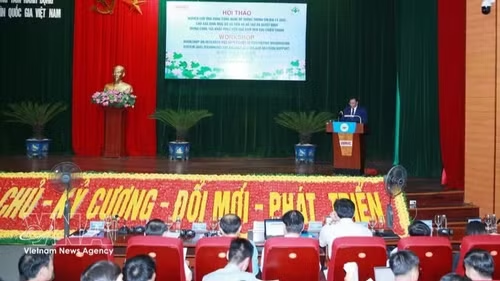
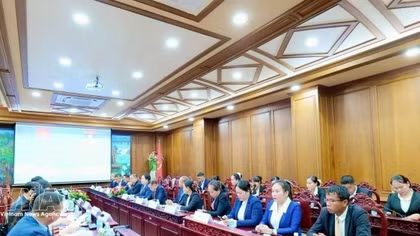
The application of policies and advanced technologies from Japan towards reducing the damage caused by floods and landslides was highlighted at a seminar held in Hanoi on November 9 by the Vietnam Disaster Management Authority (VDMA) in collaboration with the Japanese Ministry of Land, Infrastructure, Transport, and Tourism.

japan shares experience in natural disaster mitigation hinh 0
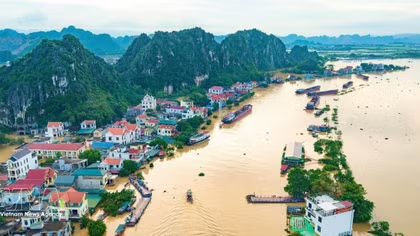
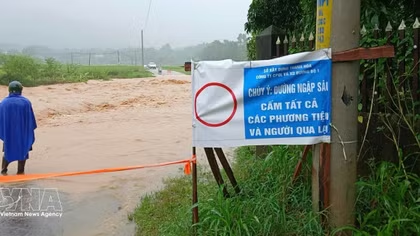
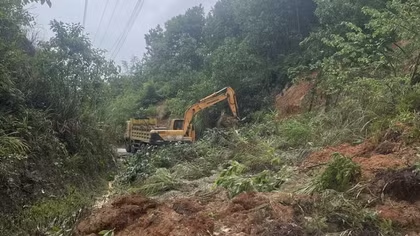
Damage caused by a storm in Lao Cai last October 

The event is significant for disaster prevention and mitigation in Vietnam.

As a country hard-hit by natural calamities, Japan spent an average of 1.2 percent of its gross domestic product (GDP), equivalent to US$60 billion during the 2010-2016 period, on the implementation of disaster prevention, response, recovery, and rehabilitation programmes.

According to Yusuke Sakai, a representative from Japan’s National Institute of Advanced Industrial Science and Technology, the construction of sabo dams – a leading model in channels for debris flow control – is one of the most effective measures to reduce the damage of landslides. 

Sabo dams are built at the upstream areas of rivers where they suppress the flow of sediment.

At the event, participants also introduced some state-of-the-art technologies used in natural disaster mitigation in Japan, including a global satellite mapping of precipitation (GSMaP) and a global high-resolution 3D map service (AW3D).

Head of the VDMA Tran Quang Hoai said that Vietnam is among the countries facing the most severe impact of climate change. The country has suffered from 20 out of the 21 forms of natural disasters, only being sparred by a tsunami. 

Flash floods and landslides have created critical losses to Vietnam, accounting for 10.1% of the total loss in terms of human and assets caused by natural disasters, he added.

Nguyen Trung Kien, from the Department of Science-Technology and International Cooperation under the VDMA, said that previous research on flash floods and landslides have made significant contributions to lessening risks caused by future natural disasters.

However, he stressed that the research should be made more detailed to ensure precise forecasting and suitable responses to natural calamities.

In the time to come, competent authorities should immediately implement the Government’s Decree No.76/NQ-CP dated on June 18, 2018 and the Prime Minister’s Direction No.19/CT-TTG dated July 13, 2018 on the prevention of natural disasters. Furthermore, preventative works should be put in place, including a pilot monitoring system, warning map system, and early flood warning system, among others.
VNA

Other News

Hanoi ready to implement Capital Law 2026, unlocking new development momentum

Hanoi ready to implement Capital Law 2026, unlocking new development momentum

The effectiveness of the Capital Law 2026 will be measured not by the number of legal documents issued but by tangible improvements in governance and public administration, better services for people and businesses, faster administrative procedures, stronger investment attraction and higher economic growth.

Vietnamese students earn honours at ROBOG Asia Cup 2026

Vietnamese students earn honours at ROBOG Asia Cup 2026

Three teams from Chu Van An Secondary School in Vietnam’s Thai Nguyen province have earned First Prize honours and advanced to the quarterfinals at the ROBOG Asia Cup 2026, a regional robotics and artificial intelligence (AI) competition for students held in Hong Kong, China.

Hanoi sets out new investment blueprint with century-long development vision

Hanoi sets out new investment blueprint with century-long development vision

As of early June, Hanoi had attracted 74.6 billion USD in foreign direct investment (FDI) through more than 9,250 valid projects. FDI inflows in the first six months were projected at 3.2 billion USD, surpassing the annual target by 116%, while nearly 16,000 new businesses were established in the first five months, up 34.4% year-on-year.

Vietnam promotes legal cooperation and rule of law at global forum

Vietnam promotes legal cooperation and rule of law at global forum

Vietnam’s development and international integration have gone hand in hand with the improvement of its legal system, the incorporation of international commitments into domestic legislation, and legal reforms aimed at fostering development, openness and global integration. The country regards international law as an essential instrument for building fair, mutually beneficial relations among nations.

Hanoi to hold investment promotion event on June 29

Hanoi to hold investment promotion event on June 29

At the event, Hanoi authorities plan to grant investment policy decisions and investment registration certificates to 20 exemplary projects in the fields of transportation infrastructure, industrial parks, urban development, social housing, environment, science and technology, and foreign investment attraction.

Hanoi's Red River urban area development draws widespread attention

Hanoi's Red River urban area development draws widespread attention

Located south of the Red River and extending from the historic inner city to newly developing areas in the south and the west, the central urban area along Red River’s right bank covers approximately 45,317 hectares and is projected to accommodate around 6.365 million residents by 2045 and 6.455 million by 2065.

Hanoi's Red River urban area development draws widespread attention

Hanoi's Red River urban area development draws widespread attention

Located south of the Red River and extending from the historic inner city to newly developing areas in the south and the west, the central urban area along Red River’s right bank covers approximately 45,317 hectares and is projected to accommodate around 6.365 million residents by 2045 and 6.455 million by 2065.

Regional cooperation strengthened to combat cross-border drug crime

Regional cooperation strengthened to combat cross-border drug crime

Vietnam, China, Laos and Myanmar face common challenges as drug syndicates increasingly exploit the Mekong River, cross-border transport networks, e-commerce platforms, international logistics services, cyberspace and cryptocurrencies to organise drug transactions and smuggling operations.