- Hanoi urged to shut down café shops along railway tracks
- Vietnam Railway proposes measures to curb rail accidents
- Hanoi dig through stone arches of centennial railway bridge
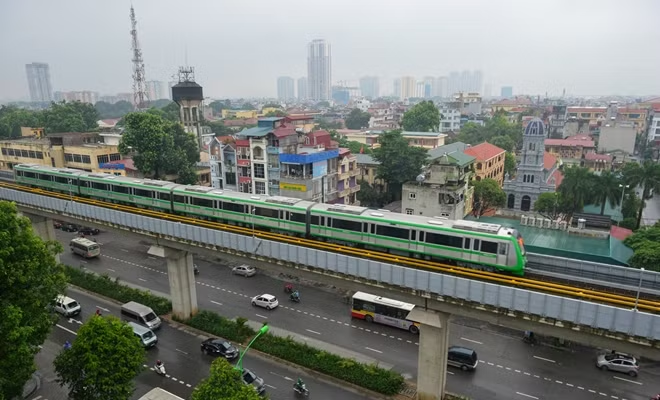 |
| JICA supports monitoring greenhouse gas emission by urban railways in Hanoi and HCMC. |
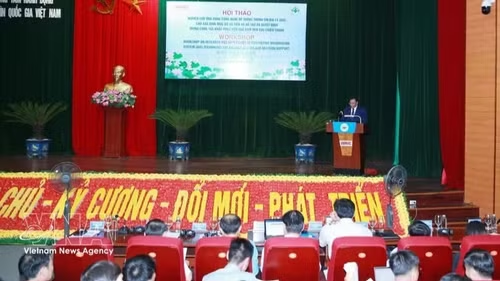
The Japan International Cooperation Agency (JICA) organized a report meeting to consult with all stakeholders the mid-term results of the “Data Collection Survey on development of Measurement, Report and Verification (MRV) system in urban railway sector in Vietnam” in Hanoi on Nov. 4, 2019 and in Ho Chi Minh City on Nov.5, 2019.
With cooperation of the Department of Climate Change under the Ministry of Natural Resources and Environment (MONRE) and HCMC’s Department of Natural Resources and Environment (DONRE), JICA has been implementing “Data Collection Survey on development of Measurement, Report and Verification (MRV) system in urban railway sector in Vietnam”. The survey is carried out between February 2019 and September 2020.
The survey targets urban railways Line 1 and 2 in Hanoi and Line 1 in HCMC, which are all financed by Japanese ODA.
It was designed to estimate potential greenhouse gases (GHG) emission reductions by the three urban railways lines, providing a scientific base for promotion of low-emission means of transport such as metro in metropolitan areas like Hanoi and HCMC.
The 2013 GHG inventory data of HCMC, collected with supports from JICA, showed that HCMC contributed as much as 16% of the country’s total GHG emission while its population was only 9% of the country’s total. Only the city’s transport sector accounted for 45% of its total emission.
Urban railways is considered an alternative mean of transport with lower CO2 emission compared to motorbikes or cars. With urban railways systems that will be developed to accommodate rapid growth in passenger transport demand, metropolitan areas like Hanoi and HCMC will make significant contributions to the national targets of GHG emission reduction committed by the government in their National Determined Contribution (NDC) report submitted to the United Nations Framework for Climate Change Convention (UNFCCC) in 2015.
Development of urban railways is not only considered as one of the potential options of GHG mitigation but also widely known as an effective solution for traffic congestion and air pollution, particularly in Asian countries where traffic jam is frustratingly affecting people’s daily life and air pollution is worsening at an alarming pace.
The interviews of households in Hanoi and HCMC undertaken by the survey reveals that a significant majority of the correspondents (81% along Line 1 in HCMC and 66% along Line 1 in Hanoi) expressed their willingness to use the urban railways in the future.
“More people shifting from private means of transport to urban railways will definitely result in cleaner air and create more comfortable urban life. We hope that the survey will help to raise the awareness of people in Hanoi and HCMC on the importance of our urban railways projects not only in improving urban mobility but also contributing to the global efforts against climate change,” said Mr. Murooka Naomichi, Senior Representative of JICA Vietnam Office.
Metro lines will be an essential element of the public transport network to improve urban mobility by connecting a megacity like Hanoi and HCMC with its surrounding areas, said Prof. Atsushi Fukuda (Nihon University), a well-known expert on urban railways development and its environmental impact, who is an advisor to the survey.
Mr. Mai Tuan Anh, Head of Meteorology, Hydrology and Climate Change Division of HCMC DONRE, highly appreciated JICA’s supports and expected that the survey will provide reliable data and practical methodology for HCMC to monitor their urban railways operation in the future. She also confirmed that development of urban railways will be included as a prioritized activity in the climate change action plan of the city for 2021-2025.