JICA's support on low carbon technology assessment

The Ministry of Natural Resources and Environment (MONRE) and
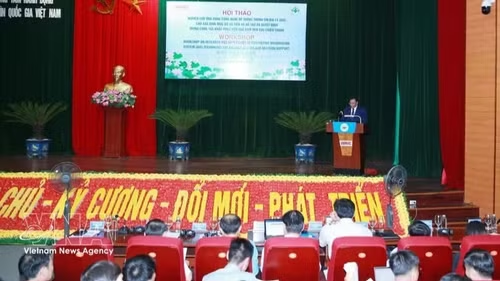
Japan International Cooperation Agency (JICA) co-organized a final workshop on November 28 to share the results of the Low Carbon Technology Assessment. 

The Low Carbon Technology Assessment has been carried out
under the Component 1 of JICA’s Technical Cooperation project on “Support the Planning and Implementation of Nationally Appropriate Mitigation Actions (NAMAs) in a Measurement,
Reporting and Verification (MRV) Manner (SPI-NAMA)”.

This assessment has been jointly conducted by the Department of Climate Change (DCC) under MONRE and JICA since September 2016 with an aim to facilitate the implementation of Vietnam’s mitigation targets which were defined in the Nationally Determined Contribution 1 (NDC) submitted to the United Nations Framework Convention on Climate Change (UNFCCC) in 2015.

Participants at the event
Participants at the event 

DCC and JICA have studied possible low carbon technologies, which could implement 45 mitigation options of the NDC in 4 sectors, such as energy, agriculture, land use and forestry, and waste. In addition, they also assessed fluorocarbons (F-gases) which have larger impacts than CO 2 as one of low carbon technologies.

Throughout the assessment works, DCC and JICA facilitated the communications and coordination among relevant stakeholders including concerned ministries and private sector via sector-based in- depth discussions and multi-stakeholder dialogues to identify appropriate low carbon technologies for their sectoral mitigation actions. 

As a result, capacity of relevant ministries for planning and implementation of sectoral mitigation action plans has been enhanced.

Taking the sectoral needs and priorities, the assessment has produced a catalogue of prioritized low carbon technologies with potential application in Vietnam. “This low carbon technology assessment
is not only a very useful and practical reference for the ongoing review and update process of the NDC led by MONRE but also will contribute to the implementation of the Government Decree on Roadmap for GHG emission reduction”, said Mr. Nguyen Van Tue, Director General of Department of Climate Change. 

He also highly appreciated JICA’s supports for this survey, adding that by actively involving in the assessment process, MONRE’s facilitation capacity for future implementation of mitigation actions required by the Paris Agreement has been strengthened.

JICA expects MONRE and the relevant ministries to continue their leadership in bringing NDC into concrete mitigation actions through low carbon technologies introduction moving towards a low-carbon society in Viet Nam.


PSNews

Other News

Hanoi ready to implement Capital Law 2026, unlocking new development momentum

Hanoi ready to implement Capital Law 2026, unlocking new development momentum

The effectiveness of the Capital Law 2026 will be measured not by the number of legal documents issued but by tangible improvements in governance and public administration, better services for people and businesses, faster administrative procedures, stronger investment attraction and higher economic growth.

Vietnamese students earn honours at ROBOG Asia Cup 2026

Vietnamese students earn honours at ROBOG Asia Cup 2026

Three teams from Chu Van An Secondary School in Vietnam’s Thai Nguyen province have earned First Prize honours and advanced to the quarterfinals at the ROBOG Asia Cup 2026, a regional robotics and artificial intelligence (AI) competition for students held in Hong Kong, China.

Hanoi sets out new investment blueprint with century-long development vision

Hanoi sets out new investment blueprint with century-long development vision

As of early June, Hanoi had attracted 74.6 billion USD in foreign direct investment (FDI) through more than 9,250 valid projects. FDI inflows in the first six months were projected at 3.2 billion USD, surpassing the annual target by 116%, while nearly 16,000 new businesses were established in the first five months, up 34.4% year-on-year.

Vietnam promotes legal cooperation and rule of law at global forum

Vietnam promotes legal cooperation and rule of law at global forum

Vietnam’s development and international integration have gone hand in hand with the improvement of its legal system, the incorporation of international commitments into domestic legislation, and legal reforms aimed at fostering development, openness and global integration. The country regards international law as an essential instrument for building fair, mutually beneficial relations among nations.

Hanoi to hold investment promotion event on June 29

Hanoi to hold investment promotion event on June 29

At the event, Hanoi authorities plan to grant investment policy decisions and investment registration certificates to 20 exemplary projects in the fields of transportation infrastructure, industrial parks, urban development, social housing, environment, science and technology, and foreign investment attraction.

Hanoi's Red River urban area development draws widespread attention

Hanoi's Red River urban area development draws widespread attention

Located south of the Red River and extending from the historic inner city to newly developing areas in the south and the west, the central urban area along Red River’s right bank covers approximately 45,317 hectares and is projected to accommodate around 6.365 million residents by 2045 and 6.455 million by 2065.

Hanoi's Red River urban area development draws widespread attention

Hanoi's Red River urban area development draws widespread attention

Located south of the Red River and extending from the historic inner city to newly developing areas in the south and the west, the central urban area along Red River’s right bank covers approximately 45,317 hectares and is projected to accommodate around 6.365 million residents by 2045 and 6.455 million by 2065.

Regional cooperation strengthened to combat cross-border drug crime

Regional cooperation strengthened to combat cross-border drug crime

Vietnam, China, Laos and Myanmar face common challenges as drug syndicates increasingly exploit the Mekong River, cross-border transport networks, e-commerce platforms, international logistics services, cyberspace and cryptocurrencies to organise drug transactions and smuggling operations.