After two failed ceasefire agreements between the United States and Russia to end the fighting in Aleppo, a new round of talks includes Saudi Arabia and Qatar, which support Syrian opposition groups. Syria's ally Iran was not invited, a Western diplomat said.
"I'm not approaching this with a high sense of expectation and nothing is based on trust," Kerry told a news conference in Washington on October 19 following meetings with the Republic of Korea ministers.
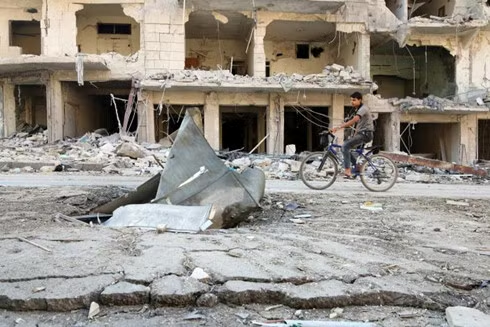 |
| A man rides a bicycle near damaged ground in the rebel held besieged al-Sukkari neighbourhood of Aleppo, Syria. (Photo: Reuters) |
"I urge Russia to sit at this table in Geneva and be serious about finding a simple way, which we are offering, to make sure that those who are genuinely terrorists are in fact separated out, isolated," Kerry said.
Kerry spoke as a senior NATO diplomat, citing Western intelligence, said that Russian warships off the coast of Norway were carrying fighter aircraft that are likely to reinforce a final assault on Aleppo in two weeks.
The Geneva talks follow a meeting between the United States and Arab and European allies on October 18 that sought to coordinate efforts toward a new ceasefire after Russia, Syrian President Bashar al-Assad's more powerful ally, unexpectedly announced it had halted air strikes on rebel-held areas of Aleppo.
Michael Ratney, the U.S. special envoy for Syria, led Washington's delegation in the talks in Geneva, while Moscow sent military experts whose names were not released. It was not clear if the talks would continue on October 20.
Russia favors a U.N. proposal to evacuate jihadists belonging to the Jabhat Fateh al-Sham militant group, formerly known as al-Nusra, from the besieged zone of eastern Aleppo in return for a ceasefire.
"Important countries, like Saudi Arabia, Turkey and Qatar, which have influence over the mainstream rebel groups, are in a position to suggest to those groups to tell the al-Nusra fighters that it is time to go to Idlib and therefore take away any alleged justification, or alibi, for the heavy bombing of urban areas of eastern Aleppo," the U.N. special envoy for Syria, Staffan de Mistura, told Swedish daily Svenska Dagbladet.
Idlib is a largely rebel-held area of northwestern Syria.
Russia has said a planned eight-hour ceasefire on October 20 will be extended if other rebels clearly distance themselves from Jabhat Fateh al-Sham, but it will not prolong the pause unilaterally.
"The Russians have no interest in getting to a point where they have to participate in the destruction of a city in order to fight a small group of fighters listed as terrorists by the U.N. and be remembered in history for that," de Mistura said.
The last ceasefire fell apart in September, since when Russian and Syrian forces have undertaken a massive bombing campaign against eastern Aleppo in which hospitals have been destroyed and hundreds of civilians killed.
Assad argues that his forces have a constitutional duty to protect the civilian population and rid the city of "terrorists".
The task of separating "moderate" rebels from Jabhat Fateh al-Sham, designated as a terrorist group by the U.N., is complicated because they have long fought side-by-side and there is little agreement on the number of their combatants in Aleppo.
The United Nations says there are up to 900 Jabhat Fateh al-Sham fighters out of a total of 8,000 rebels in eastern Aleppo, but diplomatic sources have told Reuters there are far fewer, probably a maximum of 200.