 |
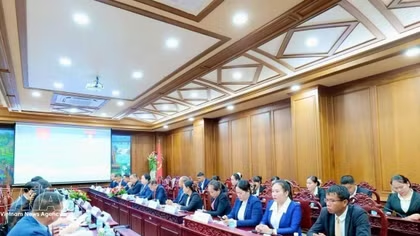
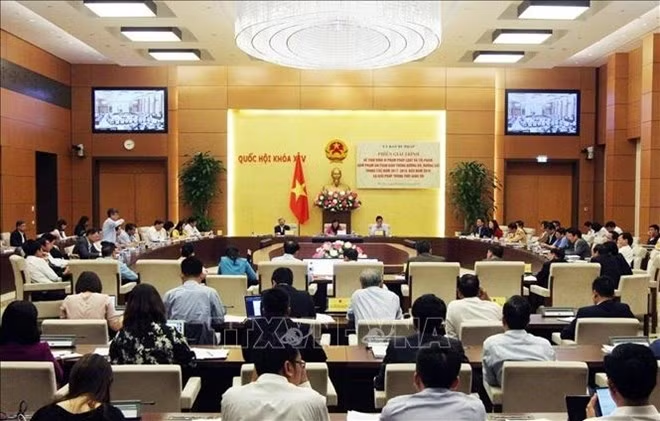
| NA’s Justice Committee held a meeting to discuss about traffic problems in Vietnam over the last three years (Photo: VNA) |
Nguyen Thi Thuy, a permanent member of the committee, said that violations and traffic accidents on roads and railways were still problems needed to be tackled.
Last year, around 8,200 people died and 14,800 others were injured because of traffic accidents on roads and railways.
Thuy pointed out major problems relating to investment in transportation, toll collection, drivers’ health and information on traffic safety.
She asked the Ministries of Transport and Public Security for reports on delayed issuances of legal documents on the implementation of laws on road and railway traffic.
The Ministry of Health was asked to clarify limitations of regulations relating to drivers’ health and regular medical check-ups. The issue has garnered a lot of attention after a number of incidents in which truck drivers were found to have been drinking or using illegal narcotics.
The Ministry of Education and Training was asked about poor dissemination of information on road safety among students. Common violations include riding electric bikes without helmets, driving in the wrong lanes and not obeying traffic lights.
Thuy added that people were also concerned about overloaded trucks and were wondering if authorised agencies intentionally ignored the violations.
Regarding toll collection on roads built under Build-Operate-Transfer (BOT) contracts, the NA’s Justice Committee asked questions about locations of BOT stations that are said to be “unreasonable”.
In the last few years, drivers in localities nationwide protested BOT stations over unreasonable locations or high tolls.
Chairwoman of the NA’s Justice Committee Le Thi Nga said every day in Vietnam, on average, about 23 people leave home and never return because of traffic accidents.
“Traffic violations and traffic accidents are still problems,” Nga said, adding that lawmakers questioned that with the available legal framework, how they – the National Assembly and the Government – can address the issue.
Deputy Nguyen Ba Son from the central city of Da Nang called for strict punishments on drivers who use drugs.
He said drivers found to be using drugs should face lifetime bans. He said he knew of cases in which truck drivers caught using drugs, after being fired applied to work as taxi drivers.
Former vice chairman of the Justice Committee Nguyen Dinh Quyen said that when a driver was found to be using drugs or committing other violations, not only the drivers but also their employers should be punished.
Minister of Transport Nguyen Van The also said that when a firm hires a driver, the firm was responsible for supervising them.
“If a driver on drugs causes an accident, the firm must take responsibility too,” The said.
The said the Ministry of Transport was set to propose to the Government a project to update roads that are prone to traffic accidents.
Last year, over 200 traffic black spots were fixed. The ministry plans to fix another 200 spots this year.
At a meeting with NA Standing Committee members on March 6, a representative from the Ministry of Public Security said that statistics on traffic deaths and injuries failed to reflect reality.
In Vietnam, the number of deaths caused by traffic accidents is calculated as the number of people who die at the scene of the accident. Those who die later from their injuries are not considered traffic deaths.
Meanwhile, according to the World Heath Organisation, a road traffic fatality should be defined as “any person killed immediately or dying within 30 days as a result of a road traffic accident.”
According to the Ministry of Public Security, last year, the ministry proposed the Prime Minister develop a Government decree on traffic accident statistics and sharing of data.
However, the Ministry of Justice did not agree with developing such a decree.
Also at the meeting, the Ministry of Transport reported to the NA’s Justice Committee that the ministry submitted a proposal to the Prime Minister that cars with fewer than nine seats using ride-hailing applications and provide e-receipts when offering transport services should be treated as traditional taxis.
This is part of the amended draft decree developed by the ministry to replace Decree No 86/2014/NĐ-CP on conditions for automobile transportation businesses.