 |
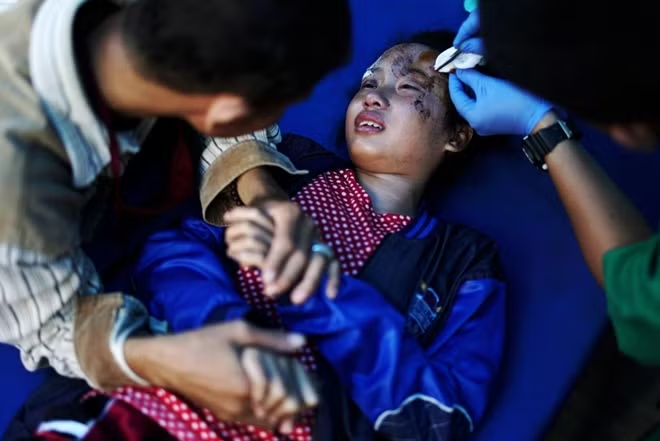
| A father holds his daughter's hand in a hospital as she receives medical treatment for injuries sustained from the earthquake and tsunami in Palu, Central Sulawesi, Indonesia, October 4, 2018. REUTERS/Athit Perawongmetha |
The small city of 370,000 people has been the focus of the aid effort launched after last Friday’s 7.5 magnitude earthquake and tsunami on the west coast of Sulawesi island.
International help for survivors has gathered pace, but communities in more remote areas have been cut off by broken roads, landslides and crippled communications, leaving people increasingly desperate for basic needs as aid has only just begun to trickle through.
By Thursday, the official death toll stood at 1,424, but it is widely expected to rise as most of the dead accounted for have been from Palu, while figures for remote areas are trickling in or remain unknown.
International aid is beginning to arrive, including supplies from Britain and Australia, after the government overcame a traditional reluctance to accept help from abroad.
The United Nations announced an allocation of $15 million on Wednesday while the International Federation of Red Cross and Red Crescent Societies said it was appealing for 22 million Swiss francs ($22 million).
The United States had provided initial funding and disaster experts and was working to determine what other help could be given, the State Department said.
Indonesian Central Bank Governor Perry Warjiyo said the disaster was a huge challenge but he played down the impact on Southeast Asia’s biggest economy.
“We are united and we stand strong,” he told a briefing late on Wednesday.
Straddling the seismically active Pacific Ring of Fire, Indonesia has long been vulnerable to quakes and tsunamis.
In 2004, a quake off Sumatra island triggered a tsunami across the Indian Ocean that killed 226,000 people in 13 countries, including more than 120,000 in Indonesia.
But safety measures implemented after that disaster, including tsunami warning systems, failed on Friday.
“There are so many challenges with this disaster, it’s never been so bad,” said Frida Sinta, an aid volunteer trying to get basic food and other supplies out to fellow residents of Palu.
The city, 1,500 km (930 miles) northeast of Indonesia’s capital, Jakarta, has teetered close to chaos this week, with outbreaks of looting, but a recovery was evident as some shops and banks reopened and a major mobile phone network was back in operation.
Orderly queues formed at petrol stations after the arrival of fuel shipments and late in the day, traffic lights and televisions flickered back to life as the power came back on.
The improvements are helping with the aid effort.
“We carry whatever we can by car or motorbike within the city wherever we can. But not yet to the most inaccessible places,” Sinta said.
State port operator Pelindo IV said Palu’s port, which was damaged by the quake and tsunami, was open, though a Reuters reporter in the city said she had not seen any shipping activity.
Altogether, the badly affected areas in the disaster zone include some 1.4 million people.
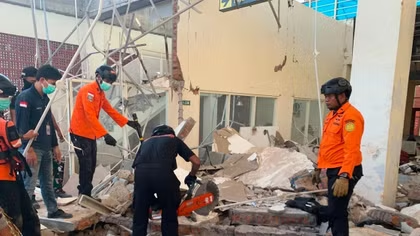
Rescue workers are pushing into outlying districts, where residents have said they have been scavenging for coconuts, bananas and cassava.
Villagers rushed a Red Cross helicopter that landed near the town of Donggala, northwest of Palu, to distribute bread and other food, a Reuters photographer said.
National disaster mitigation agency spokesman Sutopo Purwo Nugroho told a briefing the main roads to the south, west and east of Palu had been opened.
But there has been scant information about conditions on the road to the north, along the coast towards the epicenter of the quake, 78 km (50 miles) from Palu.
“There’s no data,” said Abdul Haris of the national search and rescue agency, when asked about the string of small settlements that line the road, which passes some sandy beaches that attract a trickle of tourists.
“Places have been damaged by the tsunami along the coast,” Nugroho said, but he had no details.
‘DIFFICULT TIME’
While the power is back in Palu, it will take much longer for people to pick up the pieces of their lives.
Asril Abdul Hamid, 35, a business owner, was poking through the wreckage of his home in Palu’s Balaroa district, which was badly hit by deadly soil liquefaction.
He salvaged a few mementoes including a family portrait.
“My immediate family is safe, thank God, but my cousin was killed,” he told Reuters, adding that his family had got food and water in the past few days.
International aid is beginning to arrive, including supplies from Britain and Australia, after the government overcame a traditional reluctance to accept help from abroad.
The United Nations announced an allocation of $15 million on Wednesday while the International Federation of Red Cross and Red Crescent Societies said it was appealing for 22 million Swiss francs ($22 million).
The United States had provided initial funding and disaster experts and was working to determine what other help could be given, the State Department said.
Indonesian Central Bank Governor Perry Warjiyo said the disaster was a huge challenge but he played down the impact on Southeast Asia’s biggest economy.
“We are united and we stand strong,” he told a briefing late on Wednesday.
Straddling the seismically active Pacific Ring of Fire, Indonesia has long been vulnerable to quakes and tsunamis.
In 2004, a quake off Sumatra island triggered a tsunami across the Indian Ocean that killed 226,000 people in 13 countries, including more than 120,000 in Indonesia.
But safety measures implemented after that disaster, including tsunami warning systems, failed on Friday.