 |
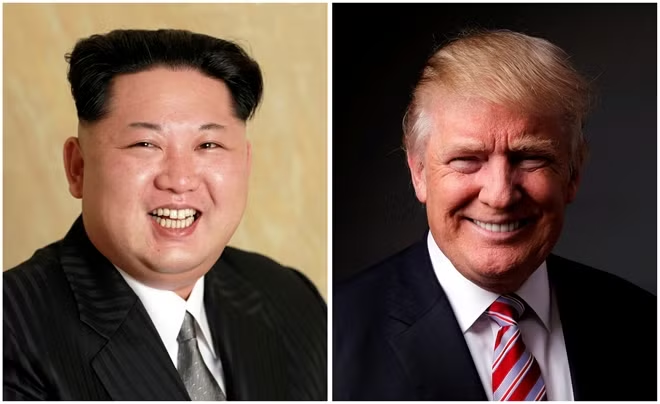
| North Korea's leader Kim Jong-un and US President Donald Trump. Photo KCNA |
Now, as a summit unexpectedly appears possible, analysts fear U.S. President Donald Trump’s understaffed administration may lack the expertise to successfully turn a political spectacle long sought by Pyongyang into a meaningful opportunity to convince North Korea to abandon its nuclear program.
South Korean officials said Friday Trump almost immediately agreed to meet North Korean leader Kim Jong Un, without preconditions, by the end of May. Even proponents of a diplomatic approach towards North Korea worry the administration could be rushing into a summit with little time to prepare.
Such a summit - the first time sitting American and North Korean leaders have ever met - would typically happen after each side had made at least some concrete agreements, said Suzanne DiMaggio, a senior fellow at the New America think tank, who has engaged North Korean officials at unofficial discussions.
“It will have to be managed carefully with a great deal of prep work,” she said on Twitter. “Otherwise, it runs the risk of being more spectacle than substance. Right now, Kim Jong Un is setting the agenda and the pace, and the Trump administration is reacting. The administration needs to move quickly to change this dynamic.”
Secretary of State Rex Tillerson has often been publicly contradicted by the White House over North Korea, including on Thursday when just hours before the announcement of a summit he said “we are a long ways from negotiations”.
Several experienced career diplomats occupy key positions in the Trump administration’s Korea and East Asia offices, but many of them are in an acting capacity while other positions are entirely empty.
Joseph Yun, the U.S. envoy in charge of negotiating with North Korea, quit last week, and Trump has yet to nominate an ambassador to South Korea.
“A Trump meeting with Kim presents both risks and opportunities,” said Bonnie Glaser, an Asia expert at the Center for Strategic and International Studies think tank.
“The U.S. side needs to be very, very well prepared and know exactly what it wants to achieve, as well as what the U.S. is willing to provide in return.”
“A REWARD TO NORTH KOREA”
Analysts say North Korea has been seeking a summit with American leaders as a way to secure international legitimacy, something that has prevented past U.S. administration’s from taking Pyongyang up on its invitations.
“A summit is a reward to North Korea,” said Robert Kelly, a professor at South Korea’s Pusan National University. “It extends the prestige of meeting the head of state of the world’s strongest power and leading democracy. That is why we should not do it unless we get a meaningful concession from North Korea. That is why other presidents have not done it.”
If the summit fails, the cost could be higher than in the past, observers noted, with North Korea firmly in possession of a nuclear arsenal and Trump having said military strikes may be needed to remove those weapons.
Kim Jong Un has “committed to denuclearization” and to suspending nuclear and missile tests, South Korea’s National Security Office head Chung Eui-yong told reporters at the White House on Thursday after briefing Trump. North Korea, though, has yet to provide more details.
“There hasn’t been any North Korea-U.S. summit meetings at all and having one after North Korea has already obtained nuclear weapons basically sends a signal that the U.S. is willing to deal with North Korea on that basis,” said Zhao Tong, a North Korea expert at the Carnegie-Tsinghua Center in Beijing.
“So that achieves North Korea’s first objective, even if there’s no progress at all in terms of what they discuss at the summit,” Zhao said.
A senior administration official said Trump was elected to take a different approach from previous presidents.
That included avoiding low-level negotiations that have failed in the past in favor of talking directly to Kim as the “one person who can actually make decisions instead of repeating the... long slog of the past,” the official said.
In 2000, Marshal Jo Myong Rok, a powerful figure in the North Korean armed forces, became the first and most senior North Korean official to visit the White House and meet a U.S. president, then Bill Clinton.
Shortly after, then-U.S. secretary of state Madeleine Albright traveled to Pyongyang to meet Kim Jong Un’s father and predecessor, Kim Jong Il, in a visit to lay the groundwork for a visit by Clinton that would only happen after he had left office.
During President Barack Obama’s administration, North Korean officials were also seeking a breakthrough with the United States, and were disappointed when American officials offered no diplomatic concessions, former U.S. director of national intelligence, James Clapper, has said.
Even observers who credit Trump’s hardline stance with setting the stage for talks said they are waiting to see if this time is different.
“North Korea has said these things before - Kim Jong Il wanted to meet with President Clinton,” said Mark Dubowitz, CEO of Washington’s Foundation for Defense of Democracies think-tank.
“Pyongyang has to be serious about denuclearization. In the meantime, the Trump administration should continue using the toughest sanctions to maintain maximum pressure before the summit in May.”