 |
However, the current space for these two types of housing stands at a meagre 3.5 million sq.m, meaning in the next three years, about three million sq.m has to be made available, something that is not feasible, many people say.
Social housing is meant for social welfare beneficiaries like poor households, seniors without families, orphans and people with meritorious records; while affordable housing is built for low income earners including State employees and workers.
They say it is high time that policy makers and other stakeholders accept the reality that the number as well as the quality of social housing projects pales in comparison to actual demand.
Meanwhile, several problems have surfaced in some affordable housing projects, built on a commercial basis.
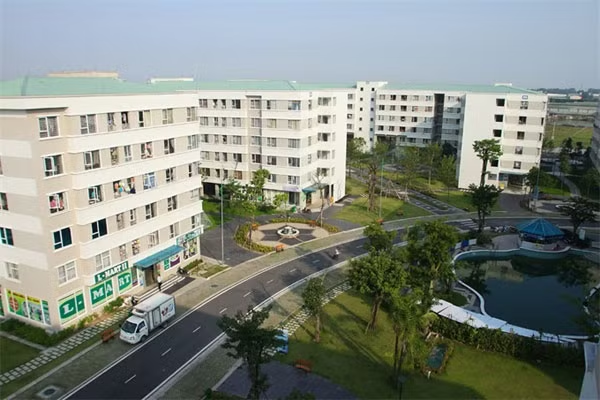
While it was being built, the Kim Van-Kim Lu urban centre (invested in by the State-owned Vinaconex and Muong Thanh Corp) generated a lot of expectations from its future residents. However, expectations have turned into growing resentment. Every morning, dozens of residents have to wait in line, sometimes for up to 30 minutes, to get into an elevator.
Nguyen Tuan Phong, a resident of the CT12B apartment building in Ha Noi for the last two years, said the building has seven elevators, but two are always broken down, causing congestion, especially during the morning rush hour at 7-8am. In addition, several of the elevators’ sensors do not function correctly, leading to numerous incidents of elderly people or children getting injured when the doors close unexpectedly.
The garbage chute is also poorly designed with its openings located in the main hall of each floor, forcing residents to install “anti-smell doors,” Phong added.
Mai My Hanh, a resident of neighbouring tower CT12A, complained that the fire alarm system malfunctions all the time, leading to numerous false alarms, greatly inconveniencing residents.
She said poor construction quality causes leaks and has hollowed out concrete sections that are filled with rags in the toilets of many apartments.
Residents are outraged. The monthly service fee that project investors receive, at VND160,000 (US$7) times 4,200 apartments, is VND4 billion ($176,300), but the service is pitiful.
Another apartment project, also owned by Muong Thanh Corp in the Linh Dam urban area south of Ha Noi, is in serious disrepair with frequent cuts in water supply, poor-quality elevators and pavement violations.
Similar complaints
The situation is the same at some affordable housing products in HCM City, with residents livid about construction quality and services.
Just a few months after moving into the Easter City apartment complex on Pham Hung Street in Binh Chanh District, residents began seeing cracks in the walls, leakages and frequent breaking down of elevators.
Faced with complaints from buyers about tardy construction, investors of the HQC Plaza complex, also in Binh Chanh District, decided to allow people begin living in unfinished apartments. Residents recently got the scare of their lives when a fire accident was caused by electrical faults.
Even worse, some projects have had to be halted after city authorities deemed the contractors ‘incapable,’ following buyers’ reports about very poor construction quality, as in the case of the high-rise 584 in Tan Phu District.
Tran Ngoc Chanh, chairman of the Viet Nam Urban Planning and Development Association (VUPDA), said due to lax oversight by authorities, most affordable apartment buildings have committed various violations of construction regulations.
Construction density, land use coefficient, building height, or population density – all have exceeded the allowed limit, leading to a decrease in quality of residents’ life, he said.
Chanh added that project investors often don’t follow plans approved by authorities. The “profit-oriented mentality” leads to attempts to maximise living space by cutting back on green space and other components.”
Loose definitions
‘Affordable housing’ is still a loosely defined term. While it is generally perceived as targeting low-income people, there are no set standards for buildings that house the majority of the population, even though a policy on classification of apartment buildings is in place, said Tran Ngoc Quang, chairman of the Viet Nam Real Estate Association, said.
“But we have to say that the ‘affordable housing’ term cannot be an excuse for slum-like, shoddy apartment buildings that cause constant headaches for the residents,” he added.
In developed countries, Quang said, affordable housing is understood as those built for the general public, in contrast to resorts or luxury real estate developments. This distinction will help customers have a clear understanding of each type of real estate with attached standards and criteria.
Le Hoang Chau, chairman of the HCM City Real Estate Association, said that in order to successfully implement an affordable housing project, the investor must meet several criteria.
First off, a ‘clean’ (where land clearance is easy) land area is needed, the building must have easy access to major traffic routes and be located not far from the city centre, guaranteed construction quality and add-on services like schools, shopping malls, and other public spaces. Second, “the price must be within the ‘affordable’ range of target customers,” with flexible payment options.
However, he admitted that meeting all these criteria is difficult, given the high land prices at the moment.
“If current situation persists, we are going to see faith waning in social housing projects, and an ‘exodus’ of current residents from affordable housing projects, causing a significant waste,” he said.
Tran Ngoc Hung, chairman of the Viet Nam Construction Association, said housing must largely be decided by market mechanisms. Social housing for welfare beneficiaries (elders without family, poor households, orphans, etc.) should be handled by the Government, while other types of housing projects, including affording housing, should be subject to demand and supply, he said.
Hung suggested that at least 10-20 per cent of urban land be reserved for affordable housing projects.
Administrative procedures related to affordable housing projects should also be streamlined to facilitate progress, real estate companies have said.
One company in HCM City’s Thu Duc District said prolonged wait leads to costs overrun and slow progress. “The original aim is affordable apartments, however, because of unexpected costs,” the prices have to go up, the company’s director said.
Other enterprises also want the Government to collect taxes on a yearly basis or other time-periods, not the lump-sum that is collected even before the project has started.
Renting out affordable housing apartments is one of the options that developers are considering, but very few companies, have done it. Two of them are Thu Thiem and Viglacera.
The Ministry of Construction has said it is developing a housing reserve fund to deal with capital shortages for social or affordable housing projects. It has also said it will consolidate construction, technical and preferential pricing standards. It will also work on ways to prevent unscrupulous project investors from cheating people into buying low-quality apartments.