- Comey infuriated Trump with refusal to preview Senate testimony: aides
- Trump meets Russia foreign minister amid Comey controversy
- Comey had pushed for more resources for Russia probe before being fired by Trump: source
Confident of securing a sweeping victory, May had called the snap election to strengthen her hand in the European Union divorce talks. But in one of the most sensational nights in British electoral history, a resurgent Labour Party denied her an outright win, throwing the country into political turmoil as no clear winner emerged.
May's Labour rival Jeremy Corbyn, once written off by his opponents as a no-hoper, said May should step down and he wanted to form a minority government.
But May, facing scorn for running a lackluster campaign, was determined to hang on. A spokesman for her office said she would go to Buckingham Palace to ask Queen Elizabeth for permission to form a government - a formality under the British system.
 |
Sky News reported that Northern Ireland's Democratic Unionist Party (DUP) would back her, allowing the Conservatives to reach the 326 seats needed for a parliamentary majority. The DUP declined to comment.
With 649 of 650 seats declared, the Conservatives had won 318 seats and Labour 261.
The DUP, which took 10 seats, was considering an arrangement which would involve it supporting a Conservative minority government on key votes in parliament but not forming a formal coalition, Sky said.
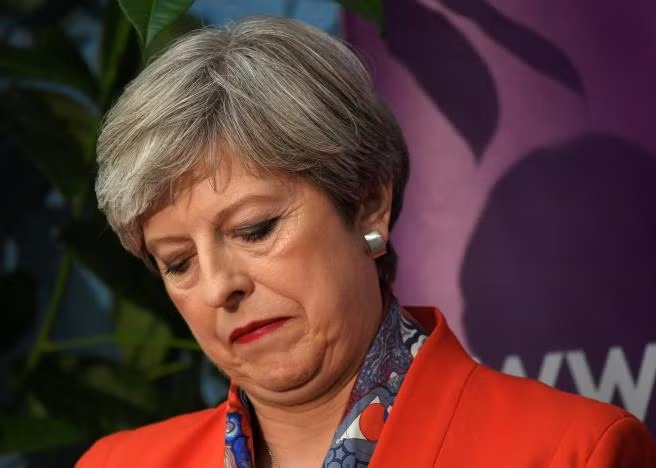
"If ... the Conservative Party has won the most seats and probably the most votes then it will be incumbent on us to ensure that we have that period of stability and that is exactly what we will do," a grim-faced May said after winning her own parliamentary seat of Maidenhead, near London.
But with complex talks on Britain's divorce from the EU due to start in 10 days, it was unclear what their direction would now be and if the so-called "Hard Brexit" taking Britain out of a single market could still be pursued.
After winning his own seat in north London, Corbyn said May's attempt to win a bigger mandate had backfired.
"The mandate she's got is lost Conservative seats, lost votes, lost support and lost confidence," he said.
"I would have thought that's enough to go, actually, and make way for a government that will be truly representative of all of the people of this country."
Asked whether Brexit negotiations should be delayed, Corbyn told Sky News: "They're going to have to go ahead because Article 50 has been invoked."
"Our position is very clear, we want a jobs-first Brexit, therefore the most important thing is the trade deal with Europe," he said.
Corbyn said Labour was ready to lead a minority government. Chief among its potential allies would be the Scottish National Party (SNP), which suffered major setbacks but still won a majority of Scottish seats.
BREXIT RISKS
From the EU's perspective, the upset meant a possible delay in the start of Brexit talks and an increased risk that negotiations would fail.
"We need a government that can act," EU Budget Commissioner Guenther Oettinger told German broadcaster Deutschlandfunk. "With a weak negotiating partner, there's a danger that the negotiations will turn out badly for both sides."
The EU's chief negotiator said the bloc's stance on Brexit and the timetable for the talks were clear, but the divorce negotiations should only start when Britain is ready.
"Let's put our minds together on striking a deal," Michel Barnier said.
Sterling tumbled as much as 2.5 percent on the result while the FTSE share index opened higher. The pound hit an eight-week low against the dollar and its lowest levels in seven months versus the euro.
"A working government is needed as soon as possible to avoid a further drop in the pound." said ING currency strategist Viraj Patel in London.
Craig Erlam, an analyst with brokerage Oanda in London, said a hung parliament was the worst outcome from a markets perspective.
"It creates another layer of uncertainty ahead of the Brexit negotiations and chips away at what is already a short timeline to secure a deal for Britain," he said.
"DREADFUL CAMPAIGN"
Conservative member of parliament Anna Soubry was the first in the party to disavow May in public, calling on the prime minister to "consider her position".
"I'm afraid we ran a pretty dreadful campaign," Soubry said.
May had unexpectedly called the snap election seven weeks ago, even though no vote was due until 2020. At that point, polls predicted she would massively increase the slim majority she had inherited from predecessor David Cameron.
May had spent the campaign denouncing Corbyn as the weak leader of a spendthrift party that would crash Britain's economy and flounder in Brexit talks, while she would provide "strong and stable leadership" to clinch a good deal for Britain.
But her campaign unraveled after a policy u-turn on care for the elderly, while Corbyn's old-school socialist platform and more impassioned campaigning style won wider support than anyone had foreseen.
In the late stages of the campaign, Britain was hit by two Islamist militant attacks that killed 30 people in Manchester and London, temporarily shifting the focus onto security issues.
That did not help May, who in her previous role as interior minister for six years had overseen cuts in the number of police officers. She sought to deflect pressure onto Corbyn, arguing he had a weak record on security matters.
With the smaller parties more closely aligned with Labour than with the Conservatives, the prospect of Corbyn becoming prime minister no longer seems fanciful.
That would make the course of Brexit even harder to predict. During his three decades on Labour's leftist fringe, Corbyn consistently opposed European integration and denounced the EU as a corporate, capitalist body.
As party leader, Corbyn unenthusiastically campaigned for Britain to remain in the bloc, but has said Labour would deliver Brexit if in power, albeit with very different priorities from those stated by May.
"What tonight is about is the rejection of Theresa May's version of extreme Brexit," said Keir Starmer, Labour's policy chief on Brexit, saying his party wanted to retain the benefits of the European single market and customs union.
Analysis suggested Labour had benefited from a strong turnout among young voters.
The campaign had played out differently in Scotland, the main faultline being the SNP's drive for a second referendum on independence from Britain, having lost a plebiscite in 2014.
SNP leader and First Minister Nicola Sturgeon said it had been a disappointing night for her party, which lost seats to the Conservatives, Labour and the Liberal Democrats.
Scottish Conservative leader Ruth Davidson said Sturgeon should take the prospect of a new independence referendum off the table.