Mekong Delta faces challenge to reducing greenhouse gas emissions in rice farming

Rice production is one of the largest sources of greenhouse gas emissions in agriculture, and how to reduce the emissions while still ensuring food security and raising farmers’ income in the Mekong Delta is now a hard nut to crack to many.

Rice cultivation emits the most greenhouse gas in agriculture at present

Rice cultivation emits the most greenhouse gas in agriculture at present

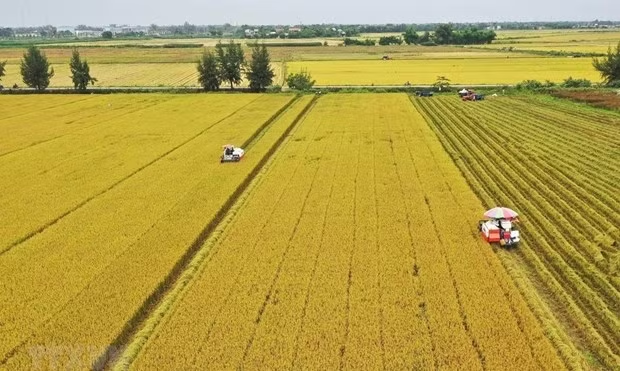
The key rice farming zone of Vietnam has about 3.9 - 4 million ha under rice and produces 23.8 - 24 million tonnes of the unhusked grain each year, accounting for over half of the total rice farming area and output in the country.Current farming techniques can help increase productivity and output but also result in more greenhouse gas emissions.

Chairman of the Ho Chi Minh City High Technology Association Dao Ha Trung said the Mekong Delta is tasked with helping guarantee food security, but rice cultivation emits the most greenhouse gas in agriculture.

Le Thanh Tung, Deputy Director of the Crop Production Department at the Ministry of Agriculture and Rural Development, said Vietnam has committed to reducing greenhouse gas emissions to the international community, but there remain obstacles and challenges to the realisation of that pledge.

Localities have been focusing on boosting rice productivity and output to achieve fast GDP growth, other economic targets, and guarantee national food security. Given this, they haven’t managed to combine food security, economic development, and social security targets with emission reduction ones. In addition, low-carbon rice production remains costly, making farmers reluctant to adopt the practice, he noted.

Trung held that apart from increasing communications about climate change impacts, State agencies need to change policies and measures for cutting emissions such as applying technology to production and management, instead of merely providing financial support for climate change response.

Fighting climate change and reducing greenhouse gas emissions are an essential task that must centre on people, he said, adding that without concrete benefits, it is hard to persuade farmers to join hands in low-carbon production.

Therefore, it is necessary to raise income for rice farmers who practice low-carbon cultivation by adopting production chain management so as to control every step in the chain, Trung went on.

Nguyen Van Toan from the research institute for agricultural and rural planning said to reduce about 10% of greenhouse gas emissions by 2030, it is essential to boost communications to raise farmers’ awareness of the issue. Besides, as farmers are direct producer of the grain, they need to grasp measures for cutting emissions such as turning rice straw into a resource instead of burning it.

About 42 - 45 million tonnes of rice straw is there to be treated in the country every year. If straw is used for different purposes in value chains, it will help reduce greenhouse gas emissions. For example, straw mixed with certain substances will become fertiliser, which will save VND3.5 trillion (over US$152 million) - a considerable profit for farmers, according to him.
VNA

Other News

Private economic sector poised for breakthrough growth

Private economic sector poised for breakthrough growth

More than a year after the Politburo's Resolution No. 68-NQ/TW on private sector development came into effect, expectations now extend beyond increasing the number of enterprises. The goal is to build a stronger business community with greater resilience, larger ambitions and the capacity to compete in global supply chains.

Vietnam remains ASEAN growth leader in 2026 despite global headwinds: WB

Vietnam remains ASEAN growth leader in 2026 despite global headwinds: WB

Vietnam is expected to remain one of ASEAN’s fastest-growing economies in 2026, supported by resilient exports, strong investment inflows and an ambitious reform agenda, despite mounting global uncertainties, according to the World Bank’s latest Vietnam Economic Update released on May 15.

Ministry establishes monitoring framework for carbon market

Ministry establishes monitoring framework for carbon market

Under a new circular, the exchange of greenhouse gas emission quotas and carbon credits is conducted on the domestic carbon credit exchange through the carbon trading system, which is interconnected with the national registration system.

Biofuel ready for nationwide rollout

Biofuel ready for nationwide rollout

For biofuels, particularly E10, to develop successfully, stronger and more coordinated policies are needed, especially pricing mechanisms capable of creating a sufficiently attractive gap between E10 and mineral-based petrol, an expert has said.

Vietnamese farm produce promoted at African investment, trade forum

Vietnamese farm produce promoted at African investment, trade forum

The 12th Africa Forum for Investment & Commerce (AFIC 12) opened in Algiers, the capital of Algeria, on May 9, drawing around 2,000 participants, including officials, economists, businesses, financial and development organizagtions from 43 African countries and international partners, including Vietnam.

Int'l medical, pharmaceutical expo opens in Hanoi

Int'l medical, pharmaceutical expo opens in Hanoi

The exhibition, which runs until May 9 at the Hanoi International Centre for Exhibition, showcases advanced products and technologies across a range of fields, including pharmaceuticals, drug manufacturing machinery and equipment, medical devices, hospital and clinic services and dental equipment.

Mega projects to transform Ho Chi Minh City urban landscape

Mega projects to transform Ho Chi Minh City urban landscape

Leading the charge in this massive building spree is the new central city square in the core of the Thu Thiem new urban area. Spanning more than 20 ha, it’s the crown jewel of the Central Square and new administrative center complex.

Vietnam establishes itself as one of region’s most dynamic manufacturing and supply bases

Vietnam establishes itself as one of region’s most dynamic manufacturing and supply bases

The country’s stable political and economic environment provides a critical foundation for long-term sourcing strategies. At the same time, Vietnam has demonstrated a strong ability to scale up manufacturing, supported by a continuously expanding industrial base capable of meeting both high-volume demand and increasingly complex technical and quality requirements.

Vietnamese pomelos gain broader access to Australian market

Vietnamese pomelos gain broader access to Australian market

The update by Australia’s Department of Agriculture, Fisheries and Forestry to its Biosecurity Import Conditions system (BICON) on April 10, officially setting out import conditions for Vietnamese pomelos, is regarded as a major milestone in market access efforts.

Vietnam's industry spearheads transition to circular economy

Vietnam's industry spearheads transition to circular economy

The circular economy is no longer just a policy choice. It has become an inevitable trend for delivering sustainable and green growth, sharpening competitiveness at home and abroad, and meeting Vietnam’s net-zero emissions target by 2050. It is now a prerequisite to sustain long-term economic expansion, particularly in industrial production and supporting industries.

Nearly 100 tonnes of Vietnamese fruits, vegetables airlifted to UAE

Nearly 100 tonnes of Vietnamese fruits, vegetables airlifted to UAE

Vietnamese fresh produce and processed foods are increasingly recognised for their quality, with items such as cashew nuts, coffee and spices gaining popularity among Middle East consumers. In 2025, Vietnam’s farm produce exports to the UAE exceeded 445 million USD, up nearly 24% year-on-year.