Mekong Delta sets up public tap water faucets as saline intrusion peaks

The Cuu Long (Mekong) Delta is taking steps to ensure sufficient freshwater supply for household use and agricultural production in areas affected by saltwater intrusion and drought.
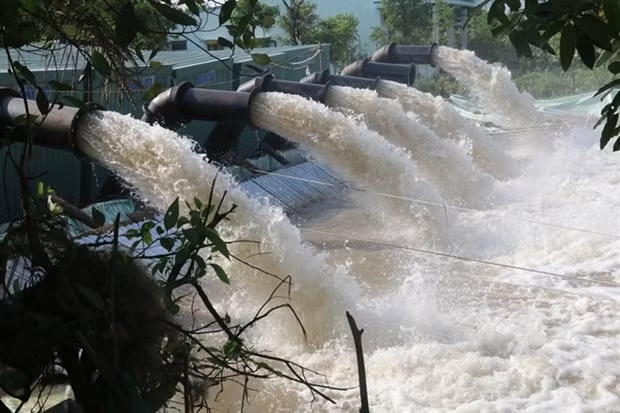
Pumping irrigation water for agricultural production in Tien Giang province’s Go Cong Dong district.

The Cuu Long (Mekong) Delta is taking steps to ensure sufficient freshwater supply for household use and agricultural production in areas affected by saltwater intrusion and drought.

More wells will be drilled and water pipes installed to transport water from water supply plants to households in these areas, the Ministry of Agriculture and Rural Development said in a document sent to the Prime Minister on February 13.

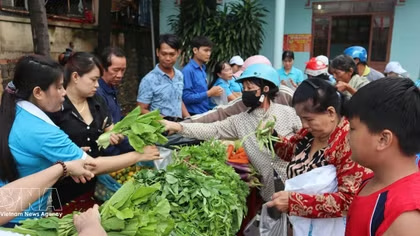
The delta will also set up more public tap water faucets, plastic water containers and large plastic water bags at the offices of People’s Committees and cultural houses in communes to supply fresh water for local residents.

Water tank trucks will provide fresh water to about 40,000 households in the provinces of Kien Giang, Ben Tre, Long An, Ca Mau and Tra Vinh.

Ben Tre and Tra Vinh will install facilities to filter saltwater and brackish water and turn it into freshwater for local residents in affected areas.

On February 9 – 11, Nguyen Xuan Cuong, Minister of Agriculture and Rural Development, visited several provinces to inspect the effects of saltwater intrusion and drought.  

The delta, the country’s largest rice, fruit and seafood producer, is facing saltwater intrusion during the 2019 - 20 dry season.

It is expected to reach its peak this month and in the first half of March, and then fall gradually by mid-March to June, according to the National Center for Hydro-Meteorology Forecasting. 

Saltwater intrusion is expected to enter 55 kilometers deep into the delta’s main rivers from February 21 – 27, down 20 kilometers against mid-February. 

On March 7 – 15, water with a salinity rate of 4 grams per liter is expected to enter 80 kilometers deep into the delta’s main rivers, an increase of 5 kilometers against mid-February.

Before the dry season, delta authorities, anticipating saline intrusion, decided to plant the winter-spring rice crop one month earlier and dredged canals to store irrigation water. They also upgraded and built new irrigation projects and saltwater prevention sluices.

The measures have helped mitigate the damages to agricultural production, according to the ministry.  

About 60 percent of the delta’s 1.5 million hectares of the winter-spring rice have been harvested, and the remaining areas are blooming or ripening and will be harvested in one to three weeks. The remaining areas are safe as they still have irrigation water for rice.

However, saltwater intrusion is threatening about 29,000 ha of spring-summer rice because of a shortage of irrigation water. The cultivation of spring-summer rice in the area is unstable and should be switched to other drought-resistant crops, said the ministry.  

Saltwater intrusion is also causing a shortage of daily use water for 79,700 households in the provinces of Ben Tre, Soc Trang, Kien Giang, Ca Mau, Bac Lieu and Long An.

Several provinces in the delta have asked the Government to provide funds to help them upgrade and build saltwater prevention sluices, pumping stations and temporary dams.

Soc Trang province, for instance, has asked for 1.37 trillion VND (59 million USD), while Long An province has asked for 170 billion VND (7.3 million USD).


VNA

Other News

Hanoi ready to implement Capital Law 2026, unlocking new development momentum

Hanoi ready to implement Capital Law 2026, unlocking new development momentum

The effectiveness of the Capital Law 2026 will be measured not by the number of legal documents issued but by tangible improvements in governance and public administration, better services for people and businesses, faster administrative procedures, stronger investment attraction and higher economic growth.

Vietnamese students earn honours at ROBOG Asia Cup 2026

Vietnamese students earn honours at ROBOG Asia Cup 2026

Three teams from Chu Van An Secondary School in Vietnam’s Thai Nguyen province have earned First Prize honours and advanced to the quarterfinals at the ROBOG Asia Cup 2026, a regional robotics and artificial intelligence (AI) competition for students held in Hong Kong, China.

Hanoi sets out new investment blueprint with century-long development vision

Hanoi sets out new investment blueprint with century-long development vision

As of early June, Hanoi had attracted 74.6 billion USD in foreign direct investment (FDI) through more than 9,250 valid projects. FDI inflows in the first six months were projected at 3.2 billion USD, surpassing the annual target by 116%, while nearly 16,000 new businesses were established in the first five months, up 34.4% year-on-year.

Vietnam promotes legal cooperation and rule of law at global forum

Vietnam promotes legal cooperation and rule of law at global forum

Vietnam’s development and international integration have gone hand in hand with the improvement of its legal system, the incorporation of international commitments into domestic legislation, and legal reforms aimed at fostering development, openness and global integration. The country regards international law as an essential instrument for building fair, mutually beneficial relations among nations.

Hanoi to hold investment promotion event on June 29

Hanoi to hold investment promotion event on June 29

At the event, Hanoi authorities plan to grant investment policy decisions and investment registration certificates to 20 exemplary projects in the fields of transportation infrastructure, industrial parks, urban development, social housing, environment, science and technology, and foreign investment attraction.

Hanoi's Red River urban area development draws widespread attention

Hanoi's Red River urban area development draws widespread attention

Located south of the Red River and extending from the historic inner city to newly developing areas in the south and the west, the central urban area along Red River’s right bank covers approximately 45,317 hectares and is projected to accommodate around 6.365 million residents by 2045 and 6.455 million by 2065.

Hanoi's Red River urban area development draws widespread attention

Hanoi's Red River urban area development draws widespread attention

Located south of the Red River and extending from the historic inner city to newly developing areas in the south and the west, the central urban area along Red River’s right bank covers approximately 45,317 hectares and is projected to accommodate around 6.365 million residents by 2045 and 6.455 million by 2065.

Regional cooperation strengthened to combat cross-border drug crime

Regional cooperation strengthened to combat cross-border drug crime

Vietnam, China, Laos and Myanmar face common challenges as drug syndicates increasingly exploit the Mekong River, cross-border transport networks, e-commerce platforms, international logistics services, cyberspace and cryptocurrencies to organise drug transactions and smuggling operations.